March 18, 2009
The holiest place in Ireland
The slab of stone that marks the spot where the mortal remains of Patrick, Brigid and Columcille (of Bangor) were buried in the 12th Century. The legend says that "Three Saints in one grave shall lie". This stone is from the 19th Century and replaced an earlier marker. At the dissolution all Reliquaries were seized and the remains within them destroyed. The Reliquary that had held Patrick, Brigid and Columcille was among those stripped and publically burned, the Commissioner, Lord Grey, signing a declaration later that the bones were a mixture, some resembling those of beasts.
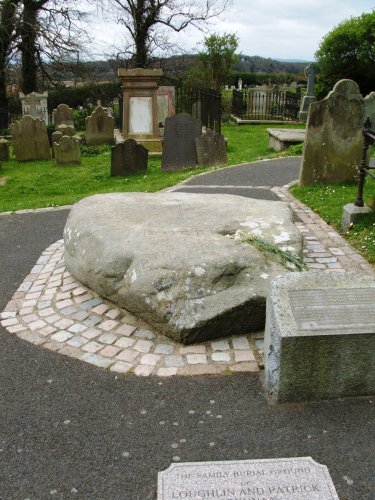
The huge slab of granite that marks to place of the triple grave. Patrick, Brigid and Columcille.
It is my belief that the Monks had taken precautions and removed the saints themselves long before the Commissioner arrived and secretly reburied them, filling the reliquary itself with any spare bones they could find, possibly even some from the kitchens. One thing is certain, within a very short time people had begun to circulate the rumour that Patrick, Brigid and Columcille had not been destroyed and remained hidden. I can tell you that there is a special feel to this place, a tranquility that is comforting even on a wet and stormy day.
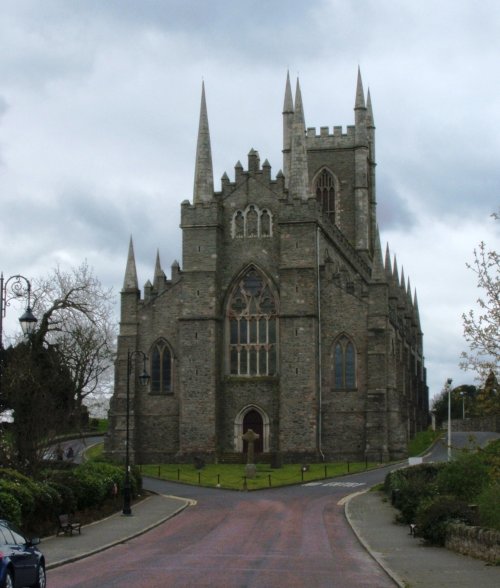
The Cathedral Church of the Holy and Indivisible Trinity, Downpatrick.
In Patrick's day the drumlinn on which the cathedral stands was an island surrounded by water and marshes. It had to be approached across a causeway and was the stronghold, or Dun, of Daire. Daire ruled the local area and gave Patrick the first building to use as a church, home and base, four miles away at a place now called Saul, an Anglicisation of the Irish word sciobol which means "barn". The site of this barn, probably a small wattle and daub structure in an enclosure is today the site of a tiny church, built in the 1930's on the site of the ruined monastery, itself built on the site of the community where Patrick died in 461. The Dun of Daire became very quickly the Dun of Patrick and that in turn has become Downpatrick.
The grave is situated to the south of the little cathedral which is itself the restored remains of the Quire of the medieval monastery. To me, this is without doubt the holiest place in Ireland.
Posted by The Gray Monk at 03:33 PM | Comments (0) | TrackBack
March 17, 2009
Magnus Sucatus Patricius - Bishop and Missionary
The man known in his own time by the names Magnus Sucatus Patricius died this day in 461, probably aged around 76. He was born in Britain around 385 of wealthy landed parents and seized as a slave in a raid which descended on his family's villa in around 401 when he was not quite 16. He is perhaps best known by the legends that have grown around him, yet he would very likely be appalled at these same legends for he was a modest man - one who wept at the death of the very master who had abused him as a slave. He was also a remakable and truly great man and it has to be the supreme irony that we know of him possibly only because Church politics in the early Middle Ages caused the Abbots of Armagh to dig deep within their records and to unearth two of the most remarkable documents to survive anywhere in Britain or Ireland from what we now call the late Roman Period or the Dark Ages.
The Letter to the Soldiers of Coroticus is in every sense of the word an Excommunication issued by a man moved by horror and grief, a man who knew what slavery meant to the men and women of his flock who had been seized by the Soldiers in his letter. A man who railed against the practice of slavery in an age when it was considered normal to enslave anyone who could not resist your force of arms. The second is more telling because it is his Declaration of Faith and exposition of his ministry. It is from that that we learn of his own seizure and six years as a slave in Ireland, of the misery he suffered during those six years and of his resolve which saw him overcome opposition from the Church itself to become the first Missionary Bishop since St Paul.
Patrick, the man, awed the Irish who had held him as a slave. They gave him the nickname "Naofa buachaill" or "Holy Boy" to mock his faith and his prayers, but he turned that into a weapon, one they could not overcome with violence or blandishment. He saw himself as God's slave and laughed at anyone who threatened to deprive him of his freedom with the answer - "You cannot, for I have none, I am the slave of God." Through this he won the respect and then the hearts of all who encountered him. Patrick, the Bishop wasn't popular with his fellow bishops in Britain or in Rome. He was a maverick, one who refused to play the political games and got on with tending the people God had entrusted to him.
Christ be with me, Christ within me,
Christ behind me, Christ before me,
Christ beside me, Christ to win me,
Christ to comfort and restore me -
Christ beneath me, Christ above me,
Christ in quiet, Christ in danger,
Christ in hearts of all that love me,
Christ in mouth of friend and stranger.
Patrick was not a Monk, nor did he found monasteries, those came after his death. The monastics claimed him, yet he founded churches in villages (Duns or Raths in the Irish of his time) and gave communities Bishops and Presbyters to lead them and minister too them. After his death these gradually became monastic communities with Abbots taking ascendancy over the Bishops and the tradition that he was a monk grew to support this take over of the church by the ecclesiastics. If you went to look for Patrick in his own time or in a service you would have to have him pointed out as he never wore a mitre (They came much later - around 1100) or carried a crook or crozier and dressed in the ordinary clothes of the people he worked amongst. This is supported by one of the legends that speaks of a would be assassin being unable to tell the Saint apart from his charioteer.
You will not find Patrick in any list of those beatified by any Pope, nor will you find his name among those appointed Bishop by the Popes of his time, most likely because his patron was St Germanus of Auxerre and not Celestine of Rome. Patrick was declared Saint by those who knew and loved him, by those who carried on his work for the gospel with unswerving love and loyalty and one day I hope to be permitted to sit at his feet and thank him for the inspiration he has given me and millions of others. Yes, I am wearing something green. No, I will not be parading waving any national flags, nor will I be drinking any green beer. I may raise a glass of fine Irish Whiskey to the man I would like to meet more than any other in this life or the next. I am celebrating his feast in prayer and worship as he would wish me to.
Posted by The Gray Monk at 07:07 AM | Comments (3) | TrackBack
February 22, 2009
Sunday rambles
I confess, I enjoy the quiet simplicity of a said Mass. It is uncluttered and one can focus on the heart of the worship without distraction. That's not to say I don't enjoy the music and the dignity of the full blown High Mass or even the boisterous joy of the Family Eucharist with kids squeaking and squawking as the younger members play on the play rug at the West End. But today I've had several treats in the worship, first, in the said Mass at 0800, my favourite bit of St Paul, the passage from 2 Corinthians which begins "Though I speak with the tongues of angels, and have not Charity ..." and ends "and now abide these three, Faith, Hope and Cahrity; but the greatest of these is Charity."
There is such a wealth of wisdom in that passage it is impossible not to be moved by it.
Then, in the Parish Eucharist, the opening hymn was my favourite, probably originally formulated by St Patrick or based on something he wrote - Be thou my vision" is a lovely hymn and it expresses a vision of God that we do well to remind ourselves of from time to time. The final bit of pure pleasure came with the Sung Mass and a visiting choir who performed a Palestrina Mass setting flawlessly. Worship in three different styles and all equally uplifting. What more can you ask?
Well, perhaps a little more, like the Organ Recital yesterday by Carleton Etherington. I was flattered to be asked to turn the pages for him as he put the Mighty Milton through its paces, followed by some fireworks on the Glorious Grove and finally brought us back to earth gently with the little Elliot and its softer flutes and mixtures. But perhaps that's for another day.
Posted by The Gray Monk at 03:58 PM | Comments (0) | TrackBack
December 25, 2008
Merry Christmas
It has been a fantastic Christmas at the Abbey, with 1100+ for the childrens' service called the "Christingle Service" yesterday aftrnoon and 650 for the Midnight Mass. Coupled with the three Masses this morning we have shared worship with well nigh 2000 people. A wonderful way to celebrate the coming of Christ into the world.
So this is the appropriate moment to wish you all a very merry Christmas and a fabulous year to come.
Posted by The Gray Monk at 07:53 PM | Comments (0) | TrackBack
December 14, 2008
Advent 3
Today is the Third Sunday in Advent, a day in which tradionally we look at the ministry of John the Baptist and the whole ministry of "preparation". At the Abbey we will begin our High Mass with Asperges, the ritual sprinkling of Holy water over the congregation, furniture and floors and anything else that gets in the way. This starts at the High Altar and the Priest, Deacon and Sub-Deacon then sweep down the Quire and through the Nave liberally spraying water with a bunch of Rosemary and a bowl of Holy Water.
It is a symbolic cleansing in preparation for the coming of the Christ Child and perhaps even the Coming of Christ in Glory at this Christmas. As I said in my sermon last week - Advent is about preparing for His return. I am preaching again this week and you might like to take a look at the text I will be delivering at Evensong. It is based on Malachi 3 1-4 and 4 and Philipians 4 4 - 7.
“See, I will send my messenger, who will prepare the way before me.”
May I speak, and may you hear in the inspiration of the Holy Spirit. Amen
Malachi spoke to a disillusioned nation, one under the Babylonian heel probably around 400 BC. Around the time Nehemiah had succeeded in getting the people to rebuild the temple and there was still a lot of ambiguity in what people followed or believed. It is very likely that the leaders of the nation still had a foot in both camps – pagan and Judaic, after all, the Babylonian Rulers had imposed, as the Book of Daniel intimates, their pantheon of gods on all their conquered peoples and the reality is that, much as it is in our own society, many will simply have complied without a second thought. Much of his argument will have been directed at the leaders; to get them to return fully to the faith in the knowledge that the people would then follow.
Does this speak to our own age? What does it say to us as we prepare for the coming of our Lord? Perhaps more loudly than ever, for we too live in an age where our leaders preach and practice a form of inclusiveness Malachi would have recognised; one where the desire to “include” means embracing all manner of things from other faiths and from no faith at all. It is an insidious message, one which suggests that God has no place in our daily lives and should be confined to Sundays (or any other ‘Sabbath’ you care to use) and should play no part in any other dealings we have with the world. He would have recognised too the statement by a government front bencher in the Guardian recently that it was “right to exclude from the Commissionership a man who was a practicing Christian since his faith might bias his judgement”. You could be excused for thinking that such an exclusion showed a distinct bias among those making the decision.
We tend to think of the prophets of ancient Israel as wild looking and sounding men who thundered from hilltops and street corners, predicting doom and destruction to everyone who failed to follow their pronouncements to the letter, but was that really the case? And who did they actually address in the prophesies. Quite often it wasn’t the people “in the pew” or even in the market place, their warnings and messages were addressed directly to the rulers and their courts and were very often very unwelcome. You have only to look at Herod’s response to learning of the prophecy of a ‘King’ born to rule over Israel to see what I mean.
The Prophets of ancient Israel were often teachers, leaders themselves and gathered about them “schools” of disciples. Look at John the Baptist, the last Old Testament prophet and first among the Christian ‘Saints’. He followed that prophetic tradition and had a school of disciples, some of whom may even have joined Christ after John’s imprisonment or the revelation that Jesus was the one whom John proclaimed. Malachi’s disciples would have taken his teaching and his prophecies out of the court and into the wider congregation, many no doubt, having small ‘schools’ of their own who would also spread the word – and perhaps this is a lesson for our time. Have we a ‘school’ preparing people for the reception of the Gospel and the coming of our Lord? And what, if anything, are we doing about it? Consider for a moment the effect of each and every one of us going out from here to discuss the sermon among our friends and families – or, horror of horrors – among our colleagues at work. Yet that is exactly what the disciples of the prophets and of our Lord himself did. That is why they made such an impact.
Malachi gives us some interesting images of the coming of the Lord, speaking as he does of the “refiner’s fire” or even the “launderers soap” – images of making clean or purification. But his message is not one of doom and gloom, but of a new start, one which is God centred. And that is the message for every age including our own – good things do come from God, but only if we are truly focussed on Him – in short, we need to become God-centred in everything we do. But there is a warning too –
“Surely the day is coming; it will burn like a furnace. All the arrogant and every evildoer will be stubble, and that day that is coming will set them on fire.” With my fire service background, that is an image that is certainly evocative, but who will be the arrogant and who the evildoer on that day? That is certainly a question his hearers would have asked, for they, as with us, would hardly recognise themselves as falling into such a description. And that is, of course, the problem, we confuse our concepts of “reasonable” and sometimes “rights” with God’s direction and call to us to do His will.
It is imagery that St Paul among others, draws upon regularly and even our Lord himself uses the analogy of the “refiner’s fire” in one of his conversations with the Pharisees. The “Day of the Lord” and the need to prepare for it is a recurring theme in the prophets and in the writings of the New Testament, where again, the hearer of the Word is called upon to live in the way of the Lord and to prepare for his return.
So what challenges do we face today in our society that might be familiar to Malachi and the prophets? Sadly I think, quite a lot.
The official approach of an “agnostic” if not an openly “atheistic” state has created a moral and spiritual vacuum into which all manner of things are being drawn and proclaimed as “fair” or “reasonable” or even as “necessary to redress past imbalances”. The problem, as Malachi and the other prophets would tell you, is that “no faith” doesn’t mean “no belief” – it means a transference of belief into all manner of other things both good and bad. Ask yourself the reason why so many now feel it essential to lay flowers, soft toys or even photographs at the scene of a tragedy. In time past they would have brought their grief here, into the church and sought comfort and solace from the Word of God – but now they feel adrift, cut off without hope in the hereafter because they do not know the truth of Christ’s teaching, they have not heard the Word proclaimed and they have no contact with it outside of the Baptism, Weddings and Burials.
You may know too that the Muslim Faith is currently growing faster among young people than any other. In fact it is predicted that in one generation from now the electorate will be in a position to elect a fully Muslim government to power in this country. What does that say of our stewardship of the Gospel, of our commitment to preach it in everything we do? What does our tacit acceptance of the constant onslaught of misinformation and propaganda in the media, in literature and in government against our faith, our church and by implication the Gospel we are to proclaim? I suggest to you it says a great deal of our failure to live up to our call to ministry – for we are all called. We who gather week on week are called to proclaim that Gospel in all the world whatever else we do.
So what can we do to check this slide? As it happens there is a great deal we can and should be doing. First, we should be living our faith – and yes, I kid myself that I do from time to time – but how do I do that? Do I pray daily for the strength to serve the Lord my God? Do I show my faith in my dealings with others? Do I seek opportunities to do as St Paul famously did in Athens – proclaim the “Unknown God” and make His good news known? Do I listen diligently to the sermons preached week on week in this place as a willing pupil of the “Preachers School” and then take that word out into the world in the week ahead? If not then I certainly should be – and so, I suggest, should you.
And what is our message to the world? Is it one of doom and gloom? Of hell fire and damnation?
Not a bit of it, it is one of hope and joy. Hope in the resurrection of our Lord and Saviour and joy in the grace and forgiveness God shows to us daily. Our message needs to be clear, it needs to attract, not repel and it needs to be true to the message of the Gospel – and most importantly, it needs to be shown in our daily lives.
As the writer to the Philippians says: -
“Rejoice in the Lord always, I will say it again; Rejoice! Let your gentleness be evident to all.” And there lies the key, if we show ourselves filled with joy in our faith, if we show ourselves steadfast in faith to a world blown this way and that be fads, trends and ideologies, if we show ourselves faithful to the Gospel word, the world will take notice. But it cannot simply be left there, we have to learn to teach our faith to others if they are to see what we see, to rejoice in the things that make us rejoice. This is perhaps the lesson we need to relearn from the ancient Prophets and their ‘schools’. We need to rediscover the joy of studying what we believe and hope to bring others to understand. We need to rediscover the joy of exploring our faith and putting it to work in our lives – and to do that fully, we really do need to study.
So how do we receive the call of Malachi or of John the Baptist? In Malachi we hear “I am sending a messenger,” and in the Baptist we see the messenger and hear the cry of Isaiah – Make straight the way of the Lord.” In the Gospels we hear of the birth of our Lord and of his death and resurrection – and of the hope that is ours if we have the courage to heed to call to believe, to hold to faith and to fulfil our calling to be disciples and teachers of the Word.
Only when we fully grasp that calling can we truly discover the joy that springs from being able to put aside our cares and concerns, our burdens and our sorrows and accept the true peace that our Second Lesson described in its close.
“And the peace of God, which transcends all understanding, will guard your hearts and minds in Christ Jesus.”Amen
Posted by The Gray Monk at 09:50 AM | Comments (0) | TrackBack
December 07, 2008
Advent Two
This morning I'm the preacher for the Sung Eucharist at 1100. The readings are an interesting selection from Isaiah 40: 1 - 11, 2 Peter 3: 8-15 and the Gospel is Mark 1: 1 - 8. The resultant sermon is in the extended post below. It is and will be short - during Advent we have the Litany in Procession to begin the service and this takes care of Intercessions. It is also quite lengthy and preachers are warned to be considerate in their preachment.
Advent is about preparaing ourselves for the coming of the Lord. We do not know waht form that will take, nor do we know when. We do know that we must be prepared.
“Prepare the way of the Lord, make straight paths for him”
May I speak and may you hear in the name of the Father and of the Son and of the Holy Spirit.
Amen
There appears to be a world of difference between the message of hope proclaimed by John in our Gospel reading from St Mark and the vision of doom set out in St Peters letter. In the one, John tells of a saviour who brings the baptism of the Holy Spirit, in the other Peter warns that the end will be cataclysmic. Which is the one we celebrate? Which is the one we should heed?
We need to remember two things here, the first is that the writers of both the gospels as we have them and the writer of the portion of the letter read today expected to see “the day of the Lord” arrive during their lifetimes. In fact, it is evident from the writings of St Paul that he changed his view, and no doubt but that Peter and the others had to adjust their thinking on this as well. Hence Peter’s warning that –
“With the Lord is a day is like a thousand years, and a thousand years are like a day.”
In effect he is telling his readers that to speculate on when that day will come is pointless, yet it is the duty of every Christian to be prepared for it. When that day comes if we are not ready, we won’t have time to make amends for time itself will have run to an end.
It cannot escape your notice if you, like me, are fascinated by astronomy, that the description Peter gives us of the heavens vanishing with a roar and everything being destroyed by fire is pretty close to what science tells us happened to the dinosaurs when the earth was last hit by a giant meteor – or could happen if we are unlucky enough to get caught in a Gamma Ray burst from an exploding star somewhere in the universe. Does this mean, as Richard Dawkins tries to allege, that there is no God? On the contrary, the miracle that is life is so fragile, so dependent on so many tiny variables that it is almost impossible to explain our existence without a God. But God is not just some super scientist randomly creating suns, worlds moons and perhaps even new life forms even as we sit here, God cares for his creation, cares to the point of becoming human himself in the only way possible, through being incarnate in the womb of Mary and born in the stable in Bethlehem. In this way, as St John tells us –
“The Word became flesh and made his dwelling among us.”
And it is in anticipation of his return that our seasons lead us through the great cycle of the gospels year on year, reminding us to be vigilant, to prepare, to be ready when that day should come.
In the coming year our Gospels will be taken largely from St Mark’s version of Christ’s ministry among us and it is worth considering that it may well be the oldest of the four, and certainly it is the most direct in its imagery and its language. Many believe that it may also have as its source Peter himself who was certainly alive and living in Rome, very probably with John Mark, the author of this work. Like the gospel of St John, there is no nativity story and no reference to Bethlehem. Mark plunges straight to the beginning of Christ’s ministry and he draws on eyewitnesses for confirmation of his account, in one place even naming them.
The other striking feature of it is the absence of the original ending. We don’t know what happened to it and the oldest manuscripts may even have been involved in a fire and the ending damaged beyond recovery. Does it matter? It shouldn’t, what it should do is confirm the authenticity, the sincerity of the author and the events he is describing.
Mark’s gospel begins as we should, as Isaiah called upon his nation to do –
“Make straight in the wilderness a Highway for our God.”
This is the call to every Christian, that we must in every age proclaim the coming of our Lord, sometimes suffering the derision of those whose intellect is exceeded only by their own blindness to those things they do not want to see or understand and sometimes enjoying the fellowship of our companions on the journey through this life.
Now we are called to prepare ourselves once more for a new year of waiting, watching and readiness. For a new year of opportunities to show our love of Christ and to show the message of his gospel in our daily lives, until his coming again in Glory.
And for all who are ready on that day, they shall see the Glory of the One and Only; full of grace and truth.
Will we be ready? Will we have fulfilled our calling to live in grace and to bring His Gospel to the world? Let us live in prayerful hope that we are doing it already.
Amen
Posted by The Gray Monk at 07:13 AM | Comments (0) | TrackBack
October 31, 2008
Prayer request .....
PLease pray today and for the next several weeks for blogger Da Goddess. Joan (Her real name) is undergoing surgery as I write, to fuse two of her vertebra and alleviate chronic and crippling back pain which has disabled her for some time. The operation is a complicated one which requires the removal of all the organs in the lower abdomen in order to reach the lower spine and the affected vertebra. The spinal column and cord must then be exposed in order to remove the damaged "disc" and replace it with a material which will lock the two vertebra in place and prevent further damage. Everything then has to be put back into place and secured, the wound and the abdominal cavity cleaned and made secure and then she faces traction and a lengthy recovery. Please add to your prayers her family, especially her son Spenser, who is very concerned that it might all go horribly wrong. He wants his Mum back and mobile, but is aware that it can, as easily, result in complete disablement.
Your prayers will be appreciated.
Posted by The Gray Monk at 04:14 PM | TrackBack
Saints in Light
Is the Christian Church's response to the creeping and rather sinister conversion of All Saints Eve into some sort of beano for witches, warlocks and some pretty pagan goings on. And before anyone leaps out to defend this as "innocent" just ask yourself exactly what the Pumpkin Heads are all about. The slow and steady degradation of this, once one of the greatest Christian Festivals at which the lives of all the saints on earth and in heaven was celebrated, ask yourself what witches and warlocks have to do with it.
It is a fact that most of this stuff was introduced after the Reformation and was an effort to discredit the medieval celebration and custom of praying to and through the saints. Yet, if you look to the origins of it as a feast you discover that it was a day set aside for the contemplation of the lives of the saints and a clebration of their work among us. Special saints all have their own days, this festival was a celebration of the whole Christian community. Yes, it certainly does fall quite close to the pagan festival of the harvest, but not close enough to be confused with it unless you are seeking to deliberately discredit the Christian celebration of saints. I find it really quite disturbing that there does seem to be a deliberate policy to "paganise" everything Christian and to destroy the Christian foundations of this country.
Unfortunately for the likes of Dawkins et al, the absence of organised religion almost invariably results, as Halloween proves, in people seeking to attach their desire to believe in something, to anything.
So, we in Tewkesbury, in line with our Bishops and the rest of our Diocese, are holding a procession of light and "saints" - ourselves - from the Abbey to the daughter church of Holy Trinity where we will join in a service celebrating the Saints. The procession will be led by incense, cross and acolytes so that it cannot be mistaken for anything but a Christian statement.
May all the saints be with you, may they interceded for you and greet you in heaven at the time of your translation.
Posted by The Gray Monk at 03:39 PM | Comments (0) | TrackBack
October 26, 2008
Sunday Matins
Just preparing for the broadcast Matins this morning and looking out of the window - its pouring down. Its also the weekend when the clocks go back and we're now on GMT as opposed to BST so I wonder how many people will have forgotten to reset their clocks?
Do follow the link in yesterday's post, it will take you to the broadcast on BBC Radio 4 from the Abbey this morning and I can assure you that the choral rendering will be worth every second you spend on it.
Have a great Sunday.
Posted by The Gray Monk at 05:35 AM | Comments (0) | TrackBack
October 25, 2008
Broadcast service from Tewkesbury
Tomorrow morning at around 0800 GMT Radio 4 of the BBC will broadcast Moring Service from Tewkesbury Abbey. For those who haven't had the opportunity to visit us or to hear our choir and the Magnificent Milton in use, try tuning in to BBC Radio 4 or to the live webcast - which will, incidentally, be available to hear all day.
Give it a try, you never know how the readings, prayers or misic will touch you - even at a distance!
Posted by The Gray Monk at 12:50 PM | Comments (0) | TrackBack
October 21, 2008
Prayer request
Joanie, Da Goddess, is to undergo major surgery today. She goes under the knife at 0700 in San Diego California in an attempt to fix a major problem in her back. At the risk of going for To Much Information - TMI - I will tell you that the operation requires the removal of all her viscera so that the doctors can reach the affected part of her spine. They will then attempt to repair the damaged vertebra and discs so that she can once more live a normal life without constant debillitating back pain everytime she moves.
Please pray for her - the surgery will last several hours and there is always a risk attached to such drastic surgery. Her recovery will take at least three months and I commend to you her collection of photographs which she is selling at very reasonable prices in order to keep herself going while she recuperates.
I should perhaps explain that Californian Workers Compensation ceases the moment she is operated on - and makes no allowance for recovery time. Effectively she will have no income and no insurance should anything else go wrong. Your prayers and your support are vital.
Thanks.
Posted by The Gray Monk at 07:00 AM | Comments (4) | TrackBack
September 07, 2008
A symphony of the faithful?
A reflection on the variety of personal faith and Christian practice.
Romans Chapter 12 verse 16: Live in harmony with one another.
This verse caught my attention as I listened to the second reading during a Eucharist recently. It was repeated in the excellent sermon that followed the Gospel for the day. Take with all that flowed around this in the readings it set my mind in gear and it is my hope that you will share my musings on this subject.
As I reread the Chapter from which this text is taken I am once more struck by the image that occurred to me first as I listened at the service. For the essence of the message is not that we should or can all be the same, but that we are all, just the same, part of the overall symphony. The letter to the Romans is a very interesting in itself for it teaches us a great deal about the writer’s vision for the faithful and of how the growing church saw itself and the future. Chapter 12 in particular focuses on the Human Relationships, stressing the need to love one another, regardless of hurt. It also stresses the differences between our gifts both spiritual and physical – but it makes clear that these should not be allowed to divide us, but rather an encouragement to work with each other, accommodating difference.
Years ago I had a very gifted music teacher. I was probably his greatest failure in that I never learned to read music properly and generally played my instrument by ear. I played the B Flat Tenor Trombone after starting out on the E Flat Euphonium. Both very interesting instruments, though hardly the instruments that hold the “lead” in orchestral terms for any length of time. Generally they would be regarded as “accompanying” – carrying a harmony to the principle theme carried by the strings or the woodwind – or someone else. Yet our teacher used to insist that each section of the band or the orchestra played through its entire part while the rest of us listened carefully. Then, when everyone had played their part, he would start again, this time with two parts, then three and finally building up until every part was being played. In this way we learned to appreciate the harmony that is built around the central “tune” or theme.
So it is with the diaspora of Christianity. We all hold a part of the whole; some may even hold more than one part, but it is heard best when the whole is played in tune and in obedience to the conductor’s lead. As with the orchestra, so with the faithful; our Conductor is Christ and each branch of the Church of God, whether we call ourselves Catholic, Roman, Orthodox or Baptist, Full Gospel or whatever, must play its own part in the overall symphony that is the message of the gospel.
This is the message to the Romans. It is only when Christians can lay aside their differences and live in harmony that the message of the Gospel can truly be heard in all its beauty and in all its glory. Each of us is a part of God’s orchestra and each of us must play the part of the harmony assigned to us and our gifts in time to the overall score for the symphony to work. The “theme” or “tune” may pass from one section to another from time to time, but the whole is in the harmony that surrounds it.
Let the music of the Gospel be heard through the entire world. Let the orchestra of the faithful be united in the service of our God.
Posted by The Gray Monk at 09:28 AM | Comments (2) | TrackBack
July 24, 2008
A measured response ...
A few months ago it was widely reported that a hundred or so Muslim clerics or scholars (Since Islam is officially a religion without clergy!) wrote to the leaders of some twenty-seven Christian Churches including the Pope and the Archbishop of Canterbury. Plus Rowan has now responded with a seventten page reply in which he says that Christians and Muslims should enter into discussions on the difference in our understanding of God - but he stresses, wisely, that we should not rush this. The letter is entitled "A common word between us and you" and is a very carefully thought out and argued response.
In his response Archbishop Rowan sets out some of the areas of "understanding" that need to be addressed and not least among these is the Christian understanding of the Triune nature of God, something the followers of Islam do not accept. As the Archbishop says in his letter, the Trinity is not to be understood in human terms, it is not a "physical" thing, but rather a manner of presenting in the world. The "name" God, is not a name as of a person, it is rather a term for a life beyond our understanding, eternal and self-sufficient. As a Rabbi once told me, we must consider God as being at the beginning of time and at its end - and everywhere in between at the same time.
I commend to you the Archbishop's own words rather than mine - please do go to his website and read the letter for yourselves. If a true dialogue can be started between the faiths, who knows where God will lead those willing to follow where He leads!
Posted by The Gray Monk at 06:51 PM | TrackBack
June 08, 2008
Sunday's Sermon
Well, I'm preacher at the Sung Mass today. Its been a while since I last had this slot and I'm afraid inspiration hasn't been with me much of this week. Spending it tutoring a class on fire and explosions doesn't lend itself much to theology. My effort at assembling my thoughts for this set of readings (Genesis 12: 1-9; Romans 4: 13 - end; Matthew 9: 9-13 and 18-26) are in the extended post.
+ In the name of the Father,
And of the Son,
And of the Holy Spirit.
Amen
“It is not the healthy that need a doctor, but the sick.”
A bit of a facer that – especially when aimed at a group who consider themselves the healthiest of the healthy in spiritual terms. Again and again our Lord points to the Pharisees and challenges their belief that their obedience to the “Rules” makes them pure. In essence Jesus is saying that they are just as “sick” as everyone else – perhaps even more so.
Our readings today highlight the role of “faith” in our spiritual journey and in our lives. We are told that Abraham never questioned God’s promise that in his old age and in the face of the evidence of his wife’s barrenness, that they would be blessed with a son. Likewise, his faith was justified by his obedience when told to move from the safety of his home city, with its amenities and availability of every commodity, for the unknown in Canaan. As I was reminded recently while visiting an exhibition of the lives of the early settlers west of the Appalachian Mountains in Kentucky. Away from the manufacturers, away from the sources of raw materials, life becomes a very hard struggle indeed. If you cannot grow it, herd it or gather it – you go without it.
I would guess that Abraham at least knew that he would be able to buy some of the commodities they needed in Canaan and along the way, but there would have been some uncertainties – some areas where he and his would have had to place their trust entirely in God’s hands. Our gospel points to this “taking one’s faith and putting it on the line” in the story of the “Ruler of Israel’s” daughter. It will not have been easy for a man, probably a Sadducee, to take such a large, for him, leap of faith. This story is given even more point when one looks to Luke and finds the account of the Centurion, a Roman, not even a Jew, who is so convinced that Christ will answer his request that he says, “Only say the word …..”
The writer to the Romans reminds us sharply that faith, not the law, or adherence to the Law, is what God requires of us. This is what the Pharisees found so hard to understand.
Our gospel reading provides us with both sides of this debate in the story of Matthew’s response to Christ’s call, the healing of the woman and the raising of Jairus’ daughter. Matthew, called Levi in Mark and Luke, obeys immediately Jesus invites him to, no small step for a man charged with gathering the taxes. No doubt Matthew/Levi found being invited to follow such a reputedly holy Rabbi both intriguing and challenging. Small wonder the Pharisees in Jesus following found this upsetting – tax collectors rated among the lowest forms of grasping, self serving and corrupt members of the administration. Nothing much changes there then!
Worse, Jesus, this apparently “model” Jew, then sits down to eat with not just this shunned member of the community – but with all his cronies as well. To the Pharisees complete anathema to eat with any so debased and beyond redemption even if they were to attempt to become model followers of the spirit and letter of the Law. Yet Jesus sits down with this group and – in terms of the Law – makes himself “unclean” by his association with them.
His response to their horror at his behaviour must have set them back severely. Not only does he say
“It is not the healthy that need a doctor, but the sick.”
But he continues
“But go and learn what this means: I desire mercy, not sacrifice.”
There’s another sermon just in that sentence!
There is both a warning and a direction in that statement. First, we are told never to consider ourselves so spiritually “pure” as to presume that we are among the chosen, for in that, we are relying upon our own efforts and our observances of our own sets of rules. Second, in order to receive mercy we need to show mercy. Why do we judge others by standards we barely keep ourselves? The Pharisees could see only the sinners in Jesus’ dinner companions; Jesus could see the frightened, seeking penitent looking for grace.
It is not the observance of the rituals that brings us grace, it is opening our hearts and minds to God and his wishes for us that gives us that gift.
The woman in the crowd is healed by her faith. She does not know Jesus, she is afraid to confront him and ask for the grace she needs. In any case her condition, in the Religious Law of the Pharisees, precludes anyone from having contact with her. To do so would make them “unclean” and require a lengthy ritual of cleansing before they could again join a congregation or make an offering in the temple. She hopes her touching the hem of his robe will go unnoticed – it doesn’t.
“Take heart, daughter. Your faith has healed you.”
Abraham and Sarah had faith, even though they recognised that a child was unlikely at their age. Their faith was rewarded, as the writer to the Roman’s reminds us, not through their own actions, but through faith and the grace of God.
In raising Jairus’ daughter, for whom funeral rites have already begun, Jesus again challenges those who place their hope in ritual or the application of the letter of the law – it is in the faith of Jairus that, in the grace exhibited in Jesus, his daughter will be restored to his family that he is justified.
As our reading from Romans tells us
“Against all hope, Abraham in hope believed and so became the father of many nations.”
Jairus dared, in the face of death, to hope that his daughter could be restored. The woman in the crowd, dared to hope against all hope, even the shunned guests at Matthew/Levi’s dinner dared to hope that, in Christ, they too could at last hope for some spiritual hope – and they, unlike the Pharisees that day, were rewarded.
As we prepare to join our Lord in this act of worship and sharing of his Body and Blood we too dare to hope for the justification of our faith and the strengthening of faith as we face the world. John Donne’s famous sermon reminds us that we should not send to ask “for whom the bell tolls” because we are perhaps the very one it tolls for. We cannot assume that we are spiritually full of health, only the great physician can truly know that. Therefore his statement to the Pharisees applies to us as much as to them.
“It is not the healthy that need a doctor, but the sick.”
We must therefore pray that the good physician will give us the grace to recognise our need for healing and to accept it from his hands.
Amen
Posted by The Gray Monk at 07:00 AM | Comments (1) | TrackBack
May 04, 2008
Sunday after Ascension
Recently I have been reading several books on ministry - and a few on theological topics as well. One that has been both a challenge and an enlightening experience is N T Wright's book "The challenge of Jesus".
Now I will confess that having to preach on Low Sunday has never been my favourite opportunity, but thanks largely to the insights in Bishop Wright's book and the recent experiences in the Near and Middle East, I have developed a new insight into something I have rather taken for granted. The Ascension is an unfolding in many different ways and at many different levels - and perhaps St Luke's accounts of the Passion, the Resurrection and the Ascension need to be examined a lot more carefully by many of us.
In the extended post is my sermon for Evensong.
Sunday after Ascension 2008
Evensong
Give us grace, O Lord, not only to hear your word with our ears, but to receive it in our hearts and to show it in our lives; for the glory of your name.
Amen.
“I pray also that the eyes of your hearts may be enlightened in order that you may know the hope to which he has called you.”
The period immediately following the Ascension may be seen as a low point in the lives of the disciples/apostles to be. The space between our Lord’s final departure and the coming of the Holy Spirit. But is this gap in the ministry a true reflection of the way God was working? Probably not, but it is a reflection of how humanity works when trying to get to grips with things outside our experience or outside our understanding of the universe. Consider the rollercoaster ride the disciples had been on for the weeks between entering Jerusalem triumphantly before being plunged into the depths of despair at the crucifixion, and just as you think it is all over, you have to confront and try to make sense of the resurrection.
Then, just as you are settling into a comfortable acceptance of having Jesus back from the dead and walking among you again – he’s snatched away. Make sense of that!
The Ascension was, as Fr Paul reminded us on Thursday, a part of the “revealing” of Christ which begins at Epiphany and follows through Easter and the Resurrection – in essence, the Ascension brings every Christian to a cross roads. Which way from here? This is very much the choice faced by the disciples as they watched Him depart into the clouds. They stood at a new cross-road; from here they must make their own choices, decide their own pathways to bring the message entrusted to them to the world. The only thing they had at that time – according to Luke – was the promise that the Holy Spirit would be there to guide them.
Reading Tom Wright’s excellent book, The Challenge of Jesus I was struck by the parallel with this situation that we must all confront. Just as the disciples were now faced with a world teetering on the brink of destruction – let us not forget that Jerusalem would be razed to the ground a mere forty years after these events – they had a choice between remaining as they were or moving forward. Between exploring the new dispensation they had been given – or clinging to the old. Our world teeters on the brink of major cultural change - a precipice one might say.
We know from Paul and other’s writings, that there was a very strong faction which insisted on holding to at least some of the old religion, but, as the Church grew, it became ever more difficult to reconcile that stance with the experience of those who accepted the spiritual challenge to grow in the spirit. The Temple, which had for so long been the very centre, the single most powerful symbol of Jewish faith, has, as Luke tells us in his re-interpretation of Psalms 42 and 43 in his gospel, now been made redundant. Replaced by Christ himself.
That, for most people, is like saying we are going to walk out of here tonight and never come back. The building will be closed and pulled down – the land used for a new supermarket, because it is no longer required. Shocking thought? Of course it is – but that is exactly what Luke implies in his telling of the story of the road to Emmaus – Jesus is the “new” temple and the breaking of bread and the blessing of the cup replaces all the long list of sacrifices made daily in the Temple itself.
“Destroy this temple and I will raise it again in three days.”
Jesus’ own words quoted in John Chapter 2 and referred to by the Sanhedrin witnesses at his trial. But, as Luke and the others are at pains to tell us – Jesus is speaking of his own resurrection – the ‘new’ temple raised from the dead to bring life to an ailing world.
Luke’s gospel account of the final days draws heavily on the imagery of Psalm 43 – the words from the cross echo the verses –
“For thou art the God of my strength, why hast thou put me from thee; and why go I so heavily while the enemy oppresseth me?”
Then, in sharp contrast comes the resurrection and the reunion in Emmaus, Jerusalem and Galilee. Then, suddenly, He is taken from them again. Luke tells us that they retired to Jerusalem and spent the time in prayer, praying no doubt for some indication of where they should go now. How should they move forward? Or maybe they should simply cling to the past?
Jesus Ascension leaves the way open for growth. It opens the door to the inspiration that is needed if the gospel is to reach the world. Luke tells us in Acts that this was not the understanding of the disciples at all in the first days. Even Peter clings to his Jewish understandings, clean and unclean, ritual washing, rituals for praying, rituals before meals. Cross roads always present you with a dilemma when there is no obvious signpost and no reliable map. That is what the disciples faced as they waited in prayer after the Ascension.
They have two things to hold onto – the promise that he will return and the hope that they will shortly join him again. And to understand the impact that the revelation of the Ascension will have had we must also look at the contemporary Jewish understanding of heaven. The Pharisees believed that only those who were strict in their observance of ritual and purity of worship could hope to win God’s approval and enter Sheol – a sort of underworld for the souls of those who had died. The Sadducees on the other hand believed that there was no life to come. Now the disciples had seen a vision of the life hereafter – had seen Christ himself enter it; surely a faith changing moment for them all. That, in itself, was a serious challenge to the beliefs held by the Sadducees who, if anything, were even more conservative than the Pharisees!
Just as the disciples faced a hostile response from their leaders and their world, so too, do we. Our “modern” world has created a morass of materialism, confused humanism and even more confused morality. I am not advocating a return to the strict moralistic religion of the 17th or 18th centuries – that would be a denial of what the Ascension and the encounters between the disciples and Christ in Emmaus, Galilee and Jerusalem was all about. This is not the time to reach back into the comfortable past, to take refuge in ritual and formularies. This is a time to rise to the challenges that lie ahead. To find new ways to reach out to a people desperate for a spiritual signpost, something which says what they need to hear, an indicator of where they need to go.
One of the challenges we must face in this “post-modern” world as Tom Wright describes it, is the critical and sceptical revisionism that denies all “truth” unless it can be substantiated and “proved” by something material. There is a way we can meet that challenge and it is in embracing what we are all called to be – to live as Christ has invited us to live, in love and in hope. In this way we can and will show the world that it is not about how many gameboys my children have, or whether I have the latest TV set, a grand house or even a brand new car. It isn’t about how “green” I am, but about how I live the gospel imperatives in my everyday dealings with those around me. If I am truly living them, then it will show – not in how often or how publicly I pray, read scripture or observe certain rituals in worship – but in how I impact upon others.
We may all encounter the hidden stranger, as Tom Wright calls Jesus, somewhere in our own Emmaus experience. How we respond to that encounter and after His departure is the important part. One thing should be clear – we cannot go back from there even if that means giving up on our cherished ambitions for a carefully planned and comfortable future.
The resurrection, Emmaus, the Ascension – all of these lead us toward a mission, a call to change, to move forward, to grow mentally, spiritually and perhaps even physically. We have to grow out of our comfort zone and reach out to those who need our encouragement, our support and above all, to a world that, in this age, seems to have become confused, uncertain and lost.
The world is changing around us and, just as the Ascension marked a major change for the disciples, we must face the challenge that change brings us. Western culture is dying – it has been led down a dead end, probably with the best of intentions, but it is still a dead end. As we look around us we see a situation very similar to that faced by the disciples – yet it is not as hopeless as it seems. Everywhere there are people seeking to discover the path to spirituality and God – that is where the mission of every Christian lies, to bring that gospel of God, made manifest as the babe in Bethlehem, as the King visited by the Magi, as the crucified sacrifice upon the Cross and as the risen, and now, ascended Son of God.
We have received the Holy Ghost, the Comforter – let us now grow in Christ as the disciples did, let us exercise that calling to live in ways which manifest the love of God in the world, so that the world may see Him at work in us – and come to share in the joy of His grace and fellowship – and, at the last, reception into the life of the world to come.
Like the disciples, we stand now at the cross roads. We must make the choice for ourselves. Do we move forward in faith and hope, exploring new ways and new ideas as we seek to serve our God – or do we hold back, clinging to the old, the familiar and the safe? The choice is ours – venture out and let Christ be our guide, our guardian and our map – or hide His light from the world and retreat into obscurity.
Like St Paul I pray that the eyes of all our hearts may be enlightened in order that we may know the hope to which he has called us.
Amen
Posted by The Gray Monk at 02:21 PM | Comments (0) | TrackBack
March 23, 2008
Christ is risen!
He is risen indeed! Halleluljah!
As the scripture says, don't look for him in the tomb, because he is not there. Recently I attended a Requiem Mass for a long standing member of our congregation and we sang all his favourite hymns and used his favourite setting of the Mass. It wasn't a mournful celebration of a life, but a celebration of the life to come - a Mass of the Resurrection. Way to go Gerald!
We look in vain at the graves, tombs and memorials of our friends and family for, just as Christ's tomb was empty of his living presence, so are ours. That is the message of the Easter resurrection.
Christ is risen!
Posted by The Gray Monk at 09:19 AM | TrackBack
March 21, 2008
Good Friday ....
The Solemn Liturgy always moves one in unexpected ways and it moves individuals differently as well. It is very dramatic - exactly as it is intended to be.
Somehow, trying to deal with the mundane after taking part in it, just seems to be all wrong. So, back to the quiet and contemplative mode.........
Posted by The Gray Monk at 01:26 PM | TrackBack
March 18, 2008
Something special ...
There is something very special about a small all male voiced choir singing a plainsong setting in the Abbey. This is what the building was built to resonate to - and it does so magnificently. Last night Mausi and I attended Vespers. The men of the Chor Anglais, a local group of music scholars and singers who are normally the adult line in the Schola Cantorum at Tewkesbury Abbey, sang the office with a congregation of about eighty in the Quire. These were certainly the numbers of "the living" present, but there was a strong sense of a vaster gathering about us as this music soared around the vaulting.
Vespers is one of the monastic services the monks were required to say in the late evening before retiring to their cells until Midnight when Matins began the new day for their prayer round. It was a very fitting way to start our Holy Week and to finish St Patrick's day.
Dropping off to sleep last night I still had the soaring chants running through my ears. A peaceful night, and a blessed sleep at the end of a full day.
Posted by The Gray Monk at 08:18 AM | Comments (1) | TrackBack
March 16, 2008
Passiontide
Today is Palm Sunday and we enjoyed the company of a very well behaved donkey (Actually, being a "she", technically a "Jenny") named Rosie in the Abbey today. As it was also very inclement outside the normal procession with donkey could not be held in the grounds, so Rosie very kindly led us around the inside of the Abbey. There was only one moment of tension, when, as she passed through the Lady Chapel and beneath the Milton Organ, the organist opened the Tuba stop. Rosie's ears went flat along her neck and for a moment her eyes showed white as she contemplated a quick exit, then she decided it wasn't a threat and ambled on around the aisles. Her end reward a bag full of carrots which she then happily munched in the proch.
No mess, no "accidents" and one very sweet tempered visitor departed full of carrots and a couple of happy brays as she joined the hymns from the porch once or twice.
This day also marks the start of Holy Week and we have a full schedule of services for every day. The highlight of the week is, naturally, Good Friday and Holy Saturday as we prepare to celebrate Easter next Sunday. I suspect most of us will be exhausted by that time, but it will be a very worthwhile tiredness. Almost lost in Holy Week (Unfortunately in my view) is the feast of St Patrick tomorrow. I shall keep it even if the rest of the Church of England is focussed on "higher" matters.
On which note - A happy and blessed St Patrick's day to you all.
Posted by The Gray Monk at 09:36 PM | TrackBack
March 09, 2008
Passion Sunday
Passion Sunday is now drawing to a close, but the Passiontide is just beginning. This is the Sunday that marks the start of the run up to Easter. We keep this Sunday with gospel readings that include the resurrection story of Lazarus, one of the miracle signs that Christ used to signal his own resurrection. St John tells us that many who witnessed this event came to believe as a result - hardly surprising really. After all, its not every day that you open a tomb (which should by that stage be rather smelly) and the supposedly dead man walks out, still wrapped in his grave clothes. It sounds almost like something from a Stephen King novel. Yet this is the story of Lazarus and we have a number of reliable witnesses to an event which scholars have been trying to explain for centuries.
There is also the story of the widow's dead son, called back to life and restored to this "vale of tears" as the psalmist describes it. There are, of course, several aspects to both stories which we miss at this distance in time and in displacement and "Europeanisation" of the gospels. Not least being that both deaths involve the man, the bread winner, dying and leaving unsuported women to fend for themselves. That was a serious problem for the women unless they had powerful relatives or were themselves very wealthy. A poor woman left bereft like that had a major problem. The second aspect which is not addressed in these, or any of the other miracle stories, is what did the "victims" feel about it?
In the Jewish understanding of the period, the dead gathered in a place called Sheol, a place of waiting. It was not a place of "living", but a place in which the dead "waited". Both Lazarus and the widow's son seem to have experienced something very different - and both had certainly not had the classic "near death experience" but something much more profound. Sadly, we are not told what.
The third aspect is the foreshadowing of what is to come for Jesus himself. Death to be followed by a resurrection which transcends this life completely. It is that aspect which we celebrate this week and in the coming days, reliving the run up to the entry into Jerusalem, the betrayal, the Last Supper, the Crucifixion and finally, on Easter day itself, the resurrection. Lent can be anything but dull!
Posted by The Gray Monk at 08:56 PM | TrackBack
March 02, 2008
Mothering Sunday
Also called "Refreshment Sunday" it marks the middle of the Lent fast (assuming you had decided to give up something!) and traditionally it is a day on which you may break the fast and indulge yourself. But it has a more important function as well, hence its more common name. It is a day when we celebrate mothers and motherhood.
At the Abbey we mark it by wearing vestments that are "Rose" in colour (Pink to everyone else!) and with Asperges, the sprinkling of the congregations with Holy water using a sprig of Rosemary while the Penitential Psalm is sung. Children (Young and old) are then invited to collect small posies specially made for the occassion by our Flower Guild and present these to their mothers. Today I think one of the most poignant moments was the sight of two little girls collecting posies which they then presented to their father. Their mother died very suddenly late last year of undetected cancer and he led them round to the cloister Garden of Rest where her ashes are interred and helped them place their flowers on the spot in which she rests.
The Rose vestments are worn for the Virgin Mary of course, the model mother who, like so many mothers over the centuries have carried their chidlren to full term, then watched as they grew up and finally struck out on their own. Some have had the joy of watching their children go on to become pillars of society, or simply become well balanced and well rounded people. Others have had to watch as their children sink into the clutches of drug dependency or alcoholism. And some have had to bury theirs as a result of wars or crime. Being a mother is never an easy task and it is very far from being a "right" in some dusty legal code. It is a God given gift filled with both joy and pain.
Today the Church at large remembers mothers and motherhood - and celebrates the many mothers who shape our lives and mould our futures.
Posted by The Gray Monk at 04:01 PM | TrackBack
February 24, 2008
Lenten thoughts
Today's Gospel reading certainly gives a lot to ponder over. From St John's Gospel it is the story of the Samaritan woman at Jacob's Well. With our monthly Chapter meeting looming I find myself hard pressed to do it justice in a short post, but here goes.
What this story certainly tells us is that the gospel is inclusive in its message which is for all who have ears to hear or eyes to see. Samaritans were, in the eyes of their Jewish relations, outcasts. This woman was an outcast among outcasts. Yet Jesus makes clear that His message is as much for her as it is for those who frequent the Temple or observe the strictest rituals or the Law and Worship.
All that is required of anyone is to accept the truth of that Gospel and to make every effort to live by it. Lent reminds us of that need, a need to refocus and refresh ourselves for the ongoing struggle to fulfil that requirement. And here is a final thought, a few days ago I mentioned that the name of one of my students is Abdulrachman, literally, Slave of the Almighty. Consider this, it is what we are all called to be - and therein lies the ultimate freedom.
Posted by The Gray Monk at 03:13 PM | TrackBack
January 27, 2008
Impressions of faith ....
Worshipping in a place like Tewkesbury Abbey provides some interesting insights into faith across the centuries. Several things about the Abbey have put this into perspective for me over the years, but I am sometimes only reminded of them when I show visitors from abroad some of the little hidden treasures or poignant reminders of lives cut off short.
Looking at the structure one realises that, when it was first built, there would have been little in the vicinty on anything like this scale. The houses in the town around it would have been wattle and daub, single storey, or at most double storey with sleeping spaces under the thatch covering the roof. So the towering walls of this great church would have been awe inspiring to say the least. Then there is the length of time it took to build - a relatively short thirty nine years - which means that many of those who started work on it as boys apprenticed to a mason, would have been nearing the end of their working lives by the time the main church was finished. One can argue that they only did this because they needed the pay, and yes, that would be a fair critique, but there is, when you look closely at the stonework and the delicacy with which some pieces are finished, something more than that. The men and boys who built this great church put something of themselves and their hopes for the life to come into it as well. This is their building, every stone a standing testiment to their faith and their beliefs.
Commencing work on a project like the Abbey was, for everyone involved, a major act of faith. Most knew they would never see it completed - but they set to work on it anyway.
Praying in the Abbey one is always reminded of the men, women and children who dedicated their lives to creating it, then to maintaining it and to worshipping in it. It commands the vale in which it stands and can be seen from Cleeve Hill some ten miles away. It can be seen from the M5 from roughly six miles out towards Gloucester and from some three miles away from the north. The tower can be seen from Gloucester and it dominates the landscape, a testament to all who see it that faith built it, faith sustained it and faith keeps it still. Perhaps the greatest testament to that faith is the fact that this massive structure has no foundations ..... Yet it has stood for 904 years and will probably still be here in another 900 years. Yet it is not quite true to say it has no foundations for it was founded on faith and in faith, just as it is sustained in faith - the faith that has led those who built it and who have worshipped and still worship in it, to proclaim the faith of Christ, crucified, dead, buried and risen from the tomb.
Worshipping here, leaves one sometimes lost for words, but seldom lost for faith.
Posted by The Gray Monk at 03:23 PM | TrackBack
December 25, 2007
A merry Christmas to all
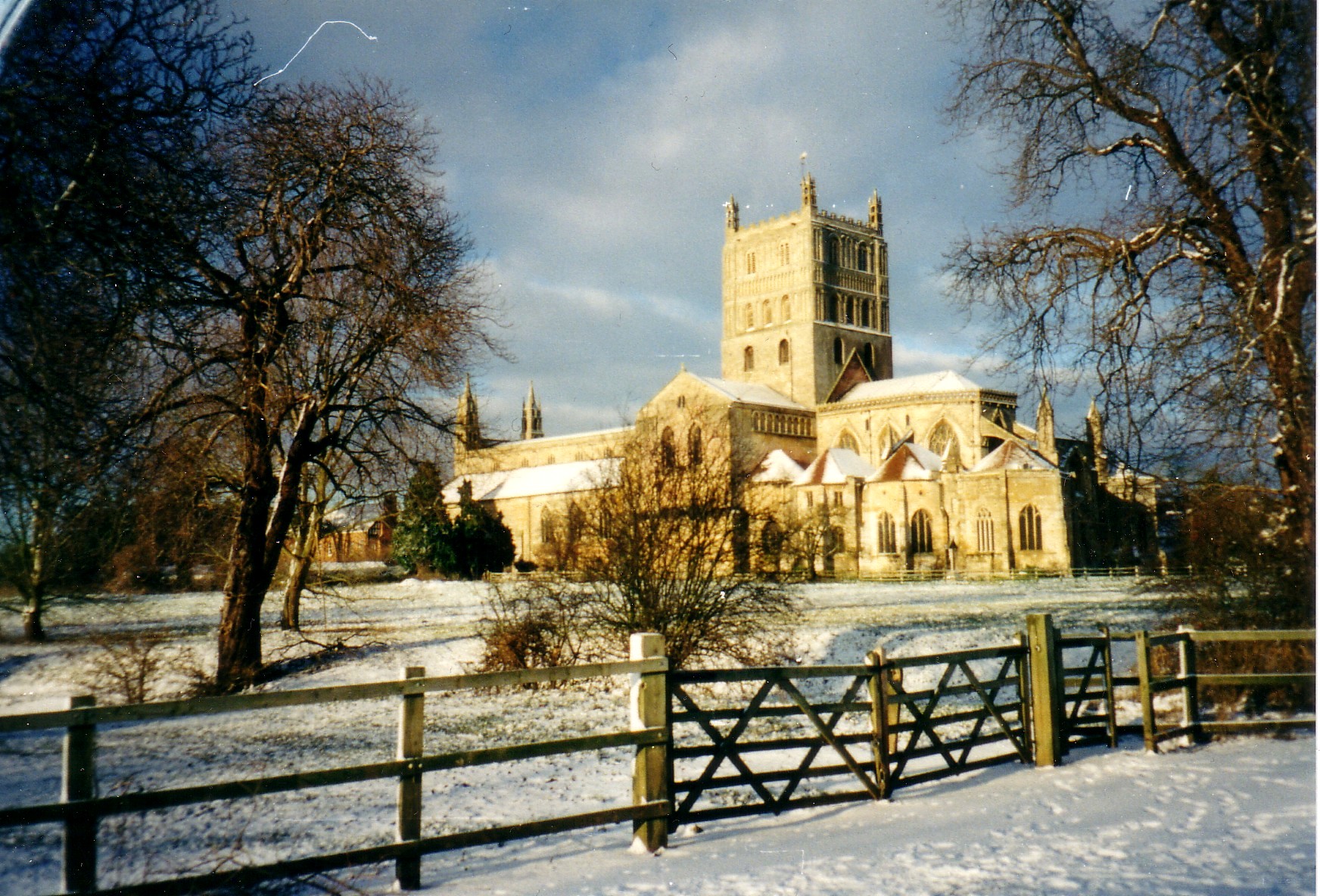
May the Christ child bring his blessing into your home and to your family at this Christmastide.
Posted by The Gray Monk at 08:54 PM | Comments (1) | TrackBack
December 23, 2007
Joseph and Mary
A interesting thought for today rests on St Joseph, the husband of Mary and foster father of Jesus. The gospel reading for today gives an insight into this man's feelings and sense of justice when he discovered his bride to be was pregnant. Jewish law stipulated that a girl falling pregnant was to be stoned to death, but Joseph had a different view. He intended to quietly send her away so she could have the child somewhere and escape the stigma. Then he changed his mind and married her after a visit from an angel.
Most paintings depict him as an old man, but one Spanish artist depicts him, more accurately I think, as a young man with a small Jesus clinging to his leg as he works. Whatever you think of Joseph there is one thing that stands out. Here was a man whose hopes of a loving marriage were rudely dashed by the discovery of his betrothed's pregnancy. Jospeh was not the sort of person to "live" with his bride to be, so it must have come as a terrible blow to find she had apparently betrayed his love for her. Yet he doesn't react in the way many would, he reacts with sympathy and love. Even leaving out the angelic messenger, his subsequent behaviour, his protection of the infant and later the growing boy sets us an example that is hard to beat.
In my view Joseph is probably the most under rated person in the entire Bible.
Posted by The Gray Monk at 01:41 PM | TrackBack
December 16, 2007
Sunday sermon
Today is Asperges Sunday, the day on which we will carry out a ritual sprinklinmg of the congregation and the church with Holy water at the Sung Eucharist. The liturgical colour for Asperges is Rose - a deep shade of pink, trimmed on the vestments with silver. The Deacon will carry a bowl of holy water while the Priest uses a bunch of Rosemary to splash everyone he can possibly spray with the water as the three minsters go round and through the church. It is also the day on which we remember that John the Baptist was sent to foretell the coming of Christ.
Asperges is a part of the preparation for the return of Christ to the world, which is what the season of Advent is supposed to get us into readying ourselves for. It is a ritual cleansing for eveyone and everything accompannied by the penitential psalm. Unfortunately these days it seems to almost get swamped beneath the commercial run up to Christmas. Strictly speaking we should not sing Christmas Carols until Christmas Eve - and there are a whole section of Advent Carols in most hymnals that never get sung these days, yet are theologically far more correct than many of our favourite "Christmas" ones. Well, that's my "Bah humbug!" over with. Sing away, but do spare a thought for the spiritual preparation we should be embracing as well.
Today I am Deacon for the Parish Eucharist and I am also the preacher. My sermon is in the extended post. I hope it gives some food for thought.
Advent 3 2007
Tewkesbury Abbey
+May I speak in the name of the Father, and of the Son and of the Holy Spirit,
Amen
“What did you go out into the desert to see?”
John the Baptist is one of the enigmatic figures of the New Testament. We are told that he was a cousin of Jesus and that he, by his own words, is a messenger, the voice crying in the wilderness, “Make straight the way of the Lord.” Though we call John a Saint he is, in reality, the last of the Old Testament prophets. So when our Lord asks “What did you go out into the wilderness to see?” He already knows – the crowd had gathered because the people believed that they would hear and receive baptism at the hands of one possibly the successor to Isaiah, Ezekiel, Jeremiah or one of the other prophets. They probably hoped, but did not expect, to encounter the Messiah. And certainly the Messiah they encountered was not one they recognised.
The people came out into the Wilderness looking for a leader and they found John. John gave them fire and brimstone, and a chance for ritual cleansing at the hands of one recognisable as a prophetic figure. A man of God. His followers felt they could recognise a prophet in him, they could connect to the figures in the Torah through him. He preached with fire in his voice and water as his cleansing tool – and so he stirred anxiety and enmity among the ruling class and eventually Herod.
St John’s Gospel tells us that when the Levites and priests of the temple came to him and demanded to know who he was he tells them bluntly “I am not the Christ.” They try again, “Then who are you? Are you Elijah?” And again he tells them “No!”
One can only imagine their annoyance when he finally uses the words of Isaiah to say
“I am the voice of one crying in the wilderness, make straight the way of the Lord.”
Many will have found this disappointing, many had, no doubt, begun to hope that this rather rough and probably rather wild looking man was the long awaited Messiah, after all, this was a time when “messiahs” were popping up everywhere. No doubt too, this was why Herod had decided to use John’s denunciation of his marriage to his brother’s wife as an excuse to put him out of circulation.
But, from his prison cell, John hears that Jesus has taken over the ministry and the crowds he had drawn. This Jesus he had himself baptised in the Jordan. And now doubt assails him, for the descriptions he is hearing don’t tally with what he is expecting from the Chosen One, the Messiah.
How often we, as human beings, fall into this trap. We draw for ourselves a picture, an image of how things ought to be, of how WE would like them to turn out. And when they don’t we are thrown into turmoil. The very foundations of our faith are shaken – because we have created in our own minds an image of perfection that is not met. Those followers of John the Baptiser must have felt the same disappointment when Jesus stepped forward and revealed himself as the one that John had foretold. Here was no conquering King in the Davidic tradition, here was a simple Nazarene, admittedly of David’s lineage, but a quiet spoken man who carried no sword and did not advocate its use to clear the land of gentiles and pagans. Who came instead speaking of a heavenly Kingdom, a Kingdom moreover that seemed to welcome every condition of man, not just those who followed the Law and the Prophets, ritually cleansing themselves and studying the Torah all the days of their lives. He was not what they expected, nor was he in any sense what John expected – and John was the prophet sent to prepare the ground for him.
Again, if we turn to St John’s gospel we see that the Baptist must have eventually seen for himself the revelation that the Kingdom he was expecting and heralding was no earthly one. For in last weeks gospel we were told that he said when challenged concerning his baptising with water.
“I baptise you with water. But after me will come one who is more powerful than I, whose sandals I am not fit to carry. He will baptise you with the Holy Spirit and with fire.”
So why is John now sending to ask “Are you the Christ?”
Well, it would certainly seem that at this early point in Christ’s ministry, the evidence of the “fire” and the “Holy Spirit” was not yet apparent, certainly not to John’s disciples. They too, it seems, fell into the trap of seeing only what they where looking for.
I am sure that you, like myself, have sometimes looked for something we expect to see plainly only to be unable to see it anywhere. Sometimes we are looking so hard at the thing that we can’t see it. A case of being unable to see for the looking. Often that is how we manage not to see God at work around us. We have our own idea of what it should look like, must look like that we simply don’t see Him at all. Even when he is stood directly in our paths and working directly in and through us.
Shortly after our Lord sent his message to the imprisoned John, Herod had him executed, yet, in the message John does seem to have seen the hidden Christ and it seems that he died certain that his task, the task of foretelling, was complete.
We are called to be Christ’s hands, feet, eyes, and body here and to speak, live and show the Gospel to the world, just as John did. We are called to be ready to greet our Lord when he returns in glory – and that is what Advent is meant to bring us to preparation for. Are we prepared? Have we prepared? Perhaps more importantly, have we got our eyes fixed so firmly on the returning Christ we expect to see that we cannot see Him already among us?
WE must make sure that when He does return we do not have someone write of us:
“He was in the world, and though the world was made through Him, the world did not recognise Him.”
Amen
Posted by The Gray Monk at 01:51 PM | TrackBack
December 02, 2007
Advent Sunday
Last Sunday I worshipped in Mainz Dom, this week I am home again in my familiar setting of the Abbey. The two buildings are not that different in scale, but very different in character. Mainz's red sandstone and small windows tend to make it darker inside than the Abbey is usually, but what really counts is how the two buildings are used.
Today is Advent Sunday, the start of the preparation period for Christmas. It is generally a sombre season liturgically for the focus, preparation, is for the coming of Christ's Kingdom on Earth. As the gospel tells us, we do not know the hour or the day on which that will come and that is probably just as well. In this day and age the lead up to Christmas for most is anything but a spiritual journey - it is a very material one. Christmas Cards to be found and sent, presents to be bought and wrapped, decorations to be put up and masses of food to be acquired, prepared and consumed on the day itself. That is a great shame, for the season deserves more attention and Christmas itself should be celebrated with more foicus on the Babe and less on the fact that it provides an excuse to overindulge on every front.
Advent reminds us of the journey in faith which we must make if we are to fully appreciate the import of that infant whose birth so changed the world. As St John wrote; "The Word was made flesh and dwelt among us; the only begotten of the father, full of grace and truth."
But our modern approach to Christmas is sadly, the very epitome of the statement from the same author - "He was in the world, and though the world was made by Him, the world did not recognise Him." Well, some did, though it took them a while too, and thanks to them we now celebrate that event. Let us hope that it can be recovered for those who do believe and become once more, a season for celebrating the arrival in the world of its saviour.
When God set out to save us from ourselves, He didn't send a committee and He certainly didn't send us a politician. He sent His one and only Son, the Word Incarnate.
Posted by The Gray Monk at 02:48 PM
November 25, 2007
Sunday in Mainz
Mausi and the Monk took some time out of preparing for the conference to attend church this morning, at the Mainz Dom. This magnificent Romanesque building is unusual because it has a "Sanctuary" at the East end and another opposing it at the West. The transepts cross at the location of the Western Altar and above it soars the lantern of the striking central tower, crowned by a small bell chamber at its very peak. The pews all face West where the Presbytery is situated behind the altar and this was the site of the Mass.
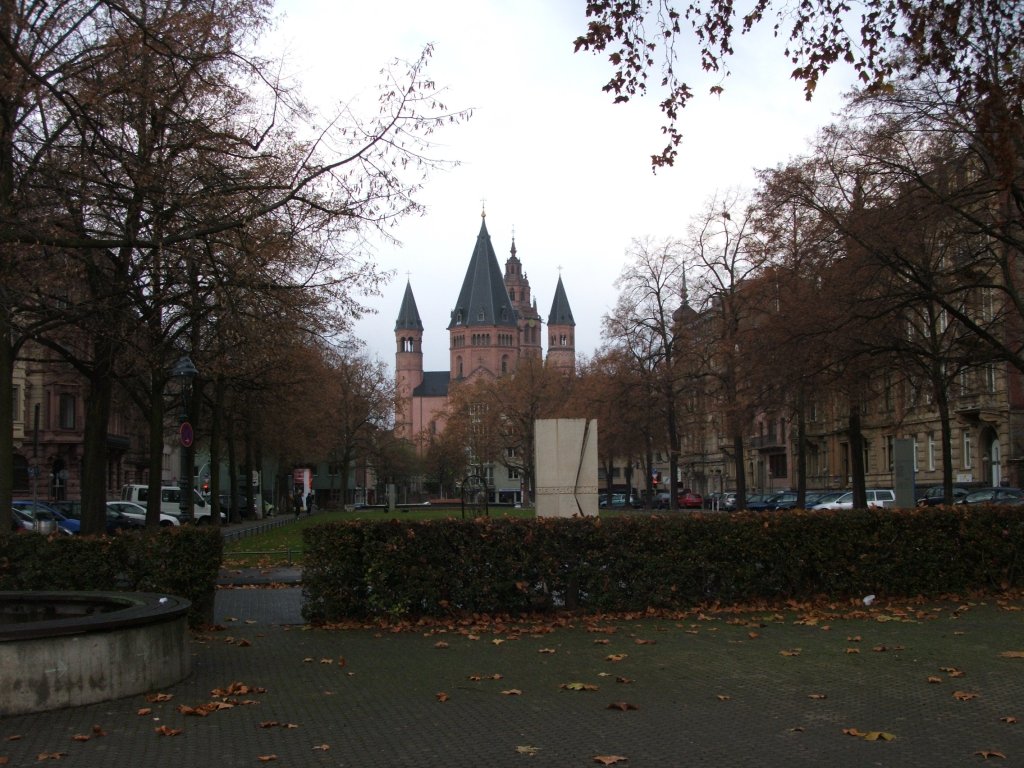
Mainz Dom seen from the Rhine-side esplanade.
We managed to attend the High Mass of the morning, sung by a large all girl choir and set to a rather modern setting. The girls carried it off rather well, but - to someone from my tradition at least - having the congregation applaud them as they processed out at the end of the service came as something of a surprise.
The Monk did wonder - perhaps naughtily - what the reaction of his own Abbey's Verger team would be to being told to wear the rather splendid gold lace trimmed Bicorn hats, dark tail coats with sash and gold eppaulettes, knee breeches and buckle shoes while carrying a staff of office and a mace in procession. Their deportment was splendid as they marched side by side down the central aisle, reminding us that this is the home of a Cardinal Archbishop, no less. The service itself was an interesting experience since the Monk does not have sufficient German to follow the spoken word, although he managed to sing the printed hymns quite well and made te appropriate responses when he could find them in the service missal.
One innovation that he somehow can't see working in the Abbey is the electronic hymn boards - which flash up the hymn number - and the verse to be sung next! Ah, the wonders of technology - Vorsprung durch Technik?
Posted by The Gray Monk at 06:36 PM | Comments (5) | TrackBack
November 21, 2007
Warning on The Golden Compass
The makers of the film The Golden Compass, and its author, Phillip Pullman, seem to me to epitomise what is wrong with British Society and our current "ruling class". Pullman is a prominent Atheist and Humanist and self declared enemy of Christianity. He is on record as stating "I want to go after Christianity. ..... I want to undermine Christianity."
This epitomises the current trend among our intelligentsia and literati. It flows through the civil service and the current governing party. They want God dead. They want Christianity killed off. Any means are fair, any means will do. There is only one aim, to replace Christianity with their "live for today, listen to us, we have all the answers" mantra in the hope that it will enshrine them in power. It won't, simply because when they have succeeded in destroying Christianity they will have created the vacuum that Islam will rush to fill - and they and their agnostic followers will have one choice only. Become Muslims or be swept from any position of power, authority or criticism. Islam will not tolerate agnostics, atheists or critics. And men like Mister Pullman will have to run for their nicely prepared bolt-holes in the US and other countries they have spent a lifetime undermining with their self serving poison.
I don't often get mad at people like this, my normal reaction is pity, but this man's arrogant stupidty makes me very angry. Worse, his and his supporters deliberately targeting children with this film which shows children killing God as its finale, is nothing short of irresponsible. Do they really believe that a Godless society is going to be a better society? Didn't the excesses of the Soviet system or the Chinese Communist system, Pol Pot, Hitler or the wars of the Socialist century teach them nothing? Christianity and Islam have certainly been behind a number of conflicts, but the worst in terms of human life lost, destroyed or disrupted have all been initiated by Atheist regimes. All have been fought on socialist or humanist philosophies.
I can only hope that parents tumble to this blatant piece of destructive propaganda for the failing Humanist cause and shun the production. Sadly there will be those who will rush out to buy it purely because Christians don't approve, little realising the damage they will do to their kids. We can but hope that the kids are more sensible - or that God will find a way to defeat these idiots.
We can but hope.
This is the text of an e-mail I have received from a friend in South Africa.
Subject: WARNING!!! New Movie For Children
Hi Moms and Dads and people deemed likely to take young children to the movies,
This is important since the marketing for this movie has already started. It looks a lot like "Narnia" but is so far from it. BEWARE!
There will be a new children's movie out in December called THE GOLDEN COMPASS. It is written by Phillip Pullman, a proud athiest who belongs to secular humanist societies. The movie has been dumbed down to fool kids and their parents in the hope that they will buy his trilogy where, in the end the children kill God and everyone can do as they please. Nicole Kidman stars in the movie so it will probably be advertised a lot. This is just a friendly warning that you sure won't hear on TV.
Pullman , a prominent British atheist, has acknowledged that this is in fact his goal. He has claimed that "it is my goal to go after Christianity, I want God to be dead in my works. I want to undermine Christianity"
Posted by The Gray Monk at 06:04 AM | Comments (6) | TrackBack
November 20, 2007
Science and God
Every now and again someone sends me something that makes me pause and ponder on the whole issue of faith. In the Extended Post is one such item and it is well worth reading. I don't know where it originated but it is certainly well argued - far better argued than any other such riposte I can recall. There are one or two issues I must take with parts of it, such as "the Bible says I am evil" and the implied suggestion that evolution is a "scientific myth", but on the whole it is very well thought out and presented. It certainly expresses some deep theology in very understandable terms.
Just as "dark" is not the opposite of "light" but the absence of it, so "evil" is not an entity on its own or the opposite of "good" or God, but the absence of them. Just so "man" - or to use the Biblical terminlogy "Adama et Eva" - are not of themselves evil, but become capable of great evil in the denial of God and the repudiation of faith. It has been stated by far more eminent minds than mine, that the human mind is "wired to belief in a spiritual existence" and when you do look at the wonder of our brains it is easy to see that this must be so. We do not understand how the electricity that our brains run on is generated, dissipated or even transmitted. Our neural networks can be disrupted by magnetic fields, and by electric stimulation - and we may have some idea of which areas of the brain perform what tasks, but we don't have a clue how. We have to take on "faith" that it works and in working gives us the levels of self awareness that we enjoy.
I will recommend that you read the Extended Post for yourselves. I will add only that the statue of Michael the Archangel and the Devil on the wall of Coventry Cathedral expresses some of the Christian understanding of Good versus Evil and of our faith that, in the end, even the wrong doer will be shown mercy. Look closely at the statue - Michael is triumphant, at his feet the devil lies chained and defeated, but Michael's spear is grounded, not at the devil's throat or breast, but in the position of guard. Michael has the devil in his power - but spares him.
Our faith tells us that we are all in God's power and our real freedom lies in acknowledging him as Lord and Master of our lives in everything, in joy, in suffering and even in death.
Subject: Science vs. God
"Let me explain the problem science has with Jesus Christ." The atheist professor of philosophy pauses before his class and then asks one of his new students to stand.
"You're a Christian, aren't you, son?"
"Yes sir," the student says.
"So you believe in God?"
"Absolutely."
"Is God good?"
"Sure! God's good."
"Is God all-powerful? Can God do anything?"
"Yes."
"Are you good or evil?"
"The Bible says I'm evil."
The professor grins knowingly. "Aha! The Bible!" He considers for a moment.
"Here's one for you. Let's say there's a sick person over here and you can cure him. You can do it. Would you help him? Would you try?"
"Yes sir, I would."
"So you're good...!"
"I wouldn't say that."
"But why not say that? You'd help a sick and maimed person if you could. Most of us would if we could. But God doesn't." The student does not answer, so the professor continues. "He doesn't, does he? My brother was a Christian who died of cancer, even though he prayed to Jesus to heal him How is this Jesus good? Hmmm? Can you answer that one?"
The student remains silent.
"No, you can't, can you?" the professor says. He takes a sip of water from a glass on his desk to give the student time to relax.
"Let's start again, young fella Is God good?"
"Er...yes," the student says.
"Is Satan good?"
The student doesn't hesitate on this one. "No."
"Then where does Satan come from?"
The student : "From...God..."
"That's right. God made Satan, didn't he? Tell me, son. Is there evil in this world?"
"Yes, sir."
"Evil's everywhere, isn't it? And God did make everything, correct?" "Yes."
"So who created evil?" The professor continued, "If God created everything, then God created evil, since evil exists, and according to the principle that our works define who we are, then God is evil."
Without allowing the student to answer, the professor continues: "Is there sickness? Immorality? Hatred? Ugliness? All these terrible things, do they exist in this world?"
The student: "Yes."
"So who created them?"
The student does not answer again, so the professor repeats his question. "Who created them? There is still no answer. Suddenly the lecturer breaks away to pace in front of the classroom. The class is mesmerized.
"Tell me," he continues onto another student. "Do you believe in Jesus Christ, son?"
The student's voice is confident: "Yes, professor, I do."
The old man stops pacing. "Science says you have five senses you use to identify and observe the world around you. Have you ever seen Jesus?"
"No sir. I've never seen Him"
"Then tell us if you've ever heard your Jesus?"
"No, sir, I have not."
"Have you ever actually felt your Jesus, tasted your Jesus or smelt your Jesus? Have you ever had any sensory perception of Jesus Christ, or God for that matter?"
"No, sir, I'm afraid I haven't."
"Yet you still believe in him?"
"Yes."
"According to the rules of empirical, testable, demonstrable protocol, science says your God doesn't exist. What do you say to that, son?"
"Nothing," the student replies. "I only have my faith."
"Yes, faith," the professor repeats. "And that is the problem science has with God. There is no evidence, only faith."
The student stands quietly for a moment, before asking a question of his own. "Professor, is there such thing as heat?"
"Yes," the professor replies. "There's heat."
"And is there such a thing as cold?"
"Yes, son, there's cold too."
"No sir, there isn't."
The professor turns to face the student, obviously interested. The room suddenly becomes very quiet. The student begins to explain.
"You can have lots of heat, even more heat, super-heat, mega-heat, unlimited heat, white heat, a little heat or no heat, but we don't have anything called 'cold'. We can hit up to 458 degrees below zero, which is no heat, but we can't go any further after that. There is no such thing as cold; otherwise we would be able to go colder than the lowest -458 degrees. Every body or object is susceptible to study when it has or transmits energy, and heat is what makes a body or matter have or transmit energy. Absolute zero (-458 F) is the total absence of heat. You see, sir, cold is only a word we use to describe the absence of heat. We cannot measure cold. Heat we can measure in thermal units because heat is energy. Cold is not the opposite of heat, sir, just the absence of it."
Silence across the room. A pen drops somewhere in the classroom, sounding like a hammer.
"What about darkness, professor. Is there such a thing as darkness?"
"Yes," the professor replies without hesitation. "What is night if it isn't darkness?"
"You're wrong again, sir. Darkness is not something; it is the absence of something. You can have low light, normal light, bright light, flashing light, but if you have no light constantly you have nothing and it's called darkness, isn't it? That's the meaning we use to define the word. In reality, darkness isn't. If it were, you would be able to make darkness darker, wouldn't you?"
The professor begins to smile at the student in front of him. This will be a good semester. "So what point are you making, young man?"
"Yes, professor. My point is, your philosophical premise is flawed to start with, and so your conclusion must also be flawed."
The professor's face cannot hide his surprise this time. "Flawed? Can you explain how?"
"You are working on the premise of duality," the student explains. "You argue that there is life and then there's death; a good God and a bad God. You are viewing the concept of God as something finite, something we can measure. Sir, science can't even explain a thought. It uses electricity and magnetism, but has never seen, much less fully understood either one. To view death as the opposite of life is to be ignorant of the fact that death cannot exist as a substantive thing. Death is not the opposite of life, just the absence of it."
"Now tell me, professor. Do you teach your students that they evolved from a monkey?"
"If you are referring to the natural evolutionary process, young man, yes, of course I do"
"Have you ever observed evolution with your own eyes, sir?"
The professor begins to shake his head, still smiling, as he realizes where the argument is going. A very good semester, indeed.
"Since no one has ever observed the process of evolution at work and cannot even prove that this process is an on-going endeavour, are you not teaching your opinion, sir? Are you now not a scientist, but a preacher?"
The class is in uproar. The student remains silent until the commotion has subsided.
"To continue the point you were making earlier to the other student, let me give you an example of what I mean."
The student looks around the room. "Is there anyone in the class who has ever seen the professor's brain?" The class breaks out into laughter.
"Is there anyone here who has ever heard the professor's brain, felt the professor's brain, touched or smelled the professor's brain? No one appears to have done so. So, according to the established rules of empirical, stable, demonstrable protocol, science says that you have no brain, with all due respect, sir. So if science says you have no brain, how can we trust your lectures, sir?"
Now the room is silent. The professor just stares at the student, his face unreadable.
Finally, after what seems an eternity, the old man answers. "I guess you'll have to take them on faith."
"Now, you accept that there is faith, and, in fact, faith exists with life," the student continues. "Now, sir, is there such a thing as evil?"
Now uncertain, the professor responds, "Of course, there is. We see it everyday. It is in the daily example of man's inhumanity to man. It is in the multitude of crime and violence everywhere in the world. These manifestations are nothing else but evil."
To this the student replied, "Evil does not exist sir, or at least it does not exist unto itself. Evil is simply the absence of God. It is just like darkness and cold, a word that man has created to describe the absence of God. God did not create evil. Evil is the result of what happens when man does not have God's love present in his heart. It's like the cold that comes when there is no heat or the darkness that comes when there is no light."
The professor sat down.
Posted by The Gray Monk at 12:26 PM | Comments (2) | TrackBack
November 01, 2007
All Saints
Just a very quick thought for the day - this being the feast of all the Saints, living, departed and yet to be. Every Christian is called to be a saint, some of us achieve that in a public way, some are not recognised in their own time and some are recognised only in their interactions with those they help, assist and meet in their daily lives.
Join me in celebrating the lives of all the saints.
May we all fulfill our calling.
Posted by The Gray Monk at 05:56 AM | TrackBack
October 28, 2007
Mass of the minority ..
Last Tuesday night I had the deeply moving privilege of joining a small congregation of some forty Christians, Catholic and Protestant, who meet together for a Catholic Mass celebrated by a little Bishop from Benghazi. Bishop Silvester is a gentle little Franciscan who celebrated a wonderful eucharist for us all, and though many chose not to take communion, he gave to all who did, of his flock or not.
Talking to him has been an education and certainly made me feel very humble. Christians here are a minorioty, and some thirty five years ago all Christian Chuirch buildings were confiscated and closed. Officially they are still allowed to meet and worship, but under no circumstances are they allowed to demonstrate any public sigfn of their faith, or to attempt to speak of it to any Muslim. There is also a very "low grade' campaign of harassment, ranging from the man with the keys to the school hall they are allowed to use for their once per month public service being "away" and the keys with him, to the local youth gathering outside to noisily "play" while the service is held, and then follow the congregation home as they disperse.
Bishop Silvester was staying in the "Guest House" with me, so I took the opportunity to walk with him and provide a larger presence refusing to the be intimidated when some of the youths deliberately blocked our way by simply moving to stand across the pavement. I suggested that they might like to move, got a filthy look for my pains and a "no spik English" rather belied by the fact that only minutes before they had been loudly discussing Manchester United - in English. The little Bishop has had his church burned down twice and was recently informed that he can buy back his cathedral now, but must restore it to its original condition himself. Having been closed for thirty years it is now in a ruinous state and the congregation is unable to raise the sort of money needed. There is also the fact that any donations to them must be declared and all mail addressed to them is opened and confiscated if it contains anything deemed to be proscribed by the state.
We in Britain and the West should take note of this, particularly as, if our politicians are permitted to continue their campaign of subversion of Christianity in our own countries and, particularly in Britain, to promote Islam, allowing a separate "Parliament' in Bradford for "Muslim Affairs" then we will shortly be changing our religion in a big way.
I am humbled by the experience of sharing worship with these people. I am huimbled and shamed because we in Europe do not know the damger our politicians and civil servants have placed us in. I am humbled and ashamed that we care so little for our brothers and sisters in their hardship. I may never pass this way again, but I will never forget this little congregation of saints in my prayers either.
Posted by The Gray Monk at 04:53 PM | TrackBack
October 06, 2007
Remembering the floods
Today saw the Abbey packed for a service of thanksgiving and remembrance. It is now just over two months since the devastating floods that struck on the 20th July and our Bishop, the Bishop of Gloucester decided some weeks ago that we were the appropriate place to hold this service for the whole county.
Around six hundred people attended together with the Lord Lieutenant, the High Sheriff and the Sheriff of Gloucester, all the Mayors from all the towns hit by the flood and of course the many whose homes and possessions, businesses and treasures, however humble, were destroyed. Six symbolic candles were lit in the centre aisle by those bereaved or representing those who suffered loss and the service was broadcast by BBC Radio Gloucester. An ITV News camera was also present, so no doubt there will be some reports on the TV as well.
For those of us there, it was a very moving and well thought out service. For me particularly, it was great to see the sailors, soldiers and airmen there in their uniforms alongside the Police, Fire and Ambulance services, because it reminds people that our standing armed forces are not just about fighting, but about defending us in all sorts of emergency. For once the politicians had to take a back seat and listen to the people they will always claim to represent telling of how they worked for themselves, their neighbours and those whose need was greater than their own. It was truly humbling experience even for those of us that were there and involved in the whole unfolding tragedy.
Our prayers of thanks and our hymns of praise rang through the building, but, as our Bishop reminded us, now is the time to build on the good that came spontaneously during the crisis when we looked after each other, and to make it the way of the future.
Posted by The Gray Monk at 04:34 PM | TrackBack
September 25, 2007
Escatology anyone?
The Book of Revelation is most emphatically not my favourite read. It is disturbing, it is sometimes contradictory and it frequently seems to be dualistic, if not downright Gnostic. It would be true to say that it made it into the Bible as we have it today by a very narrow margin. Even in Nicea in 350AD there were doubts as to its provinence - doubts expressed from even earlier weighed heavily with the assembly when deciding the canon of what would become the Vulgate as translated into Latin by St Jerome.
While on my sojourn in Surrey, I have with me a paper we will be discussing at our regular theological forum on Thursday evening. Reading the paper has made my head hurt, reading Revelations so I can check the background had me wondering what St John of Patmos was taking at the time. Reading the commentaries I have with me makes me wonder what trhe authors of those actually believe. So, I revert to my favourite Saint and an 8th Century version of his famous "Breastplate" -
Be thou my breastplate, my sword for the fight,
Be thou my whole armour, be thou my true might,
Be thou my soul's shelter, be thou my strong tower,
O raise thou me heavenward, great Power of my power.
High King of Heaven, thou heaven's bright son,
O grant me its joys after vict'ry is won,
Great Heart of my own heart, whatever befall,
Still be thou my vision, O Ruler of all.
Posted by The Gray Monk at 02:39 PM | Comments (1) | TrackBack
September 09, 2007
Sunday Sermon
An interesting set of readings from the Common Worship Lectionary for today, one's I found very thought provoking and meriting some further reading and thought. The Lection is:
Deuteronomy 30 15 - end
Philemon 1 - 21
Luke 14 25 - 33
The result of my musings is in the extended post below for those who care to take a read of the sermon that I am preaching at the Parish Eucharist this morning.
Parish Eucharist
9th September 2007
+ May the Lord our God speak through me, and may you receive his gospel in grace. Amen
“I appeal to you for my son Onesimus.”
I want you to imagine yourselves at home, nicely tucked up in bed. It is still dark, dawn is an hour or so off yet, but the sky outside is already lighter to the east. Suddenly, the door is smashed in, a number of armed men burst into your home charging in they attack you, seize your children and your wife, dragging them from their beds, beating them if they struggle. Outside you are all sorted into groups. Those too young to travel or work are killed as are those considered to old. Those injured and requiring too much attention join the pile of corpses and the remainder are now fitted with iron collars, the iron heated to be bent and beaten closed on your neck, stripped naked and chained to each other before being herded into boats and a life of slavery. And no, I am not describing the actions of Europeans in Africa, but of a raiding party that hit this area in 401 AD …..
The life of a slave was harsh and usually brutalised no matter who the slave owner was. If you were lucky you spoke the language of your Master, if you were not, as was the case with those taken in 401 – you didn’t. So you faced beatings for not understanding what he wanted, and more beatings for being too slow to learn. You went hungry and naked and you lived with that iron collar for the rest of your life – which you probably hoped would be short.
As a slave you were permitted to own nothing under the Celtic peoples, but the Romans had a marginally less harsh view. Under them there were three ways you could become a slave. You could be captured in war, you could be born a slave, or, if you were unable to find work or to pay a debt you could sell yourself. Under the Celts you were a slave for life, under the Romans it was possible to buy your freedom. Onesimus must have hoped that Paul would help him do that, or give him the wherewithal to do so. He probably did not want to be sent back to his owner still a slave and without the means to obtain his freedom, yet that is what he did. Paul sent him back, no longer just a slave, but, as he says:
“No longer as a slave, but as a dear brother. He is very dear to me, but even dearer to you, both as a man and as a brother in the Lord.”
The entire economy of Rome and all other major powers in Paul’s time rested on a plentiful supply of slaves. Slaves formed the industrial machinery that allowed the building of magnificent structures, cleaned the streets, kept the aqueducts flowing, kept the sewers unblocked, kept the food production in being in the absence of machines. So Paul is making a radical statement here – every slave is a brother in Christ of those who are their Masters. Earth shaking stuff, the sort of idea that causes economies to collapse in ruins. You may well imagine how it was received by Philemon, the owner of the runaway whom in Paul’s own, and probably Philemon’s words as well, was formerly useless to you …
But consider a moment, Onesimus did return. No doubt Paul had to do quite a bit of persuading, but the runaway returned to his Master, voluntarily placing himself at Philemon’s mercy. Again, under the law, his master could have him flogged or put to death, sold or hired him out for some work that would have finished him off. We don’t know the rest of the story, but it is difficult to see how Philemon could have done anything less than Paul asked of him.
Paul uses the imagery of being a “prisoner” and of the slave frequently in describing his relationship with Christ. In this letter he describes himself as “a prisoner of Christ”. It is an image we need to consider carefully for it accords with the last sentence of today’s Gospel.
“Any of you who does not give up everything he has, cannot be my disciple.”
Now comes the difference in the imagery of Paul’s descriptions – he is a prisoner by his own surrender. He is a slave by his own giving of himself to God. He has surrendered all that he has and all that he is, to Christ. It is the ultimate act of faith and trust, in Christ we are all slaves for everything that we possess comes from God, we have it in trust for God. Consider the imagery of the three men entrusted with a portion of their Master’s treasure. One puts it to work and does well, returning the principle and interest on demand, the second isn’t quite so successful but is still rewarded, the third has made no use of the treasure entrusted to him and is punished for it. This is the sort of slave/master relationship that Paul envisages in giving our all to God. In return for our surrender we are fed, clothed and given all that we need for our service to him.
It takes a huge amount of trust and faith to make the kind of surrender that Onesimus evidently made in returning to his master, but the obligation placed upon the Master in those circumstances was equally heavy. In Christ alone we know that we may place all our trust in his protection and his willingness to forgive and to comfort those who make the effort. No one can ever find it easy to surrender that completely – I know that I am far to much of a control freak to ever be comfortable, yet, I know too that it is the only way. I cannot retain control of wealth, family and all the trappings – and still fully serve Christ as my master. In that I am no different to anyone else. It is only in fully surrendering my all – and that is my person such as it is worth, that I can truly be a disciple.
And here is another element - the slave is dependent upon the master for food, for clothing, for shelter and for every other need - and the master, if he is a compasionate one, provides these. Our Lord is the most compassionate Master we will ever encounter.
Today’s Gospel presents us with a hard choice. There is no easy option. Like Paul and Onesimus we can surrender ourselves to our Master Christ, or we can, as did the majority of those who heard Christ’s words for themselves, we can walk away. On the one hand we can accept Christ’s chains of love and the collar of the slave of Christ – or we can choose the freedom that acknowledges no master. As Paul and many others across the ages have discovered, Christ is a gentle master, one who cares for everyone who does surrender to his overlordship and provides everything they need. And their greatest reward is knowing that they have served him fully and well.
So as we prepare ourselves to celebrate this Eucharist, let us consider how much we have given of ourselves to God. Are we able to say, everything I have is your Lord, make me your servant? Or are we still, like the runaway Onesimus was, afraid to give ourselves into his control? Have we the courage to turn and walk towards that surrender and to follow where he leads, or do we still insist on keeping control to ourselves?
Christ will not break down your door and drag you from your home as did the Irish slavers’ in the 5th century, nor will he pursue you if you run away. But he will welcome you with loving arms if you offer yourself to him as a free and willing gift, surrendering your life and work to his service, whatever and wherever that may take you.
The image of the slave is a powerful one, yet, in becoming slaves to Christ we are not surrendering to humiliation, beatings, abuse, but to joy and grace in his service.
“My yoke is easy; and my burden is light.”
Amen
Posted by The Gray Monk at 11:54 AM | Comments (1) | TrackBack
September 06, 2007
Stressed? Call God ....
Actually, that may not be a silly as it sounds. The Church of England is offering short prayers to help us relieve the stress and tension of our daily grind, showing in many of these short and pertinent prayers a lot of thought and consideration of what people encounter in various work related situations. A special section of the website has been set up to provide them and makes good reading if you have and mind to seek a prayer to help relieve your stress.
There is a sensible point to this and it is, as always, a simple one. God IS involved in every aspect of our lives so it makes sense to ask for his help in times of stress or strain. The truth is that if we actually lived our faith and practiced what it teaches we would not be stressed. Or, at the very least, we would be much less stressed.
Do use the links above to find the prayers and use them. They are well thought out and very useful.
LONDON (AFP) - The Church of England has published a series of prayers aimed at helping Britons cope with the post-holiday Monday blues as they trudge back into work following the long break.
(Advertisement)
The prayers include one for stressed-out commuters stuck in a train tunnel, as well as a few lines seeking heavenly help in coping with frustrating telephone conversations.
"Father, as I talk to this person, give me a listening ear and a gracious tongue," heads the one-liner entitled "Brinnng Brinnng", and published on the Anglican church's website.
In "A Commuter's Prayer", the returning worker fails to get a seat on a packed train. "We're stuck in a tunnel; everybodys sighing; we're not moving," it says.
"Let me know your peace and grace ... For the sake of my sanity," it adds.
A church spokesman noted that the prayers were published as millions of Britons return to work after the extended summer holiday.
"The selection is aimed at banishing the post-holiday blues with God's help," he said, adding: "We're showing that God's love isn't just a holiday romance."
And he denied that such prayers trivialise the church's message. "Clearly the Church is concerned about the big global issues but we also believe that God is concerned about our everyday lives just as much," the spokesman said.
The train commuter's prayer could be particularly appopriate for Londoners, facing a threatened three-day strike on the capital's Underground system from Monday evening.
Posted by The Gray Monk at 07:03 AM | TrackBack
August 30, 2007
Post number 1662
For those who know the good old Church of England and its Book of Common Prayer, the number will be significant. Yes, that is the date of the BCP and for traditionalists that is the only date that matters in the church. Sadly, Cranmer's original attempt, the 1549, did not survive as it was deemed to Catholic by the Reformers.
It always amuses me to hear these same folks banging on about it being "Cranmer's" Prayer Book, the good Archbishop had been long dead by the time it was published, burned at the stake by Queen Mary I of England (Bloody Mary of infamous repute). The book certainly encompasses most of Cranmer's work, but with some notable changes. This book is modelled on the 1554 version which never received the ascent of Parliament and that, in its turn, replaced the 1549 Prayer Book which was an almost verbatim translation of the Latin Breviary, although here Cranmer's genius with words made a fine silk purse out of the rough translations.
There are several things in the 1662 BCP that are hang overs from the earlier 1554 book - notable for its extreme protestantism which is precisely what made it unacceptable to the majority. One of these is the practice of celebrating the Eucharist stood or crouched at the North End of the altar (Sorry! Communion Table to those who practice this strange stance.). This arises from the fact that in the 1554 version the Rubric for the preparations for the Communion stated that: -
"The table shall be placed in the midst of the Quire lengthwise, covered with a clothe of fair linen and the vessels for the communion placed at it's centre. The Minister shall stand at the entrance to the Quire and admit to the communion those whom he is satisfied are properly prepared to receive it and when all are entered shall stand upon the North SIDE of the table and commence the service of Communion"
Reading the actual rubric (I have 'translated' and paraphrased it here) it is clear that only a part of it was carried over into the 1662 version - just enough to make the instruction to stand on the North SIDE a complete nonsense. The key here is the word SIDE. If the altar is placed against the East wall the North side becomes the North End and it is extremely difficult to conduct the communion service from there. In fact I have never seen it done successfully - probably because seeing the priest trying to do it from there always makes me want to go and drag the "table" away from the wall and turn it into the place prescribed by the Iconoclasts who wrote that original rubric! It is also worth remembering that this moving of the table and standing on the North side was a political statement in 1554 and 1662 - it meant that there was a clear difference between the way the Roman Catholic Church celebrated the Communion (Or Mass if you prefer!) and that of the C of E. Again, it is my view that any politically motivated ritual is invalid and should be ignored. The Communion is about focussing on God and for that reason the East facing or West facing celebration of the Eucharist is accepted as the norm by most catholic and apostolic churches.
My second problem with that stance (and those who cling to it) is that they then ignore the rest of the Rubric which still requires the priest to "Admit to the communion only those persons who he is satisfied are duly prepared and in a state of grace to be admitted" and most tellingly, to exclude those he does not believe are suitable!
In my view you cannot ignore the one part and slavishly follow the other. Ergo, the whole is contrary to the intent and purpose of the Communion and should be discarded.
There, I have said my piece on the 1662 BCP, I love the language of the collects and the prayers, I love the Offices of Matins and Evensong, use the Prayers for those at Sea and love the form for Publick Baptism. There is a great deal of good in it - but the intent in the Rubrics for the Communion is contrary to the message of love and acceptance of those in spiritual need in the Gospels. By all means use the BCP, but take care what you do with the Rubrics for the Communion!
Posted by The Gray Monk at 08:17 AM | TrackBack
August 19, 2007
Sunday Sermon
This morning I am the preacher at the Sung Eucharist. I will confess that the Gospel reading for the day is one of those which fills most preachers with dread because it seems to contradict almost everything we would like to think our faith is about. Read it yourselves at Luke Chapter 12 verses 49 to 56.
My text is taken from the Epistle set for today, Hebrews Chapter 11 verse 29 to Chpater 12 verse 2 and I have used Hebrews 12 v 1. For the full set you had better read Jeremiah 23 verses 23 to 29 as well. When you have read them perhaps you will understand the little story I begin with ....
Not an easy set of readings to use, but, in the Grace of God's own guiding, I think I have made a little sense of it.
Tewkesbury Abbey
Trinity 11 2007
+ May the words in my mouth be inspired by the Holy Spirit, guided by the teaching of the Son and blessed by the Father. Amen
"Therefore, since we are surrounded by a great cloud of witnesses, let us also lay aside every weight and the sin that clings so closely, and let us run with perseverance the race that is set before us."
When I read the lessons set for today as I sat down to prepare this sermon I was reminded of a famous incident which took place in the great fortress harbour of Gibraltar in 1941. A battlecruiser attached to Force H stationed at the Rock returned from a difficult patrol of the Western Mediterranean to be greeted by a signal that she would have to refuel, rearm and return to the patrol zone as the Flagship could not take her turn on patrol due to a breakdown. On departure, the battlecruiser passed close to the flagship, her Royal Marine band assembled on her quarterdeck playing a tune to which there were very rude and uncomplimentary words. Immediately the Admiral signalled, “On leaving harbour, who selects the music for the band?” Back came the reply, “Normally the bandmaster, but on special occasions the Captain.” Naval signal logs are also famous for their use of Biblical quotations to convey special messages, but enough of that for the moment.
The writer to the Hebrews is making a powerful point in his address to the readers, a point no less important to us today than it was to the original recipients. The early church had an immediacy to their expectation of the second coming, it was believed that it would happen within their own lifetimes and it is something we should take to heart and consider ourselves. For it is something that could happen at any time, no matter how cleverly we arrange to manage the ordering of our lives. Some things we can plan for – but, as we were reminded last week, storing up great wealth on earth can be a slightly fruitless exercise if our life expectancy can be curtailed at any moment. That was certainly true of all walks of life until a little over a hundred years ago when medical science began to make great strides and extend our life expectancy enormously. In effect, it has disconnected us with death – and the expectation of a better life in the hereafter.
Where death was a constant and familiar companion to our forefathers, that is no longer the case, and we have lost touch with the focus that familiarity gave to the promises of our Saviour in the life to come such immediacy in the first century.
The writer to the Hebrews reminds us that faith is the key. It was the faith of the Hebrews that allowed them to cross the sea and closed it over the Egyptians. It is faith which guided Jeremiah and the prophets and faith which must now guide every true believer in the Lord Jesus Christ. And we are surrounded by a great cloud of witnesses, some still living among us and many, many more who have died in that faith and with whom we are once more joined in the Communion of the Saints as we profess to believe when we sing the creed. That is the promise of the resurrection and of the faith which we profess, that all who truly come to Christ are to be numbered among the saints – and I would hope that I am here among saints for that is what we are all called to be.
Turning to our Gospel reading today however, we find a stark warning – one which reminds us that the message of Peace will not be received in peace. Those of you who have satellite television will know of the forthcoming programme by the author of “The God delusion” to be broadcast soon. Entitled “The enemy of reason” it purports to “prove” that there is no God and that all religion is a lie and a deception. Well, I suppose he is entitled to his opinion, though I personally find the hype and the promotion of these arguments as being “scientific” offensive, because they are not. Humanism and philosophy are merely materialistic forms which attempt to replace faith. As Christ says in today’s Gospel –
“When you see a cloud rising in the west, you immediately say, it is going to rain; and so it happens,”
In a desert land, easily predicted, but who can answer his second charge –
“You know how to interpret the earth and sky, but why do you not know how to interpret the present time?”
It takes greater faith to stand and declare “there is no God” than it takes to believe that God is real and present in everything we do, so why is our faith so shaky? Why is it the cause of so much dissension?
There is an important clue in the closing passage of the Letter to the Hebrews, one which picks up on a passage from the Gospel. In Luke 12 v 30
“Do not set your heart on what you will eat and drink; do not worry about it. For the pagan world runs after all such things, and your father knows that you need them.”
In essence, as another passage tells us – “take no thought for tomorrow!”
Now, if I am honest, I have to admit that there are a number of things in my possession that I am rather attached to, in fact that I would find it difficult to live without, but the real truth is that I can live without them. And it is amazing how liberating it is to know that and to recognise it.
I took as my text the closing sentence of our epistle for today, but now I would like to turn again to Luke’s gospel, again to a sentence preceding our reading for today.
“From everyone who has been given much, much will be demanded; and from one who has been entrusted with much, much more will be demanded.”
Our Lord is not speaking of the material things alone here, but of all our gifts, material and spiritual just as the writer to the Hebrews is. As we assemble to celebrate the Communion of our Lord in the presence of that great cloud of witnesses, we should take stock of how we will account for those gifts and our stewardship of them when we the Lord comes to demand it of us.
Amen
Posted by The Gray Monk at 11:30 AM | TrackBack
August 05, 2007
Musica Deo Sacra
The annual festival of Musica Deo Sacra at Tewkesbury Abbey had to be cancelled this year, for the very obvious reason that, following the flood we could not provide hotel or any other accomodation for the expected visitors or the visting musicians and choristers. This has been a severe blow to everyone, particularly those who have worked for months to bring it all together, but not least to those who had looked forward to attending it.
MDS is a dual event, it is a celebration of music yes, but more importantly, it is a celebration of scared music used for the purpose it was intended - worship. MDS is not a week of concerts, it is a week of magnificently sung services with the musicians and choristers sometimes spending months learning the music for some stunning settings. Today we would, in other circumstances, have celebrated the Solemn Eucharist with Schubert's Mass in B Minor, the West of England Players would have accompanied an enlarged choir of professionals and ammateurs to sing it with Byrd's Ave verum Corpus as the Communion Anthem and Voluntaries by Buxtehude performed on the Milton Organ to begin and end the worship. The floods have reminded us that "man proposes, but God disposes" in a rather spectacular fashion.
We will not have Schubert or the choir today, instead we will have a congregational setting (Marbeacke) and our usual worship, but at the Mass we will also be remembering all those who have suffered far mreo than the loss of a festival. We will remember the three who died, all of them in the vicinity of our great Abbey church. We will be remembering those whose homes have been destroyed or damaged and those whose businesses have been damaged. All of us have been affected by the flood to a lesser or greater degree and some will be a long time recovering.
But, while we will be remembering those who have lost so much, we will also be giving thanks for the many good things that are now flowing from the experience. A new spirit of fellowship, an outpouring of help both spiritual and material for those who need it and, of course, for the strength that sustained the emergency services, the hudreds of volunteers and the men and women who have worked without ceasing to restore the water and electricity supplies. It may be a long time before all is back to normal, but it will be restored and we give thanks for that.
And we will be working to try and build on the good that has come from this time of trial.
Posted by The Gray Monk at 04:46 PM
July 22, 2007
Sunday sermon
This Sunday is celebrated as the Feast of St Mary Magdalene, the first to see the risen Christ, the first to speak to Him and the first to know his glory. Given that tomorrow promises more rain for the area, and the Severn is rising as I type, there is a distinct possibility that I will not be able to preach at all at tomorrow's Parish Eucharist. I have prepared my sermon note anyway, as I believe that Mary Magdalen is a far more interesting figure in the gospel than Dan Browne's crude portrait makes her out to be. I also believe that she was far more influential than the traditional legend gives her credit for.
I hope my sermon note conveys some, at least, of that thought.
Update: I was right, the rising waters prevented my reaching the Abbey and many others have had the same problem.
Feast of St Mary Magdalen
+May I speak
and may you hear
in the name of God,
Father, Son and Holy Spirit.
Amen
“Mary Magdalene went and announced to the disciples, “I have seen the Lord”; and she told them that he had said these things to her.”
Those of you have managed to wade through Dan Browne’s book, “The Da Vinci Code” will have encountered his fictional version of why it was that this Mary was the bearer of the news of the resurrection. I do not plan to dwell on any of the fictions he has created around her – much of which does her almost as much discredit as the Medieval view, built on the 7th and 8th Century Western interpretation of the story of Mary Magdalen which has her as the “woman taken in adultery”, very probably the view the majority of us are familiar with.
So who exactly was she?
Well, there is a great deal we can glean from other sources. The Coptic Church claims her as “their” apostle and she is generally supposed to have died and been buried in Alexandria. The town from which she takes her name, Magdala, was located on the shores of Lake Galilee and was a very wealthy resort and commercial centre. It is located on a major route from North to South and at the time of the first century was a popular place for the ruling families of that area to have their villas at the seaside. It was almost certainly one of the many places Christ visited regularly on his travels – and her house was quite possibly where he stayed when there.
She was wealthy, again we learn this from other sources, some of them Christian and some even have her as the woman who washed Christ’s feet with her tears and anointed him with expensive perfume. Quite possibly she was a member of a noble family, and equally possibly, for it was not unusual in the Hellenic Jewish community in which she lived, a very shrewd business woman in her own right. She was almost certainly the major source of funds for Jesus’ mission over the three years between his baptism by John and his resurrection. We also know from the Gospels themselves, that she loved our Lord with all her heart and all her being.
And therein lays the very crux of her importance to us – as an example of the love epitomised by the Greek word “Philos” – to love without any constraint, reservation, qualification or sexual element. Her love for Christ is the human response to the love that Christ showed to the world. Mary was prepared to do exactly as he had commanded, give up everything, her wealth, her position of influence, even her status in her love for him. As St Paul wrote and we heard in our second lesson,
“The love of Christ urges us on, because we are convinced that one has died for all; therefore all have died.”
This is what the distraught Mary had to come to terms with at the empty tomb. That love sometimes means letting go of everything we hold in that love – in order to discover and even greater love. By no means an easy task, yet, she succeeded.
The strength and the depth of her unconditional love for our Lord made her the perfect candidate to be the first to see him face to face following the resurrection. She is the first to discover that in his kingdom there is a new creation, one which surpasses our understanding in this life.
Dan Browne and the later attempts to paint her as the fallen woman notwithstanding, Mary of Magdala shines out of the gospels as a woman of enormous faith and of even greater love of God. The line from Solomon’s great love song,
“When I found Him whom my soul loves,
I held him and would not let him go”
Could almost have been written for her. She like almost all those who encountered him, who heard his word and understood it, however dimly, held fast to the faith they learned from him and to the love he so generously bestowed upon the world. So, as we declare the faith she and others passed on to us, as we share in the communion of the saints gathered about this Eucharist, we should give thanks for her witness and for her example of love. And we should accept the charge laid on her as our own commandment:
“Go to my brothers and say to them, I am ascending to my Father and your Father, to my God and your God.”
She obeyed that commandment – and so must we.
Amen
Posted by The Gray Monk at 09:25 AM | TrackBack
June 23, 2007
Christianity under threat
I came across an interesting piece of news on Ozcatholic, a Catholic Blog in, you guessed it, Oz. They report that a Christian pilgimage shrine in China is to be dynamited under new Chinese legislation aimed at restricting "illegal religious activity" in the run up to the Olympic Games. It seems that the original assurances that this would be used only to suppress the more way out cults and trully off the wall sects is not being honoured. Read the post headed "Illegal religious activity" for yourself.
It would appear that this pilgrimage shrine, built in 1903, stands on land that someone in the Provioncial Government has development plans for. Quick solution? Declare the pilgrimages there "illegal religious activity" and send in the troops. Anyone attempting to visit the site is now routinely turned away after a rigorous search of their person. The shrine itself, dedicated to Our Lady of Carmel, is to be blown up by the troops in July.
I wonder how long before we find similar action being taken against other Christian shrines in similarly "developing" nations?
Posted by The Gray Monk at 02:39 PM | TrackBack
June 17, 2007
Pilgrimage
Yesterday the Monk took part in the annual pilgrimage to Glastonbury, reputedly one of the earliest Christian sites in Britain. Legend has it that Joseph of Arimathea brought the young Jesus here in the "missing" years of Jesus life, and that it was here that the Holy Grail was hidden in the First Century by Joseph. According to this legend Joseph's staff took root and grew into the famous Glastonbury Thorn - a species of thron tree that grows near Jerusalem.
Spiritually the pilgrimage is always, for the Monk, a bit of a boost to his sometimes strained faith and this year was no exception despite the weather. The rain held off throughout the celebration of the Eucharist and even the short sharp shower during the afternoon's Benediction service didn't chase any of the faithfull away. Out came the "brollies" and the service went on.
Whatever the founding origins of Glastonbury Abbey, it is a very special place. According to one guide book legend has it that none other than St Patrick was the first Abbot, a claim based on the writings of a 9th Century monk. Unfortunately the records he refers too were lost in a disasterous fire here in 1184 so we have no way of checking his sources. The one man we do know had a major impact here was Dunstan, the man who reformed English Monastism and then became Archbishop of Canterbury. Like Patrick a remarkable man of great spiritual strength and determination in the face of opposition and sometimes physical threat and violence.
Glastonbury today is a magnet for all sorts of New Ageism, some fairly amusing and some very sinister indeed. But as long as the Christian faithful keep the spirit of this wonderful Abbey (Its conventual church was bigger than Canterbury in its prime) alive by praying here and partaking in the pilgrimages to it, we can hope to keep the Gospel and the faith of Christ alive in Britain.
Posted by The Gray Monk at 06:43 AM | TrackBack
June 07, 2007
Corpus Christi
Today is the feast of Corpus Christi, in most of Catholic Europe a Bank Holiday, but not in Blair's Cromwellian Britain where the mighty Pound is more important that God.
What, you may ask, is this Feast of the Body of Christ? It is in fact a celebration of the institution of the Communion, the central act of worship in all branches of Christianity that consider themselves a part of the Catholic and Apostolic tradition. The breaking of bread as "the Body of Christ" and the taking of wine as "the Blood of Christ" in this act of worship has its origins in the fellowship offering before the Tabernacle in Sinai, and later the Temple in Jerusalem. You can still see it in the form that Christ and his Disciples would have used it in any Jewish household on the eve of the Sabbath when family and friends gather to share a meal before the Sabbath begins. Light is brought to the table by the women who have prepared the food, the bread is blessed and broken by the head of the household and shared by all present, then the meal proceeds and finally, a passage is read from the Torah, and the cup of fellowship is blessed by the eldest son and shared.
On the eve of his trial and crucifixion, our Lord commanded that we, his followers, continue that tradition as a memorial to him, and in our celebration we break bread using his words, "This is my Body, broken for you, do this in remembrance of me."
The liturgy has seen many changes down the years, the earleist would have followed the Jewish pattern and taken place within a meal of Fellowship. Later, as congregations became too large to continue this practice it became a separate act of worship to be followed by a meal shared in groups and later still it has become an act of worship which stands entirely alone. Yet, in this act of worship, more than in any other, we are, however briefly, joined in one with every other Christian, living and departed, for as the words of institution have it,
"We are one Body, because we all eat of one bread."
Posted by The Gray Monk at 06:52 AM | TrackBack
June 05, 2007
Heaven sent fire?
Every now and then something comes to you from an unexpected source. I recently received a copy of a sermon preached in a City of London Church which made me want to shout with joy! At last, someone high enough up the Church of England heirarchy to say publically what I have been saying in my little corner for some time - namely that the Church has lost the plot!
In the extended post below I have taken the liberty of posting the text of the Rev Peter Mullen's views on the state of the Anglican Church and the future of Christianity in Europe (and of Europe itself!) if we continue to blunder down the road of politically correct, happy-clappy, hippy 'flower power' ideology instead of recapturing the essence of faith and of theology. Like him I despair of priests who announce that they "are not trained counsellors". What in the name of the Almighty did they learn at Theological College? Obviously nothing whatsoever about actually ministering to a congregation!
As for the penchant in some circles to sing inane and meaningless choruses, usually accompanied by a badly played and badly tuned guitar, well, I would far rather return to my cloister and forgo all music than massacre the ears of God with this drivel. And no, I can barely sing myself, and am not a musician!
Read Father Peter's sermon and weep for the demise of Western Civilisation and Christianity in any form. If that pleases you, then consider carefully what will take it's place, for faith is a basic tenet of human existence and if Christianity falls by the wayside, Islam is the alternative.
Words in Edgeways – 18 & 19 1
Sermon: Trial by Fire, 15th October 2006 …
The Bishop of London, the Archdeacon and I were in bed in France—not the same bed you understand, but adjacent. This was last week on a clergy conference in Merville in the old seminary now the conference centre for the diocese of Lille. I was asleep at one o’clock in the morning when the alarm went and voices shouting, There’s a fire. Get out! Get out! I blearily got half-dressed and opened the door. The corridor was filled with smoke. I ran down the three flights of steps and joined the others on the lawn. Five minutes later the French equivalent of the Trumptonshire fire engine arrived and a wholesale conflagration was averted.
In his talk to the conference, Richard Chartres told us what had happened. He said it was a good job he was a vigilant bishop and only half asleep, or he would not have noticed the smoke pouring from a cupboard in the corner of his room. He got out of bed and saw that this cupboard containing the water heater was ablaze and sounded the alarm. He spoke apocalyptically of the fire in the closet.
The conference was about urban ministry, and the main part of the discussion was on the church’s response to terrorist atrocities, such as happened in London last year when we were all deployed at the scenes of the explosions. And we also talked about the possibility of interfaith dialogue. Some American clergy involved in the 9/11 attack in new York told us of their experience. And they handed out a glossy brochure they had produced called New York Disaster Interfaith Services.
Here we learnt a whole new vocabulary of unmet needs roundtables; mapped vulnerabilities; networking to convene leadership and facilitate the delivery of services to underserved victims and impacted communities. I tell you, if Osama bin Laden were susceptible to volleys of bureaucratic jargon, he would be a dead duck by now. But all the time I was reading this stuff, I kept thinking of the fire in the closet.
It was all jargon. Even in the loo, in French. You stand there and read the notice that says Ne pas oublier d’appuyer sur le bouton ci-dessous afin d’actioner la chasse d’eau. Or, as we say in English, Flush! A German spoke for an hour like Professor Teufelsdröckh and actually said Twentythirdly.
Then one of the Americans spoke for the next hour, telling us that the chief sins in America are poverty, racism and sexism. I confess I still don’t understand how these can be described as sins instead of as consequences. He told us merrily that the American clergy were trained in multiple sensitivity and sexual identity. Obviously, this multiple sensitivity did not include sensitivity to the English language. He ended by telling us I have learnt to be myself. And I wondered what was the point of that.
Not to be outdone by mere foreigners, the English clergy soon demonstrated that we are not easily surpassed in the matter of jargon. We were told all about how to energise, enable through models to deal with bereavement issues by means of paradigms, objectives, systems, methodology, diversity, dissemination and of course sharing with you. One priest admitted shamefacedly - I am not a qualified counsellor—which made me wonder what his theological training had been all about. You wanted to escape to the chapel and say your prayers. But the worship was the worst of it.
One priest began the prayers by saying, Let us pray around the theme of hate. Think of a person in your parish whom you hate. Perhaps you hate yourself? Or you hate God? In the debased canticles we changed forefathers into ancestors—as if ancestor worship were the coming thing in the C. of E. There were huge dollops of touchy feely and the explicit hatred of tradition. For instance in the hymn we sang, Preaching Christ and not our customs, let us build a bridge of care. See the contempt there for our customs. But what if Christ is mediated precisely through our customs?
There were vacuous choruses—the eleven-fold repetition of what was not worth singing once. All to dreamily mothballed tunes of the Joan Baez version of 1960s nostalgia. Pools of sentimentality. And then the feminisation of the church which has followed so swiftly on women’s ordination: we prayed to the Holy Ghost as Tender sister. The climax was an act of such stultifying banality that it made you wish you hadn’t come. It was called the symbolic response.
We all had to leave our pews and be given a little night-light style candle and put them on the floor of the chapel to form the shape of the Cross. All the time the creepy goo of the chorus droning on and on. Grown men, priests for God’s sake, shuffling themselves into this mullarkey. It reminded me of Blue Peter and I wondered whether we were going to be shown how to make an Archdeacon out of egg boxes. And always at the back of my mind was the fire in the closet.
Of course when we went back into the conference sessions I knew what the fire in the closet really is. Western European civilisation is decadent, perhaps beyond recovery. We inhabit a shallow consumerism, a materialistic obsession, a universal market of flesh, drugs and public debauchery all to the background of the dead metal beat of a sickening pop culture: the death rattle of the European millennium, strangled by relativism and totalitarian political correctness.
And we are faced with militant religious Islam. Never mind the terrorists, millions of decent practising Muslims look at our decayed western civilisation and wish to recapture it for God. Islam is a serious religion. Muslims are called to pray five times a day; to attend the mosque and listen to erudite sermons and lectures; to fast during the hours of daylight for a whole month each year; to dress modestly and to be faithful in sexual morality. Given population trends, comparative birth-rates, immigration and conversions to Islam, Europe will be distinctively Muslim in thirty years time.
Against this what does the Christian Church appear to be doing?
Compromising with the anything-goes sexual immorality; incorporating the nauseating popular culture into its dumbed down liturgy; barely half believing the doctrines of the Creed; inviting its members to the emptyheaded choruses and the banalities and jiggery-pokery of worship. A sentimental, infantilised Dianafication parody of religious life. How can we expect this shambolic trivialisation of the Christian Faith to resist the Muslim determination to recapture Europe for God? What do we say—come and sing our jogging-for-Jesus choruses and act daft in church with us?
There are prophets in this wasteland. The President of the Italian Senate says this:
A foul wind is blowing through Europe. This same wind blew through Munich in 1938. While the wind might sound like a sigh of relief, it is really a shortness of breath. It could turn out to be the death rattle of a continent that no longer understands what principles to believe and consequently mixes everything together in a rhetorical hodgepodge.
He suggests the only remedy:
Will the Church, the clergy and the faithful be able to and want to be purified of the relativism that has almost erased their identity and weakened their message and witness?
There was much talk on my conference of The London Challenge. I don’t want you to think of this challenge as being to them in the church hierarchy, to some system, to some central church authority to do something about our desperate predicament. The challenge is to us. If European civilisation, which is consubstantial with Christianity, is to be saved, then you and I, all of us in this church, and all the others you must bring with you into this church, must get serious about the practice of our faith: become more informed, devout and affectionate for Christ.
There is not much time left. There is a fire in the closet.
Peter Mullen
Editor’s note:
The Rev’d Peter Mullen is editor of The Real Common Worship, Edgeways
Books. This sermon of his is reprinted from www.st-michaels.org.uk.
Posted by The Gray Monk at 10:29 PM | TrackBack
June 04, 2007
A very human saint
Ego Patricius, peccator rusticissimus et minimus omnium fidelium et contemptibilis sum apud plurimos, patrem habui Calpornum diaconum filium quendam Potiti, filii Odissi presbyteri, qui fuit in uico Bannauem Taberniae. Villulam enim prope habuit, ubi ego capturam dedi.3 Annorum eram tunc fere sedecim. Deum uerum ignorabam, et Hyberione in captiuitate adductus sum, cum tot milia hominum, secundum merita nostra, quia a Deo recessimus, et praecepta eius non custodiuimus, et sacerdotibus nostris non oboedientes fuimus, qui nostram salutem admonebant. Et Dominus induxit super nos iram animationis suae, et dispersit nos in gentibus multis, etiam usque ad ultimum terrae,4 ubi nunc paruitas mea esse uidetur inter alienigenas. Et ibi Dominus aperuit sensum incredulitatis meae, ut uel sero rememorarem5 dilicta mea, ut conuerterem toto corde ad Dominum meum, qui respexit humilitatem meam et missertus est adoliscentiae et ignorantiae meae, et custodiuit me, antequam scirem eum, et antequam saperem uel distinguerem inter bonum et malum, et muniuit me, et consulatus est mei, ut pater filium.
The Latinists among you will immediately be able to identify the above as the opening of the Declaration of faith penned by the man we know as Saint Patrick. There is not much one can add to that opening, because it says so much about the man himself - implied rather than stated - and about all of us who walk in his shadow and his footsteps as we negotiate this life with all its perils and pitfalls. The "Confession", or more properly, the "Declaration", was written in an attempt to answer charges brought against him by church authorities in his home country, Britain, or more likely Britannia Prime. We do not know what the charges were, we know only that he was exonerated and, while his declaration survives, neither the names of his accusers, nor their writings have survived to inform us. Perhaps even more importantly, these two documents give us an eyewitness insight into the 5th Cenury. His is almost the only authentic voice from that bleak period of a collapsing society to come through to us - and it is a refreshing voice of faith and determination in the face of adversity.
His ministry was, we can deduce, initially rejected by his own Church, but he did not allow this to deter him. For twenty five years after his escape from slavery in Ireland he worked to gain acceptance and the authority to return to be the missionary he felt called to be. He was, in his age, "out of time" in that, having been a slave, he denounced the practice and strove to stop it. In this he was alone, yet, within a hundred years of his death, the practice had died out entirely in Ireland. His letter to the Soldiers of Coroticus is a masterpiece; expressing his outrage at the Welsh/British soldiers who raided his See and carried off as slaves his new converts. In essence his letter must have burst like a bomb in the midst of the British Church and probably gave rise to the enmity against him. Coroticus was evidently a well connected and powerful magnate of the time. Some things just never change, our own society has plenty of examples of this when someone "rocks the boat" and stands out against the injustices perpetrated by the commercial or political leadership of this and other countries.
The Church Patrick left behind him was unique in Europe. Catholic to the core - as evidenced by his quoting the Orthodox Catholic Credo in the third paragraph of the Confessio but different in that it was not heirarchical as the rest of Catholicism had become. In the Irish Church the Bishop, Priest and Deacon were "in the community" and very much a part of the community. The community's hardships were their hardships, enslave one, you hurt all.
Torn from his family and comfortable upper class life aged fifteen, beaten, starved and treated as an animal for the next six years, he lost his chance to be educated, lost his place in the society that gave him birth and then, when he returned, found his desire to serve in the church that gave him the faith that had saved him and kept him sane, was rejected by the heirarchy. We do not know how he eventually overcame that, we know only that it was a long and hard fought battle, but overcome the opposition he most certainly did. To cap his problems the country he returned to was on the edge of falling apart. The fiscal system had collapsed, the legions withdrawn and the towns were barely able to function - then, in 410 AD, the leaders of the Cities declared independence from Rome and by 476 AD Roman Britain was gone, the villas abandoned, the schools closed and the written records sparse or non-existent as the mercenaries, hired to protect it, took over and threw out the bureaucrats. We know almost nothing of how Patrick managed to cope with this or even where he went in pursuit of his calling to return as Ireland's missionary. All we do know is that he did return. It speaks volumes about his character and his abilities that he managed to work within this collapsing society and emerge as one of the great spiritual leaders, one who, unlike Augustine of Hippo, Jerome of Auxere and his other contemporaries, has left us only his Declaration and the Letter to Coroticus, yet these tell us more about the man than any of the learned treatises he might have written if he had not been snatched into slavery as a youth.
He wasn't the first, and he probably wasn't the only missionary at work in Ireland at this time, but he has certainly left an indelible imprint on the Irish people and their descendents. Just remember this, next time you look at a statue of him decked out in the full medieval Roman Catholic regalia of a Bishop, remember that isn't him. Think of a man in the Braccea, Tunic and Cloak of a Celt of the 5th Century. Plain, unadorned and possibly carry a staff to walk with. A humble man, a man whose faith shone like a beacon to those around him and a man who is rightly called "The Steadfast Man", whose faith was never shaken by any hardship from the moment he discovered his God stood beside him on that hillside with the sheep. A man whose experience as a slave left an indelible mark, one he never quite managed to put aside, but also gave him the opportunity to know exactly how to bring his message into the hearts and minds of those he came to save.
Forget the legends and the accretions that later ages have added to his story, the real man is much more interesting.
I, Patrick, a sinner, the rudest and least of all the faithful, and most contemptible to very many, had for my father Calpornius, a deacon, the son of Potitus, a priest, who lived in Bannaven Taberniae, for he had a small country-house close by, where I was taken captive when I was nearly sixteen years of age. I knew not the true God, and I was brought captive to Ireland with many thousand men, as we deserved; for we had forsaken God, and had not kept His commandments, and were disobedient to our priests, who admonished us for our salvation. And the Lord brought down upon us the anger of His Spirit, and scattered us among many nations, even to the ends of the earth, where now my littleness may be seen amongst strangers. And there the Lord showed me my unbelief, that at length I might remember my iniquities, and strengthen my whole heart towards the Lord my God, who looked down upon my humiliation, and had pity upon my youth and ignorance, and kept me before I knew him, and before I had wisdom or could distinguish between good and evil, and strengthened and comforted me as a father would his son.
Therefore I cannot and ought not to be silent concerning the great benefits and graces which the Lord has bestowed upon me in the land of my captivity, since the only return we can make for such benefits is, after God has reproved us, to extol and confess His wonders before every nation under heaven.
For there is no other God, nor ever was, nor shall be hereafter, except the Lord, the unbegotten Father, without beginning, by whom all things have their being, who upholds all things, as we have said; and His Son, Jesus Christ, whom, together with the Father, we testify to have always existed before the origin of the world, spiritually with the Father, ineffably begotten before every beginning; and by Him were the visible things made—was made man, death being overthrown, in the heavens. And he hath given Him all power over every name of things in heaven and earth and hell, that every tongue should confess to Him that Jesus Christ is Lord, and whose coming we expect ere long to judge the living and dead; who will render to every one according to his works; who hath poured forth abundantly on us both the gift of His Spirit and the pledge of immortality; who makes the faithful and obedient to become the sons of God and coheirs with Christ; whom we confess and adore one God in the Trinity of the holy Name. For He Himself has said by the prophet: "Call upon me in the day of thy trouble: I will deliver thee, and thou shalt magnify me." And again he says: "It is honorable to reveal and confess the works of God."
Although I am imperfect in many things, I wish my brothers and acquaintances to know my dispositions, that they may be able to understand the desire of my soul. I am not ignorant of the testimony of my Lord, who declares in the psalm: "Thou wilt destroy all that speak a lie." And again: "The mouth that belieth, killeth the soul." And the same Lord: "Every idle word that men shall speak, they shall render an account for it in the Day of Judgment." Therefore I ought, with great fear and trembling, to dread this sentence in that day when no one shall be able to withdraw or hide himself, but all must give an account, even of the least sins, before the judgment-seat of the Lord Christ.
Therefore, although I thought of writing long ago, I feared the censure of men, because I had not learned as the others who studied the sacred writings in the best way, and have never changed their language since their childhood, but continually learned it more perfectly, while I have to translate my words and speech into a foreign tongue; and it can be easily proved from the style of my writings how I am instructed in speech and learning, for the Wise Man says: "By the tongue wisdom is discerned, and understanding and knowledge and learning by the word of the wise." But what avails an excuse, however true, especially when accompanied with presumption? For I, in my old age, strive after that which I was hindered from learning in my youth. But who will believe me? And if I say what I have said before, that as a mere youth, nay, almost a boy in words, I was taken captive, before I knew what I ought to seek and to avoid. Therefore I blush to-day and greatly dread to expose my ignorance, because I am not able to express myself briefly, with clear and well-arranged words, as the spirit desires and the mind and intellect point out. But if it had been given to me as to others, I would not have been silent for the recompense; and although it may seem to some who think thus that I put myself forward with my ignorance and too slow tongue, nevertheless it is written, "The tongues of stammerers shall speak readily and plain"; how much more ought we to undertake this who are the epistle of Christ for salvation unto the ends of the earth, written in pure heart, if not with eloquence, yet with power and endurance, "not written with ink, but with the Spirit of the living God"; and again the Spirit testifies, "Husbandry, it was ordained by the Most High."
Therefore I undertook this work at first, though a rustic and a fugitive, and not knowing how to provide for the future; but this I know for certain: that before I was humbled, I was like a stone lying in deep mire, until He who is powerful came, and in his mercy raised me up, and indeed again succored and placed me in His part; and therefore I ought to cry out loudly, and thank the Lord in some degree for all his benefits, here and after, which the mind of man cannot estimate. Therefore be amazed, both great and small who fear God; rhetoricians and ye of the Lord, hear and enquire who aroused me, a fool, from the midst of those who seem to be wise, and skilled in the law, and powerful in speech and in all things, and hath inspired me (if indeed I be such) beyond others, though I am despised by this world, so that, with fear and reverence and without murmuring, I should faithfully serve this nation, to whom the charity of Christ hath transferred me, and given me for my life, if I shall survive; and that at last with humility and truth I should serve them.
In the measure, therefore, of the faith of the Trinity it behoves me to distinguish without shrinking from danger, and to make known the gift of God and everlasting consolation, and, without fear, confidently to spread abroad the name of God everywhere, so that after my death I may leave it to my Gallican brethren and to my sons, many thousands of whom I have baptized in the Lord. And I was neither worthy nor deserving that the Lord should so favor me, his servant, after such afflictions and great difficulties, after captivity, after many years, as to grant me such grace for this nation—a thing which, still in my youth, I had neither hoped for nor thought of.
But after I had come to Ireland, I was daily tending sheep, and I prayed frequently during the day, and the love of God, and His faith and fear, increased in me more and more, and the spirit was stirred; so that in a single day I have said as many as a hundred prayers, and in the night nearly the same; so that I remained in the woods, and on the mountain, even before the dawn, I was roused to prayer, in snow, and ice, and rain, and I felt no injury from it, nor was there any slothfulness in me, as I see now, because the spirit was then fervent in me. And there one night I heard a voice, while I slept, saying to me: "Thou dost fast well; fasting thou shalt soon go to thy country." And again, after a very short time, I heard a response, saying to me: "Behold, thy ship is ready." And the place was not near, but perhaps about two hundred miles distant, and I had never been there, nor did I know any one who lived there.
Soon after this, I fled, and left the man with whom I had been six years, and I came in the strength of the Lord, who directed my way for good; and I feared nothing until I arrived at that ship. And the day on which I came the ship had moved out of her place; and I asked to go and sail with them, but the master was displeased, and replied angrily: "Do not seek to go with us." And when I heard this, I went from them to go thither where I had lodged; and I began to pray as I went; but before I had ended my prayer, I heard one of them calling out loudly after me, "Come quickly, for these men are calling you"; and I returned to them immediately, and they began saying to me; "Come, we receive thee in good faith; make such friendship with us as you wish." And then that day I disdained to supplicate them, on account of the fear of God; but I hoped of them that they would come into the faith of Jesus Christ, for they were Gentiles; and this I obtained from them; and after three days, we reached land, and for twenty-eight days we journeyed through a desert, and their provisions failed, and they suffered greatly from hunger; and one day the master began to say to me: "What sayest thou, O Christian? Your God is great and all-powerful; why canst thou not, then, pray for us, since we are perishing with hunger, and may never see the face of man again?" And I said to them plainly: "Turn sincerely to the Lord my God, to whom nothing is impossible, that He may send us food on your way until ye are satisfied, for it abounds everywhere for Him." And with God's help it was so done; for, lo! a flock of swine appeared in the way before our eyes, and they killed many of them, and remained there two nights, much refreshed and filled with their flesh; for many of them had been left exhausted by the wayside. After this, they gave the greatest thanks to God, and I was honored in their eyes.
They also found wild honey, and offered me some of it, and one of them said: "This is offered in sacrifice, thanks be to God"; after this, I tasted no more. But the same night, while I was sleeping, I was strongly tempted by Satan (of which I shall be mindful as long as I shall be in this body), and there fell, as it were, a great stone upon me, and there was no strength in my limbs. And then it came into my mind, I know not bow, to call upon Elias, and at the same moment I saw the sun rising in the heavens; and while I cried out Elias with all my might, behold! the splendor of the sun was shed upon me, and immediately shook from me all heaviness. And I believe that Christ my Lord cried out for me; and I hope that it will be so in the day of my adversity, as the Lord testifies in the Gospel: "It is not you that speak," etc.
Some time after, I was taken captive; and on the first night I remained with them I heard a divine response, saying: "You shall be two months with them"; and so it was. On the sixtieth night the Lord delivered me out of their hands, and on the road He provided for us food, and fire, and dry weather daily, until on the fourteenth day we all came. As I have above mentioned, we journeyed twenty-eight days through a desert, and on the night of our arrival we had no provisions left.
And again, after a few years, I was with my relations in Britain, who received me as a son, and earnestly besought me that then, at least, after I had gone through so many tribulations, I would go nowhere from them. And there I saw, in the midst of the night, a man who appeared to come from Ireland, whose name was Victorious, and he had innumerable letters with him, one of which he gave to me; and I read the commencement of the epistle containing "The Voice of the Irish"; and as I read aloud the beginning of the letter, I thought I heard in my mind the voice of those who were near the wood of Focluti, which is near the western sea; and they cried out: "We entreat thee, holy youth, to come and walk still amongst us." And my heart was greatly touched, so that I could not read any more, and so I awoke. Thanks be to God that, after very many years, the Lord hath granted them their desire!
And on another night, whether in me or near me God knows, I heard eloquent words which I could not understand until the end of the speech, when it was said: "He who gave His life for thee is He who speaks in thee"; and so I awoke full of joy. And again, I saw one praying within me, and I was, as it were, within my body, and I heard, that is, above the inner man, and there he prayed earnestly with groans. And I was amazed at this, and marvelled, and considered who this could be who prayed in me. But at the end of the prayer it came to pass that it was a bishop, and I awoke and remembered that the apostle said: "Likewise the Spirit also helpeth our infirmity, for we know not what we should pray for as we ought, but the Spirit Himself asketh for us with unspeakable groanings." And again: "The Lord is our advocate, who also maketh intercession for us."
[And when I was tried by some of my elders, who came and spoke of my sins as an objection to my laborious episcopate, I was on that day sometimes strongly driven to fall away here and for ever. But the Lord spared a proselyte and a stranger for His name's sake, and mercifully assisted me greatly in that affliction, because I was not entirely deserving of reproach. I pray God that they may not be found guilty of giving an occasion of sin; they found me after thirty years, and brought against me words that I had confessed before I was a deacon; from anxiety, with sorrow of mind, I told my dearest friend what I had done in my youth, in one day, nay, rather in one hour, because I was not then able to overcome. I know not, God knows, if I was then fifteen years of age, and from my childhood I did not believe in the living God, but remained in death and unbelief until I was severely chastised, and, in truth, I have been humbled by hunger and nakedness; and even now I did not come to Ireland of my own will until I was nearly worn out. But this proved a blessing to me, for I was thus corrected by the Lord, and he made me fit to be to-day that which was once far from my thoughts, so that I should care for the salvation of others, for at that time I had no thought even for myself.
And in the night of the day in which I was reproved for the things above mentioned, I saw in the night. I saw in a vision of the night a writing without honor before me. And then I heard an answer saying to me, "We have heard with displeasure the face of the elect without a name." He did not say, "Thou hast badly seen," but "We have badly seen," as if he had there joined himself to me, as he said: "He that touches you is as he who toucheth the apple of my eye." Therefore I give thanks to Him who comforted me in all things that He did not hinder me from the journey which I had proposed, and also as regards my work which I had learned of Christ. But from this thing I felt no little strength, and my faith was approved before God and man.
Therefore I dare to say that my conscience does not reproach me now or for the future. I have the testimony of God now that I have not lied in the words I have told you. [But I feel the more grieved that my dearest friend, to whom I would have trusted even my life, should have occasioned this. And I learned from certain brethren that, before this defence, when I was not present, nor even in Britain, and with which I had nothing to do, that he defended me in my absence. He had even said to me with his own lips: "Thou art going to be given the rank of bishop," though I was not worthy of it. How, then, did it happen to him that afterwards, before all persons, good and bad, he should detract me publicly, when he had before this freely and gladly praised me? And the Lord, who is greater than all? I have said enough. Still, I ought not to hide the gift of God which he gave me in the land of my captivity, for I sought him earnestly then, and found him there, and He preserved me from all iniquity, I believe, through the indwelling of His Spirit, which worketh within me unto this day more and more. But God knows, if it were man who spoke this to me, I would perhaps be silent for the love of Christ.
Therefore I give unceasing thanks to my God, who preserved me faithful in the day of my temptation, so that I can to-day offer him sacrifice confidently—the living sacrifice of my soul to Christ my Lord, who preserved me from all my troubles, so that I may say to Him: "Who am I, O Lord! or what is my calling, that divine grace should have so wrought with me, so that to-day I can so rejoice amongst the nations, and magnify Thy name, wherever I am, not only in prosperity, but also in adversity?" and I ought to receive equally whatever happens to me, whether good or evil, giving God thanks in all things, who hath shown me that I should, undoubtingly, without ceasing, believe in Him who hath heard me though I am ignorant, and that I should undertake, in those days, so holy and wonderful a work, and imitate those of whom our Lord predicted of old that they should preach His Gospel to all nations for a testimony before the end of the world; which has been accomplished, as we have seen. Behold, we are witnesses that the Gospel has been preached to the limits of human habitation.
But it is too long to detail my labors particularly, or even partially. I will briefly say how the good God often delivered me from slavery and from twelve dangers by which my soul was threatened, besides many snares, and what in words I cannot express, and with which I will not trouble my readers. But God knows all things, even before they come to pass as he does me, a poor creature. Therefore the divine voice very often admonished me to consider whence came this wisdom, which was not in me, who neither knew God nor the number of my days. Whence did I obtain afterwards the great and salutary gift to know or love God, and to leave my country and my relations, although many gifts were offered to me with sorrow and tears. And I offended many of my seniors then against my will. But, guided by God, I yielded in no way to them—not to me, but to God be the glory, who conquered in me, and resisted them all; so that I came to the Irish people to preach the Gospel, and bear with the injuries of the unbelieving, and listen to the reproach of being a stranger, and endure many persecutions, even to chains, and to give up my freedom for the benefit of others. And if I be worthy, I am ready to give up my life unhesitatingly and most cheerfully for His name, and thus, if the Lord permit, I desire to spend it even until my death.
For I am truly a debtor to God, who has given me so much grace that many people should be born again to God through me, and that for them everywhere should be ordained priests for this people, newly come to the faith, which the Lord took from the ends of the earth, as He promised formerly by His prophets: "Our fathers falsely prepared idols, and there is no profit in them, to thee the Gentiles come and will say." And again: "I have set thee to be the light of the Gentiles, that thou mayest be for salvation unto the utmost parts of the earth." And thus I wait the promise of Him who never fails, as He promises in the Gospel: "They shall come from the east and the west [from the north and from the south], and shall sit down with Abraham and Isaac and Jacob." So we believe that the faithful shall come from all parts of the world.
Therefore we ought to fish well and diligently; as the Lord taught and said: "Come ye after me, and I will make you fishers of men." And again: "Behold, saith the Lord, I send many fishers and many hunters," etc. Therefore we should, by all means, set our nets in such a manner that a great multitude and a crowd may be caught therein for God, and that everywhere there may be priests who shall baptize and exhort a people who so need it and desire it; as the Lord teaches and admonishes in the Gospel, saying: "Going, therefore, teach ye all nations, baptizing them in the name of the Father and of the Son and of the Holy Ghost, even to the consummation of the world." And again: "Go ye into the whole world, and preach the Gospel to every creature; he that believeth and is baptized shall be saved, but he that believeth not shall be condemned." The rest are examples.
And again: "This Gospel of the kingdom shall be preached in the whole world for a testimony to all nations, and then shall the consummation come." And again, the Lord, speaking by the prophet, says: "And it shall come to pass in the last days, saith the Lord, that I will pour out my spirit upon all flesh, and your sons and your daughters shall prophesy, your old men shall dream dreams, and your young men shall see visions. Moreover, upon my servants and handmaids in those days I will pour forth my spirit, and they shall prophesy." And Osee saith: "And I will say to that which was not my people: Thou art my people: and to her who hath not found mercy; and they shall say; Thou art my God. And in the place where I said to them, You are not my people, it shall be said to them, Ye are the sons of the living God."
Wherefore behold how in Ireland they who never had the knowledge of God, and hitherto only worshipped unclean idols, have lately become the people of the Lord, and are called the sons of God. The sons of the Scoti and the daughters of princes are seen to be monks and virgins of Christ. [And there was one blessed Irish maiden, of adult age, noble and very beautiful, whom I baptized, and after a few days she came to us for a reason, and gave us to understand that she had received a command from God, and was informed that she was to become a virgin of Christ, and to draw near to God. Thanks be to God, six days after this she most excellently and eagerly entered on this state of life, which all the virgins of God now adopt, even against the will of their parents, even enduring reproaches and persecution from them, and notwithstanding they increase in number; and as for those who are born again in this way, we know not their number, except the widows and those who observe continency. But those who are in slavery are most severely persecuted, yet they persevere in spite of terrors and threats. But the Lord has given grace to many of my handmaids, for they zealously imitate him as far as they are able.
Therefore, though I could have wished to leave them, and had been ready and very desirous to go to Britannia, as if to my country and parents, and not that alone, but to go even to Gallia, to visit my brethren, and to see the face of my Lord's saints; and God knows that I desired it greatly. But I am bound in the spirit, and he who witnesseth will account me guilty if I do it, and I fear to lose the labor which I have commenced—and not I, but the Lord Christ, who commanded me to come and be with them for the rest of my life; if the Lord grants it, and keeps me from every evil way, that I should not sin before him. But I hope that which I am bound to do, but I trust not myself as long as I am in this body of death, for he is strong who daily tries to turn me from the faith, and from the sincere religious chastity to Christ my Lord, to which I have dedicated myself to the end of my life, but the flesh, which is in enmity, always draws me to death—that is, to unlawful desires, that must be unlawfully gratified—and I know in part that I have not led a perfect life like other believers. But I confess to my Lord, and do not blush before him, because I tell the truth, that from the time I knew him in my youth the love of God and his fear increased within me, and until now, by the favor of the Lord, I have kept the faith.
Let him who pleases insult and laugh at me; I will not be silent, neither do I conceal the signs and wonders that the Lord hath shown to me many years before they took place, as he who knew all things even before the world began. Therefore I ought to give thanks to God without ceasing, who often pardoned my uncalled-for folly and negligence, who did not let his anger turn fiercely against me, who allowed me to work with him, though I did not promptly follow what was shown me and what the Spirit suggested; and the Lord had compassion on me among thousands and thousands, because he saw my good-will; but then I knew not what to do, because many were hindering my mission, and were talking behind my back, and saying: "Why does he run into danger among enemies who know not God?" This was not said with malice, but because they did not approve of it, but, as I now testify, because of my rusticity, you understand; and I did not at once recognize the grace which was then in me, but now I know I should have known before.
Therefore I have simply related to my brethren and fellow-servants who have believed me why I have preached and still preach to strengthen and confirm your faith. Would that you also might aim at higher things and succeed better. This shall be my glory, because a wise son is the glory of his father. You know and God knows how I have lived among you from my youth up, both faithful in truth and sincere in heart; also, I have given the faith to the people among whom I dwell, and I will continue to do so. God knows I have not overreached any of them, nor do I think of it, because of God and his Church, lest I should excite persecution for them and all of us, and lest the name of the Lord should be blasphemed through me; for it is written, "Woe to the man through whom the name of the Lord is blasphemed." For though I am unskilled in names, I have endeavored to be careful even with my Christian brethren, and the virgins of Christ, and devout women, who freely gave me gifts, and cast of their ornaments upon the altar; but I returned them, though they were offended with me because I did so. But I, for the hope of immortality, guarded myself cautiously in all things, so that they could not find me unfaithful, even in the smallest matter, so that unbelievers could not defame or detract from my ministry in the least.
But when it happened that I baptized so many thousand men, did I expect even half a "screpall" from them? Tell me, and I will return it to you. Or when the Lord ordained clergy through my humility and ministry, did I confer the grace gratuitously? If I asked of any of them even the value of my shoe, tell me, and I will repay you more. I rather spent for you as far as I was able; and among you and everywhere for you I endured many perils in distant places, where none had been further or had ever come to baptize, or ordain the clergy, or confirm the people. By the grace of the Lord I labored freely and diligently in all things for your salvation. At this time also I used to give rewards to kings, whose sons I hired, who travelled with me, and who understood nothing but [to protect] me and my companions. And on one day they wished to kill me; but the time had not come yet; but they put me in irons, and carried off all we possessed. But on the fourteenth day the Lord released me from their power, and what was ours was restored to us through God and through the friends we had before secured.
You know how much I expended on the judges in the districts which I visited most frequently. For I think I paid them not less than the hire of fifteen men, that you might have the benefit of my presence, and that I might always enjoy you in the Lord. I do not regret it, nor is it sufficient for me. I still spend, and will still spend, for your souls.] Behold, I call God to witness on my soul that I do not lie, neither that you may have occasion, nor that I hope for honor from any of you; sufficient for me is the honor of truth. But I see that now in the present world I am greatly exalted by the Lord; and I was not worthy nor fit to be thus exalted, for I know that poverty and calamity are more suitable for me than riches and luxury. But even Christ the Lord was poor for us.
Truly, I, a poor and miserable creature, even if I wished for wealth, have it not; neither do I judge myself, because I daily expect either death, or treachery, or slavery, or an occasion of some kind or another. [But I fear none of these things, relying on the heavenly promise; for I have cast myself into the hands of the omnipotent God, who rules everywhere; as the prophet says: "Cast thy care upon the Lord, and He shall sustain thee."
Behold, now I commend my soul to my most faithful God, whose mission I perform, notwithstanding my unworthiness; but because He does not accept persons, and has chosen me for this office, to be one of the least of His ministers. "What shall I render to Him for all the things that He hath rendered to me?" But what shall I say or promise to my Lord? For I see nothing unless He gives Himself to me; but He searches the heart and reins, because I ardently desire and am ready that He should give me to drink His cup, as He has permitted others to do who have loved Him. Wherefore may my Lord never permit me to lose His people whom He has gained in the ends of the earth. I pray God, therefore, that He may give me perseverance, and that He may vouchsafe to permit me to give Him faithful testimony for my God until my death. And if I have done anything good for my God, whom I love, I beseech Him to grant to me that with those proselytes and captives I may pour out my blood for His name, even if my body should be denied burial, and be miserably torn limb from limb by dogs or fierce beasts, or that the birds of heaven should devour it. I believe most certainly that if this should happen to me, I have gained both soul and body; for it is certain that we shall rise one day in the brightness of the sun—that is, the glory of Christ Jesus our Redeemer—as sons of God but as joint heirs with Christ, and to become conformable to His image.
For that sun which we see rises daily for us; but it will not rule or continue in its splendor for ever, and all who adore it shall suffer very miserably. But we who believe in and adore the true sun, Christ, who will never perish, neither he who shall do His will, but even as Christ shall abide for ever, who reigns with God the Father Almighty, and with the Holy Spirit, before the ages, and now, and for ever and ever. Amen.
Behold, again and again, I shall briefly declare the words of my confession. I testify in truth and in joy of heart, before God and His holy angels, that I never had any occasion, except the Gospel and its promises, for returning to that people from whom I had before with difficulty escaped.
But I beseech those who believe in and fear God, whoever may condescend to look into or receive this writing, which Patrick, the ignorant sinner, has written in Ireland, that no one may ever say, if I have ever done or demonstrated anything, however little, that it was my ignorance. But do you judge, and let it be believed firmly, that it was the gift of God. And this is my confession before I die.
Thus far is what Patrick wrote with his own hand; he was translated to heaven on the seventeenth of March.
Posted by The Gray Monk at 06:41 PM | Comments (1) | TrackBack
June 03, 2007
Trinity Sunday
Guess I drew the short straw again this year. I am the preacher for the Solemn Evensong and Benediction in celebration of the Holy and Indivisible Trinity ..........
In the twenty-three years I have been in the preaching ministry I seem to have drawn the straw to preach on this most difficult of subjects more times in my time here at the Abbey than at any time in the fifteen years before I had the good fortune to be posted here. I have prepared myself this year by looking at a number of aspects of faith that revolve around the doctrine, such as "Is it Biblical?" The simple answer to that is yes, though there is a much more complicated debate to go with that.
The recent Dan Brown "Da Vinci Code" tried to present the Gnostic case and made some misleading claims about "narrow votes" in the Council of Nicea rejecting the Cathar (Gnostic) vision that Christ was simply a Divine Being and never a man, which was the real Jesus who, by contrast, wasn't God. The narrowness of the vote by the way was two to over three hundred for the Trinity.
The Trinity is best described as "An enigma wrapped in a mystery" and taken on trust (ie: Faith) and left at that. The problem is that it is so badly understood by the majority of Christians that it is the single thing which divides most of us - and provides the teachers and spreaders of the Gnostic heresy that is Islam with ammunition.
Please take a little time to read my sermon and let me know what you think.
“God said to Moses, I am who I am.”
+In the name of God, Father Son and Holy Spirit,
Amen
1. Quicunque vult salvus esse, ante omnia opus est, ut teneat catholicam fidem:
2. Quam nisi quisque integram inviolatamque servaverit, absque dubio in aeternam peribit.
3. Fides autem catholica haec est: ut unum Deum in Trinitate, et Trinitatem in unitate veneremur.
4. Neque confundentes personas, neque substantiam seperantes.
5. Alia est enim persona Patris alia Filii, alia Spiritus Sancti:
I think most of us view with dread the rota which assigns us to preach on Trinity Sunday, and I confess that I was tempted to simply read the Athanasian Creed in Latin and then sit down …..
However, my Latin being very sparse, as you will have gathered, and my pronunciation of it probably unintelligible, I will refrain from inflicting the rest of it on you.
Have you noticed how God frequently chooses as his instrument someone apparently unsuitable? Look at the Old Testament – it is full of some of the most dodgy characters you could wish to meet. Moses, a murderer and runaway, Jacob the thief of his brother’s inheritance, David was certainly no saint and neither was Solomon, yet God uses them to bring the nation that became the Israelites into an understanding of his purpose. Read on into the New Testament and we find the collection of disciples is a far from perfect group of individuals. Matthew the tax collector – in first century Judea synonymous with fraud – Peter, James and John fishermen and by definition hardly the sort of people we would welcome sitting alongside us on the bus, among the rest, several Zealots and members of way out sects and the list goes on. When we consider the early church Augustine of Hippo was something of a playboy and certainly not what anyone would have expected to become a man of God!
Yet God not only calls to them, but provides them with the energy, the courage and perhaps even the means to carry out the task he has set them. And he does so through HIS grace and power - not our own! It is in the strengthening power of the Holy Spirit that we are able to carry out the work of God, just as the Son, our saviour gave us the Word of Life in the Gospels. In the power of the Holy Spirit even the most unsuitable and sinful can become the instrument of God.
Last weekend we celebrated the coming of the Holy Spirit upon the assembly at Jerusalem, an event of inspiration and some power, since, as we read then, it provoked the cowed and frightened group of friends into getting out into the street to proclaim the gospel to a skeptical crowd. New wine in flawed and decidedly iffy wineskins. Small wonder the reaction of many was to pour scorn on them proclaiming that they were already drunk at nine in the morning.
My text, taken as you know, from our first lesson, has to be one of the most frustrating and enigmatic statements in the Bible. “I am who I am.” As an explanation it certainly lacks detail, yet it does encapsulate our understanding of God. God is, as God is.
He manifested himself to the Israelites in several ways, as the burning bush to Moses, as the fiery pillar or as a pillar of smoke, as a voice heard through Prophets or in dreams and we have parallels of that with the later Christian era in the accounts of various saints. And he continues to manifest himself to us even in our own age, when we will stop our noise and listen or open our eyes and see. Throughout the Old Testament He made himself and his desires known though all these channels and many more – when mankind was prepared to listen and sometimes when we were not. He certainly has ways of grabbing our attention when he wants it.
The doctrine of the Trinity has caused many finer minds than my own to agonise over the nature of God. It is this aspect of our faith which has given rise to the controversies of Docetism, Gnosticism and the Cathars. It is this aspect of our Faith which Islam regularly misrepresents and attacks and it is probably the least understood part of our faith of all the doctrines of the Christian credo. Yet, it is both Biblical and central to our faith. Father Peter once remarked that to preach on the Trinity is to commit heresy, well, I hope to avoid that. In doing so I want to take you to three of Christ’s own statements. In the first he tells his disciples John 6. 46
“No one has seen the Father, except the one who is from God. Only he has seen the father.”
Later he tells the disciples openly, John 16. 28
“I came from the Father and entered the world; now I am leaving the world and returning to the Father.”
In the first he tells us that he has seen the Father, ergo; he is from the father, and in the second; that he is returning to the Father – that he is the incarnation of God. In his third statement he tells the disciples that, unless he goes to the Father, the Holy Spirit will not come upon them. Yet we should not imply that the Holy Spirit is therefore somehow a mere replacement, one we cannot see, for he (or as Julian was fond of provoking us – she) was and is with God from the beginning.
As Athanasius tells us:
1. So the Father is God, the Son is God, and the Holy Ghost is God.
2. And yet they are not three Gods, but one God.
3. So likewise the Father is Lord, the Son Lord, and the Holy Ghost Lord.
4. And yet not three Lords, but one Lord.
5. For like as we are compelled by the Christian verity: to acknowledge every Person by himself to be both God and Lord,
In part this sums up a small fragment of what Jesus is trying to explain to the amazed Nicodemus. That in order to attain everlasting life we need to undergo that rebirth by water and the spirit, as our reading says:
“I tell you the truth, no one can enter the Kingdom of Heaven unless he is born by water and the spirit. Flesh gives birth to flesh, but the spirit gives birth to spirit.”
In Acts we are told that the Holy Spirit was sent as a “Comforter” to encourage, uphold and to guide, yet we also know that the Holy Spirit has been at work in the world from the first – Christ himself tells us this. One can almost pity Nicodemus as he listens to Jesus and finds that what he thought he understood he no longer understands at all.
I began this evening on a slightly irreverent note, reading the opening of the Athanasian creed in Latin. I would like to close with the serious suggestion that we do need to understand at least the intent of that creed if we are to defend our faith against an increasingly agnostic world. It is all too easy to misrepresent the Trinity and to fall into the trap of dismissing the central figure, Jesus, as a mere man, quite a powerful prophet, but just a man. To do so is to fall into a serious error in understanding him.
I can put it no better than to use St John’s opening words – In the beginning was the Word, and the Word was with God, and the Word was God.
That Word was Jesus Christ, son of God and God made manifest as man. Not a mere Prophet, as some would have Him, but the very Word itself, the one who told Moses in the desert; “I am that I am.” That is what he tells us himself in the three examples I have given, that is the statement of faith we make Sunday on Sunday in the creeds.
The pre-medieval church stated in it’s version of what we today call the Nicene Creed:
For there is no other God, nor ever was, nor shall be hereafter, except the Lord, the unbegotten Father, without beginning, by whom all things have their being, who upholds all things, as we have said; and His Son, Jesus Christ, whom, together with the Father, we testify to have always existed before the origin of the world, spiritually with the Father, ineffably begotten before every beginning; and by Him were the visible things made—was made man, death being overthrown, in the heavens. And he hath given Him all power over every name of things in heaven and earth and hell, that every tongue should confess to Him that Jesus Christ is Lord, and whose coming we expect ere long to judge the living and dead; who will render to every one according to his works; who hath poured forth abundantly on us both the gift of His Spirit and the pledge of immortality; who makes the faithful and obedient to become the sons of God and coheirs with Christ; whom we confess and adore one God in the Trinity of the holy Name.
So:
In the Father we have all things that are,
In the Son we have salvation and the promise of everlasting life
In the Holy Spirit we are provided with the grace and power to do that which God sets us.
Three person in one God, Trinity in Unity and Unity in Substance.
Amen
Posted by The Gray Monk at 07:38 PM | TrackBack
May 31, 2007
One never knows who one touches ....
My recent post on this blog, the reply to a request to sign a petition on the release of the two who murdered Jamie Bulger has had a surprising result. I was stopped today in the street by a member of the Abbey congregation who knows me and evidently reads my blog. The reason she crossed the road to talk was that she had, herself, received the same petition, and found herself in a dilemma, but said, after reading jmy thoughts on the subject, that she had found the answer and agreed with me. She found it comforting to know that, as a Christian, she was not alone in feeling that justice has not been served, is not being served and that the ethos of Christian forgiveness is here being abused and turned into something it is not.
Just goes to show, one never can tell who one is going to touch with one's own thoughts, dilemmas and solutions.
All I can do is to use the same language as my hero St Patrick
Ego Patricius, peccator rusticissimus et minimus omnium fidelium et contemptibilis sum apud plurimos.
Deo Gratias
Posted by The Gray Monk at 04:03 PM | TrackBack
May 17, 2007
Himmelfahrt
What?
Ascension Day to the rest of us. And my abiding image of the Baroque Church in which I first came face to face with the 18th Century vision of the Ascension is of a cloud covered apse - with a pair of sandalled feet protruding from the clouds. It is pretty arresting - and then my schoolboy sense of humour kicked in with a too literal interpretation of the German word for journey.....
It is an important day in the churches year, the day on which the risen Christ parted company with his disciples and was "taken up into heaven". The words of the angel to the disciples spring immediately to mind whenever I think of that pianted Baroque ceiling, "why stand do you stand here looking up into the sky? This same Jesus, who has been taken from you into heaven, will come back in the same way you have seen him go into heaven."
The Ascension is the final act in the drama that is the crucifixion, resurrection and appearances to his followers. In his departure there is the promise of a return. That is why the Church marks this as a Day of Obligation.
Strange then, that the UK, almost alone of all the EU, does not have a Bank Holiday to mark it. Secular France does, so does Germany and most others, but not the UK. Napoleon had it right when he called us a Nation of Shopkeepers. if you tried to have the day declared a holiday now you would have all the Boards of all our companies screaming that it would cut their profits. Maybe it is time they did - after all, it won't actually damage their annual profits and might even boost them if just occassionally, they did something for the benefit of someone like their workforce instead of for themselves.
The Ascension is something we should all mark with thought and prayer. Have a blessed Ascension Day.
Posted by The Gray Monk at 04:35 PM | TrackBack
May 13, 2007
Frantic Sunday....
Today is Rogation Sunday in the calendar. That usually means processing round the Parish and letting the children beat the boundary markers with willow lathes. It used to be a case of visit the boundaries and beat the kids so they remembered them, but now we just beat the boundary markers. Fun. If it's dry. Today it is hissing down with rain, so the procession went round the interior of the Abbey. We got through eighty saints in the Litany of the Saints, but we did miss the Venomous Peter's version which included the odd St Oyl of Ulay and the Blessed Alice Faggot, mother and grandmother, daughter of Theobald the Celibate, several members of the congregation, thinly disguised, and all his brother clergy, the Readers and the Churchwardens ......
But, with the change of route several other things had to change as well. At least it was dry indoors.
Tonight the Monk has to lead the Choral Evensong and we are singing Sanders setting for the Preces and Collects. Not too bad, except the Monk doesn't read music, so if he gets it wrong in his memory, the choir has a problem, second he is a bass and the note is A below middle C. Now that is pushing the Monk's voice even when he isn't suffering from stage fright, hayfever and all that goes with it. Blessed Saint Patrick, pray for me .....
Time to go and take the Hayfever medication.
Aaaatchoooo!
Posted by The Gray Monk at 03:33 PM | TrackBack
May 06, 2007
Sunday sermon
Tonight I am the preacher at Evensong. The lessons are from Daniel 6 and Mark 15: 46 - 16:8. Both deal with the fact of the resurrection, although in Daniel it is his incarceration in the lion's den that presaages Christ's rising from the tomb and is thus a different form of resurrection.
The reading from Mark ends at the point of which we have the most reliable copies of Mark's original, the remaining verses have been added at a later date since the original had evidently been damaged or destroyed to the point it could no longer be read or copied. Critics of the Christian story have long pointed to this and claimed that it was destroyed because it did not speak of a resurrection. We cannot, of course, know exactly what it did say, but, since Matthew and Luke used Mark as a common source and Mark himself used Peter as his prime source, we can be sure that it probably did discuss the resurrection and that it most likely did so in at least some of the detail contained in the other synoptic gospels. Certainly Peter gives us a hint of this in his letters (See 1 Peter 1: 3) and as Mark was Peter's companion and disciple it is very unlikely that he would not have held the same belief.
The resurrection is central to Christian belief and so I shall be saying later today.
May I speak,
And may you hear,
In the name of our Lord and saviour
Jesus Christ.
Amen
“When the Sabbath was over, Mary Magdalene, Mary the mother of James and Salome bought spices so that they might go to anoint Jesus body.”
This sentence tells us perhaps more than any other in the story of the crucifixion, just how rushed and chaotic was Jesus burial. Crucifixion was not a pleasant way to die and the victims were often denied proper burial. Jesus body was, in fact, saved by the intervention of Joseph of Arimethea and Nicodemus both of them members of the Sanhedrin. Their intervention also tells us something of the position of Jesus family and their social standing in the Jewish society of the first century. Certainly no ordinary citizen would have had access to Pilate in the way we are told Joseph had.
Why were the women there at all? Well, if you have come across the Jewish burial process you will know that the women of the family, but usually not the wife or mother, are the one’s who wash the body, wrap it and prepare it for burial. It is the men who must dig the grave, receive the body and bury it with all the family and friends joining in the prayers and the task of carrying the body to it’s final resting place. Obviously, in this case the body had not been properly prepared and possibly even the proper prayers had not been said, so the women had set out to do the preparations so that the proper observances could be made later. We can only imagine their horror on discovering that the body has gone.
The second point to infer from the passage is a perhaps obvious one – that it was the women who first discover that the body is gone. Sadly, Mark’s Gospel, in the most reliable copies of the original that we have, ends at verse 8 so we have to turn to the other gospels, Matthew, Luke and John, to see how the story continues. In these we learn that the Sanhedrin, suspecting that something like this might happen – that the body would be stolen and concealed – had posted a guard. Mark makes no mention of that, but he does tell us that the women were confronted by a young man they did not recognise, dressed in white, who tells them that Jesus has gone to Galilee.
The physical reality of the missing body would have raised all sorts of suspicions, particularly in the minds of the Sanhedrin. It must have been even worse for those close to Jesus as they would have had to confront the accusation that they were responsible for its disappearance without being able to prove that they were not. In Luke we learn, however, that Christ has risen, his body is not concealed, nor is it stolen, he is risen, yet, in some way so changed that many of his own don’t recognise him.
Mary Magdalene mistakes him for the gardener, Cleopas and his companion encounter him walking to Emmaus and don’t recognise him and so it goes on. So what had changed?
Well, by the sound of it and the evidence of the Gospels quite a lot. And not necessarily so much in his appearance, after all, would we recognise someone we met walking along the street if we knew we had seen that person die in front of us and been party to their burial? I think perhaps not.
Yet, the fact of the resurrection is central to our faith. We have just confessed it in the creed when we said together,
“I believe …. The resurrection of the Body and the life of the world to come.”
Do we really believe this? What “proof” have we that it happened? If his own did not recognise him how can we be sure it wasn’t all a clever trick, someone made up to look like him? After all, they do it in the movies and on television all the time, why not then? What, after all is said and done, does it really offer us?
Examine again the evidence of the gospels and you do find that there is a compelling argument to say that Christ did indeed walk out of the tomb, showed himself in physical form to his disciples and loved ones on several occasions – and then departed from their sight in what can only be described as a miraculous fashion. The evidence, if tested in a court of law would have to be accepted on balance of probability and the statements of eye witnesses, as acceptable and reliable. Therefore, we should conclude that Mark’s account read out this evening is a true statement of the event.
It did seem to me, as I pondered on this sermon that we should also see the calling to ministry in this, for that is what the women were doing when they went to the tomb. Their ministry was, on this occasion, to the dead, yet the dead body they sought was gone and they are given a new ministry, this time to be the first to take the word of the resurrection to the world. A point that we should perhaps give some more thought to as we welcome Sarah into our ministry team here in Tewkesbury and Twyning.
So, given the evidence that the resurrection happened, that it is central to the Christian faith, what does it, in fact, mean to us who profess that faith and in so doing declare that we believe in the resurrection?
I cannot put it better than Archbishop Michael Ramsay when he told a bumptious interviewer that the Faith of the Church gave the world Hope. Without the resurrection there is simply no hope for any of us. Without the resurrection there is no future, no life to come. This, in fact, is it! And well you may then ask, to what purpose do we bother to worship? To what purpose do we set ourselves moral rules?
The resurrection challenges us in many different ways. Like Thomas the Twin we were not there, we did not see. Unlike Thomas the Twin we have not had the opportunity to place our hands on his wounds, how therefore should we believe, as we must, in this central plank of our faith?
And there is the word that holds the key. Faith. We have no choice but to take the resurrection on faith. We have declared that faith this evening, in fact some of us declared it several times today – sometimes several times each day. We take the resurrection on faith because we know that it happened, we are told so by all the Gospellers and, if we really look around, by others as well. We are a resurrection people, our faith is founded on the fact of the resurrection and in that lies our hope of life beyond this one.
When I look about me at the secular world I see a world that has lost that wonderful thing called faith and with it, it has lost its sense of direction. In faith we look forward with hope, without faith we look back with regret and forward with fear.
Luke’s account of the resurrection tells us that: -
“When they came back from the tomb, they told all these things to the Eleven and to all the others.”
Even then there were the sceptics, even then there were the doubters, yet it was the faith of the few who did believe that has brought down to us, across the ages and with many twists and turns along the path, that same joy that the women felt when they discovered the truth of the resurrection.
Christ is Risen! Alleluia!
He is risen indeed Alleluia.
Posted by The Gray Monk at 06:03 AM | TrackBack
April 29, 2007
A tricky question .....
A friend sent me a link to a discussion forum with the question as to whether or not I would like to comment. The questions is "Have the mainstream churches lost their way?" I responded as follows:
I am unable to post a reply as I am not a "member" of this forum, but I think you may wish to use the following: -
As a member of the Ministry Team of a "Mainstream" Church, I would reply to the original charge by pointing out that the Media seldom quote the Archbishops or Bishops in their entireity, if they did many of their supposedly "loony" statements would immediately be seen as a lot less contentious. But then, only contention and apparently "loony" statements sell newspapers. The CofE certainly does not support the taking of life, slavery or any other form abuse of human rights to life or liberty. Abortion is and will always be a highly emotional issue, one full of difficulties, such as "is it right to allow the foetus to destroy the mother?" - a very real medical question in some cases. Note that I say "some" cases. I do not think you will find anyone in any Christian community who supports "abortion on demand".
There is a long running campaign among the political classes in this country (and I include the Civil Service in that) to destroy the Christian Church or to have it so weakened that it can no longer provide people with an alternative view to the world of materialism they wish to present. A world which would give them control over ever aspect of our lives, including the dictation of what is and is not "moral". It is a well known and very well used technique which goes back a long, long way in our history but the most successful examples of its use are the Soviet Union and Nazi Germany. Thus far they have successfully undermined morality, the family and the British nation, now they promote "multi-culturalism" and "Equality of Faiths" as a way to denigrate all faith.
Few serious Churchmen subscribe to the view that all faiths are the same, this liberal theology held sway briefly in the 1990's but was soon seen to be a contradiction of the Gospel message. Interestingly the "revelations" of the Gospel of Judas show us a world the politicians would dearly love to have - since the Gnostic "vision" which inspired this work is a very materialistic one, one which would exactly suit the Socialist Government we now have. If the Churches wanted to "sell out" they need do no more than adopt this gospel as their message - Blair and co would rush to pour money into churches!
We must remember that the Church is a God inspired, but still humanly driven, organisation. It does lose its way from time to time. In my own lifetime I have seen Liberation Theology come and go ("Jesus the Che Guevarra"), "Equality of Faith" is another abberation which has run it's course (The image of Buddha as Christ just doesn't work and nor does the image of Khali as a benign manifestation of God!). What is not reported in the press is the debate between Islam, whose prophet is the "Messenger" of God, and Christianity, whose Saviour is the Word of God. One bears a word, the other is the Word. Why will you not see this? Largely because Islam is another version of Gnosticism but it contains within it elements of Arianism (another Christian heresy from the third and fourth centuries) and Pelagianism (A Heresy from the Fourth Century). As long as there is human activity you will find the churches lurching from one "new" message to another since even in this human activity, the worship of God, you will find that there are those who use it to further their own particular agenda. As a Minister myself it often saddens me to see people doing this and I have to work very hard sometimes to prevent it happening within the congregation I serve.
Has the Church lost its way? I would argue not. Sometimes the message of the Church is not what people want to hear, and at the moment, certainly within the Anglican communion, the message is unpopular since it doesn't allow individuals to shirk their individual responsibilities and off load them onto some amorphous "other". That flies in the face of the current political and media driven mantra that says we are collectively responsible for the wrongs of the individual. The Church also faces some very tough challenges arising through science and medicine, challenges which make us look again at ethics, at what scripture really says about certain things and at how we respond to them. These are not matters that can be respolved by taking simplistic views and clinging to them, they need to be examined carefully and honestly and then a solution which is compatible with our beliefs worked out before we respond. Unfortunately, again, the media and the political classes demand instant answers to questions which could take years to resolve.
I look at the flight of people out of the church and towards the simplistic interpretations of scripture offered by "non-mainstream" churches with some sadness, since this tells me that these are people who do not seek to grow in their faith or in their understanding of faith and scripture. They want simple solutions to everything; comfort blankets that allow them to carry on as before without having to think.
I believe that God gave humanity, in all its diversity and with all its flaws, brains and reason so that we could explore the wonders of his creation and the wonder of the unknown that lies in the life to come. And he expects us to use them. That inevitably means that we will disagree about many things, that we will appear stupid to some and that we will sometimes lose our way. But then, that is where we believe that ultimately the Holy Spirit will put us back on the path and help us find the way.
Posted by The Gray Monk at 07:13 AM | Comments (2) | TrackBack
April 08, 2007
Happy Easter
Christ is Risen! Allellulia!
Posted by The Gray Monk at 03:14 PM | TrackBack
April 07, 2007
Holy Saturday
A day of anticipation and traditionally the day on which we clean our churches from top to bottom in preparation for the great celebration of Easter tomorrow.
Having just returned from the Easter Vigil Service I can tell you that the Abbey is looking fabulous - and the congregation are looking forward to celebrating Easter with joy. The Pascal fire has been lit, the Pascal Candle lit and blessed and the Vigil is now over, in a few short minutes Christ will have once more burst from the tomb and be among us.
Allelluleia!
Posted by The Gray Monk at 11:19 PM | TrackBack
April 05, 2007
Maundy Thursday
Having just got back from the Cathedral and the annual blessing of the oils and renewal of priestly vows Mass, it is a beautiful day, the service was, as ever, very, very moving and the light inside our Cathedral fabulous. These are the sort of days when it is a joy to be alive.
Today is, of course Maundy Thursday and in a few hours I will be off to the Abbey to take part in the Maundy Mass. During this service the Celebrant will wash the feet of twelve parishioners, in itself one of the most moving acts to witness, and even more so if you are part of it. "Then Lord, not just my feet, but my hands and my head as well!" Sor exclaimed Peter when Jesus washed his feet at the last supper. He is referring to the ritual washing performed before prayer - and echo of which is seen in the washing ritual practiced by Muslims before prayer - and to the ritual washing away of sin practiced in Judaism in the first century. The priest performs this act as a reminder that Christ came as the Servant King - and that is a part of the priests calling as well, to be the servant.
At the end of the Mass the final Gospel will be read while the Altars are stripped and all the decoration is removed from the church. As the Gospel ends and the last items are carried out the choir and congregation will scatter. A reminder again that the disciples ran away when Jesus was seized.
A day, which begins in joy and ends in abandonment. Something to make us think as we approach the Cross on Good Friday.
Posted by The Gray Monk at 03:16 PM | TrackBack
April 01, 2007
Palm Sunday
Today is Palm Sunday in the Christian Calendar, the day we mark the start of Holy Week by commemorating the triumphal entry into Jerusalem of Jesus Christ, riding on the back of a donkey. In churches all over England services will start with a procession of people bearing palm branches or crosses made from palm fronds and in many they will be led by a donkey, its back covered by a blanket to symbolise a riders 'saddle'. Many of the donkeys will be old hands, some will be new to it. Most will stop at the door to the church, but many will be led right to the altar as will happen today in the Abbey.
Having animals in procession is always an entertaining business since you never quite know what they think of all the fuss - or what they may find they want to investigate. Over the years I have seen donkeys suddenly decide that a floral display looks tasty, or that the basket of palm crosses is edible. One year we had one that was very new to this - it was his first outing as the 'star' - and the band got its Rubrics wrong. So when the donkey led off the band, instead of joining the tail of the procession as they should, nipped in behind him. First bar of the hymn brought the procession to an immediate halt as our donkey stopped dead, legs locked and refused to move with that noise behind him! Nothing would shift him at all - not even moving the band, so we ended up processing in front of him - a lesson learned to the amusement of all.
I confess to having a soft spot for donkeys, even today these little beasts can be seen all over the world loaded down with burdens almost as big as they are, uncomplaining as they wander along behind a master or draw an overloaded cart. Popular imagination says that the mark of the cross found on their backs and shoulders is the badge of honour from that first Palm Sunday. Perhaps it is. As I walk behind the donkey today I will be focussed on the fickleness of the mob that welcomed Christ when they thought he would evict the Roman and establish the Davidic Kingdom anew - and not very long afterwards, when the real nature of His kingdom became apparent - crucified Him.
Posted by The Gray Monk at 05:20 AM | TrackBack
March 18, 2007
Lenten thoughts
Over the period of Lent we at the Abbey have a tradition of using the Office of Compline on Thursday evenings, preceded by a short address, as a way of preparing for our Easter celebration. Each week a different member of the ministry team leads it and gives the address and last week it was my turn.
The speakers who preceded me in this had spoken of the Coronation Oath and the implication of the crown imposed on Jesus before the crucifixion. This was followed by the Lord Abbot who spoke on the horrow of the crucifixion itself. He described for us the details of how the victim died by this means - and it could take several days. So my theme had to follow on from these. I chose to speak on the Kingship of the Suffering Servant and my short address is in the extended post below.
And now, I use the greeting from the Office of Compline itself.
The Lord Almighty grant us a quiet night and a perfect end.
Amen
My Brothers and sisters in Christ, be sober, be vigilant; because your adversary the devil, as a roaring lion, walketh about, seeking whom he may devour; whom resist, steadfast in the faith.
But thou O Lord, have mercy upon us.
Thanks be to God.
The Almighty and merciful Lord,
the Father, the Son and the Holy Ghost,
Bless us and preserve us.
Amen
Compline Address
Tewkesbury Abbey
15th March 2007
Luke 4: 5 – The devil led him up to a high place and showed him in an instant all the kingdoms of the world.
In the last few weeks we have heard Father John speak on the Coronation of King’s and on the terrible travesty that was Christ’s crown of thorns. We have heard Father Paul speak of the horror of crucifixion – the death prescribed for slaves who rebelled and we spend Lent in contemplation of the events which will lead to both that crowning and the death on the cross, but we do so in the hope of the resurrection, not in the fear of death.
Luke tells us of the temptations in the wilderness during the forty days Christ spent preparing for his ministry. A ministry that would lead to his death. A ministry of service to those who accepted his teaching and a ministry which speaks very strongly of the calling to servitude rather than Kingship.
During his ministry Jesus several times shocked his audience by adopting the tasks of a servant, by performing acts associated with the underclass, the slave and the indentured servant rather than the expected role of the Davidic Messiah. This understanding is picked up by St Paul who several times in his writings describes himself as a “prisoner” of Christ and uses language and associations suggestive of a “bondage” or slave relationship rather than a freedom and free choice.
St Patrick, whose feast is on Saturday spent his youth as a slave in Ireland and then, when he returned, voluntarily adopted the tonsure of a slave to mark himself as the servant of Christ. As he wrote in his Confessio, “For I am very much God’s debtor, who gave me so great grace that many people were reborn in God.” It is clear from his writing that his mission in Ireland he regards as a new slavery – one in which he has willingly given himself to God. His original slavery he recognises as the slavery of sin, his new position is a willingness to serve his saviour.
St Paul called himself a “prisoner of Jesus", an image he uses in Ephesians, in the letter to Philemon and in his letters to Timothy. Nor is he alone, in using this description of his ministry, for other writers use it as well. Yet their understanding of the status they give themselves as slave or servant is a reflection of a different understanding of that term, an understanding of what it means to have given oneself wholly to the service of the greatest servant of all – our saviour Jesus Christ.
Like Paul, like Patrick, like Timothy and Philemon. Like Onesimus, we are all called to the service of our Lord and Lent is a time to remember that the World is His and yet he put it aside to become the suffering servant, to die upon a cross the death of a slave, to wear the crown of thorns in mockery of his own Kingship.
As we continue in our Lenten preparations can we, dare we, give ourselves to him as Paul, Timothy, Philemon, Onesimus and Patrick did, that forsaking our own desires, wishes and comforts we seek only to serve the Lord in all that we do and in all that we are.
He died for us as a slave would die; he washed the feet of his disciples as the lowliest household slave should have done. He showed himself to be the suffering servant rather than the triumphant King, yet, in that act of service, He showed us the true Kingship. That is the Kingship that we are also called to emulate, the Kingship of service to our Lord and in him to one another. As we walk forward towards Easter we can only echo the words of St Patrick in his Confessio:
Hence let me render unto him for all that he has done to me. But what can I say, or what can I promise to my Lord, as I can do nothing that he has not given me?
St Paul wrote, “In Christ there is no slave or free, no Greek or Roman, no male or female, for in Christ we are all free.” But it is a freedom that comes at the price of serving, of being the lowliest servant. Are we prepared to pay the price?
Posted by The Gray Monk at 07:14 AM | Comments (0) | TrackBack
February 18, 2007
Sunday sermon
It has been a while since I last preached a sermon for the Sung Mass in the Abbey. There is a simple reason - I am now a Church Warden and my attention and labour is directed at the administrative side rather than the ministry. It is, of course, a ministry in itself, but a vastly different (and more trying!) one to that I have performed in the past. I am glad though that I have been tasked with preaching on this Sunday, the last "Common" Sunday before we begin the Lenten Fast.
The Readings for this Sunday in the new Lectionary are all about revelation and transfiguration. For the record they are:
Exodus 34. 29 to end
2 Corinthians 3.12 to 4.2
Luke 9.28 to 36
The first describes the affect on Moses of his encounter with God on Mount Sinai and his need to cover his face with a veil following that. The second is Paul's interpretation of what has gone wrong with the Old Testament "being veiled" to the Jews as a result of their blindness to Christ, and the third, the Gospel describes Christ Transfiguration in the presence of Peter, James and John.
An interesting aspect of faith is raised by these and our response to God. My sermon is in the extended post below.
Quinquagesima Sunday 2007
Sung Eucharist
Tewkesbury Abbey
+ May the Word be on my lips, and in my heart,
May he be on my mind and in my going out and my coming in,
Now and forever.
Amen
“When he came out and told the Israelites what he had been commanded, his face was radiant.”
Encountering God is something we have all done at some stage in our journey through Faith. It would be fair to say that few of us have experienced the sort of encounter described in either the lesson from Exodus or in the Annunciation. I think it would be fair to say that very few of us have experienced the sort of encounter St Paul had on the Damascus road and perhaps we ought to be thankful for it, since each of these encounters marked the recipient and the witnesses indelibly. But I would suggest that we all encounter God in some way each and every day. Perhaps we don’t realise it at the time, but think carefully and you will realise that we encounter him in many different ways, in the unexpected meeting, the stranger who smiles and shares a pleasantry and in the child who greets us in a burst of love. And, of course, we meet him here, in the Eucharist and every time we pray.
There are several accounts in the Bible where we are told of specific individuals encountering God in the flesh. On at least three occasions we are also told that the people involved were changed in appearance as well. In Moses’ case his face became so radiant that it frightened the people he encountered on descending from the mountain. In Elijah’s case, the transfiguration had a slightly less frightening affect – but it alarmed those that saw it nonetheless. In our third encounter, Jesus himself is transfigured and his disciples see Moses and Elijah standing with him. Peter was so struck by this encounter that he even recalls it in his letters – and it is an event recorded in the Gospel of Mark as well. As you will probably be aware, Mark wrote his Gospel while living in Rome and in daily attendance on Peter himself, so this is a story he would have had first hand from the man himself.
St Paul in writing to the Corinthians makes the parallel with Moses’ veil between the manner in which the Jewish faith of that time followed to much the letter rather than the spirit of the Torah. Hence his statement:
“But their minds were made dull, for to this day the same veil remains when the old covenant is read.”
The simple truth, which Paul again alludes to, is that you cannot truly encounter God and not be changed. The changes may not be as dramatic as that described in Exodus, but as Peter discovered, it certainly left its mark on him and his companions when they came down from the mountain with Jesus after his encounter. We are not told how it changed them, but we can surmise. Before this, they were unsure of who Jesus really was – or what he was. After this event they knew, all doubts vanished.
But what does this say to us as we stand at the beginning of the Lenten season? Have we really recognised Christ? Have we really been marked by Him? Do we show this in the way we have changed behaviour? Attitudes? Actions? Does it show, as it did in Peter and the others, that we have seen the glory of the Lord? Or are we so blinded by the realities of this world that we missed the vision?
We who have encountered God in our lives should, like Peter, like Paul and all the other Apostles and saints should be showing in our daily lives the joy that comes from knowing and encountering our God daily. We are not expected to achieve perfection, but we should be more conscious than ever of those moments when we are less than full of the grace of God. That is really what Lent is about, a season to seek ways to change our lives into what God demands; to put aside the cares and distractions around us and show the gospel in the way we live.
St Paul in his letter to the Corinthians makes a very interesting point on this subject. We have, in our encounters with God, been shown the perfection to come but we are still bound by the rules of this life. Called to be God’s ambassadors and subjects, we are still subject to all the frailties that go with being human. Paul frequently points to his own past and his own infirmity when making this point – his life has been transformed by the call to be an Apostle, yet he must still struggle with the day to day distractions of life.
The ancient Israelites found the radiance of Moses face so disturbing they ran away and in order to avoid alarming them, Moses hid behind a veil. As Paul says, the fear of encountering God leads some people to draw a veil over the revelation that comes from the Gospels as we encounter God in word and sacrament. It is truly in Jesus that the full meaning of the grace revealed in Christ’s transfiguration is revealed to us, with the promise that we too will share in that perfection in due time.
As we prepare ourselves to encounter the risen Christ yet again in the commemoration of his death and resurrection at Easter, let us use this lent to find ways to show in ourselves and in our daily lives, how our own encounters with God are transforming our lives. Let us draw aside the veil that we use to conceal that grace and show it to all those we encounter. Let us truly prepare to greet the Risen Christ as we go through the days ahead. We know that we meet him in prayer and in every day things, so let us show that to the world. Let us make this Lent a time for thoughtful and frequent prayer, let us make this Lent a time when we show others how we care for each other and for those outside our Church family. Let us show how God has transformed us. Let us show each other the true Peace of God that comes from encountering Him in all we do and say.
Let us pray ..
Almighty God, who has shown us in Moses, Elijah and Jesus the Christ, your Son and our Lord, the grace and perfection that is to come, give us the strength to hold fast to that vision, to cherish our encounters with you and not to shrink away from them, to acknowledge our shortcomings and to strive to do what you would have us do. We ask this in Jesus name,
Amen
Posted by The Gray Monk at 03:36 PM | TrackBack
January 06, 2007
Epiphany
Well, it's Epiphany today. The day the Wise Men visited the Christ child in Bethlehem, the day they "returned home another way" and the day we mark the fact that their visit marked the fact that Christ came to all men, not just a small subject people in Judea. I was reminded of this yesterday as we drove into Wiesbaden, passing a group of small boys processing behind another youngster holding aloft a large silver star on a pole, his followers included three crowned 'kings', a number of colourfully robed others all with the broadest smiles I have seen on kids faces in quite a while. The Epiphany is, at least in this part of Germany, obviously something the kids mark at their schools and churches, and so I think we should.
Tonight I fly home and tomorrow will be back at my beloved Abbey for the annual Epiphany Carol Service, as usual made splendid by a huge display of lights and candles in all the chapels and the Presbytery. I note with interest that it is seeing a revival in many other Parish Churches as well, again as it should be, since it is, after all, the moment of revelation to the gentiles, of whom we are very definitely a part. The Eastern Church has long seen the Epiphany as being of equal importance to the Nativity, and celebrated it as such. Perhaps it is time that we in the Western Churches rediscovered our Eastern roots and sought a better understanding of the importance of these and other contextual issues which we have lost, or misunderstood.
May you all enjoy a safe and prosperous year ahead, and may we, with the Magi, celebrate properly the wonderful revelation of God's love to the world.
Posted by The Gray Monk at 10:34 AM | TrackBack
December 25, 2006
A Merry and Blessed Christmas to all!
May I take this opportunity to wish everyone visiting my Blog today to wish you all a very blessed Christmas wherever you are. As you would expect I shall be busy at the Abbey for much of it - and will be taking a short break with Mausi in Germany from Boxing Day onward.
Much is made in recent years of the fact that Christmas is an adaptation of the Pagan Feast of Beltane. Actually, it is the Roman Feast of Saturnalia and it is also the Nordic feast of Mid Winter and, and and ... It was chosen as the date to celebrate the birth of Christ by the early Church becasue the idea of the Mid winter Saturnalia actually sends the same message that the Birth of the Christ Child represents. The Feast is about renewal and the hope of the return the sun, the spring and the season of food cycles. Let's cut away all the sentimentality and garabage about His having been a model baby, no crying, no stress and Mary able to get up and nurse him immediately after giving birth. Strip away all the mythology and we have a baby born of a young bride in a stable in Bethlehem, a special baby because the babe in that stable was the promised Messiah.
If we really look at the whole of that story - removing the Western interpretations and replacing them with the way the inhabitants of first century Judea would have interpretted it. To begin with lets ask about the idea of this family being 'poor'. They owned an ass. Now that in those days, was the equivalent of owning a top of the range luxury car. To travel anywhere was expensive because you had to pay for protection from robbers and you had to pay a tax on entering and leaving each town along the way. And the ability to up stakes and dissappear into Egypt says this family were a bit above the ordinary as well. It certainly speaks of some powerful or wealthy connections able to grease the appropriate palms. Secondly, the term in Aramaic that we have interpretted as "Carpenter" is actually better interpretted as "Major Building Contractors Inc". Carpentry would certainly have been one of the services he provided, but it would have been alongside the entire building thing.
Then there is the issue of the "Stable birth". This may well have taken place in the Caravan Serrai - our "Inn" - and in the stables, but such "Inns" in the first century were far from the nice comfy "room with bath" that we expect today. At best there was one large communal room where you found yourself a clear space and settled down with your possessions for the night. These rooms were usually on the first floor - with the stables beneath them. This served two purposes, one the warmth from the animals (and probably the smells as well) filtered up through the floor and warmed the room above in cold weather, and secondly, as the owner usually stood or slept next to the entrance he was in a position where he could control entry and exit and extract the appropriate payment. The stable may well have been the only place a wonman in labour could get a little privacy for the birth!
Does any of this change the event? No, it may put into perspective a few of the issues we commonly misrepresent - or which the writers of some of our favourite carols misrepresent - but it doesn't change the fact that the baby whose birth we mark at this time represented the dawn of a new relationship for all humaity with the God that Created us, for in this baby the Word became flesh and dwelt among us.
As St John wrote: "The Word was made Flesh and dwelt among us, and we beheld his glory, the glory of the only begotten of the Father, full of grace and truth."
Posted by The Gray Monk at 09:53 PM | Comments (2) | TrackBack
November 26, 2006
Christ the King
Today was always known - at least in the Anglican Calendar, as "The Sunday Next Before Advent". It was also referred to as "Stir up" Sunday because the Collect for the day began with the famous phrase, "Stir up O Lord, thy faithful servants ..." Traditionally it was also the day on which the Christmas Puddings would be made and each member of the family had to "stir" the pudding mixture at least once in the process of making them.
In more recent years the day has become known, in a restoration of the pre-reformation calendar, as the Feast of Christ the King. Kings are not much in vogue these days, Hollywood always seems to manage to portray them as drooling idiots or as homicidal maniacs which I expect contributes something to the image, but I would argue that there are few more pertinent images than that of King or Sovereign when we think of Christ.
In some circles there is a desire to personalise him to the point of being at our beck and call - a personal trainer type Jesus, always willing to step in a destress you, pick you up when you've done something idiotic and completely human - but that is not how the early church saw him at all. Take a careful look at the imagery of the Gospels, the Incarnation, the Visitation, the Magi, the Revelation on the mountain, and finally the ressurection and the Ascension. None of these are readily identifiable as things an ordinary person or a human does, and it is a mistake to see Jesus the Christ in ordinary terms. He is not.
The writer of the Revelations was clear on this - Jesus is the King of Kings, he has no equal and there is no Higher Authority. Will he invite us to share the throne? Unlikely, we are his subjects and his servants and not the other way round. Uncomfortable it may be to think in those terms, but it is more acurate than the alternate view.
Enjoy my sermon if you like, it is in the extended post below.
Parish Eucharist for Christ the King
Tewkesbury Abbey
26th November 2006
“I am the Alpha and the Omega, says the Lord God, who is, and who was and who is to come, the Almighty.”
+May I speak and may you hear
in the name of Father, Son and Holy Spirit,
Amen
The Book of Revelation almost didn’t make it into the final canon of the books we now call the New Testament. It belongs to a canon of writings that follow a tradition which is evident in the Old Testament and which make use of allegorical images in order to represent spiritual truths and sometimes stern warnings aimed at the rich and powerful or the rulers of the people. Revelations is full of such images, and perhaps some of the best are of the majesty of God and his Christ. Certainly the descriptions of the majesty of the enthroned Christ that it presents are among the most powerful imagery you could wish for. The Book of Revelation contains much that reflects the Imperial court and the cult of Emperor worship prevalent at the time of its writing, around 83 AD, the growing Christian community was facing persecution from the then Emperor Domitian.
Certainly the many titles with which we are familiar today, Such as Our Lord and God, in Latin Dominus et Deus Noster, was one the Roman Emperor conferred upon himself. Others such as Saviour of the World fall into a similar category. What the writer of Revelations is at pains to stress is that Christ the King of all Creation is above all earthly rulers, kingdoms and boundaries. His realm is beyond the usual metaphors which describe anything related to the earthly empires and courts, it is richer, more powerful and ultimately will bring all into its subjection. This is in part what is being said when Jesus is faced by the examination of Pilate
“My Kingdom is not of this world; if my Kingdom were from this world, my followers would be fighting to keep me from being handed over to the Jews.”
Jesus is saying – and we are all familiar with this concept today – that He is the King of something far greater than this present world and therefore far greater than any of its Kings or Emperors. In the ancient language of Persia we get another of his titles – the Shah ran Shah the King of Kings and another of the titles used for Christ King of Peace was an Eastern title conferred on the Roman Emperors after their extraordinary achievement in imposing an end to civil wars, piracy and the endless round of territorial disputes the region had suffered until the Romans came in 31 BC.
Revelations presents us with a dual image, on the one hand an image of retribution for those who fail to recognise Christ as King, and on the other reward for those who do. One does wonder, in this modern age of Republicanism and egalitarianism whether these images of King and throne are really as pertinent as they were in the first century – I sometimes get the feeling that we make the mistake of thinking ourselves as having the sort of close relationship with Jesus that we enjoy with equals and frequently take for granted – and these images from Revelations remind us that Christ is our King, and a King is both the ultimate power and the ultimate judge in any matter of law. It is a good thing to remind ourselves that we cannot take that relationship for granted at any time, and this is something that the new lectionary has recognised by including several Feasts which help us focus upon Jesus as the Word Incarnate.
As I said at the beginning of my sermon, the book of Revelation falls into a very specific group of writings known as Apocalyptic scripture putting it into the same group as the book of Daniel, Job, Jonah and several others and as such is written in a way which is meant to bring awe and reflection on one’s own shortcomings. As our Gospel reminds us Jesus suggest this to Pilate –
“You say that I am a King. For this I was born and for this I came into the world, to testify to the truth.”
Saying that sort of thing to a judge today could get a rather frosty reception, saying it to a man of Pilate’s standing and power was likely to get you into very deep waters. Yet, according to our Gospel accounts, Pilate seems to have recognised something in Jesus which made him wary and ultimately to his attempt to wash his hands of having to deal with it.
Christ is, as the use of the term “I am the Alpha and the Omega” reminds us, the beginning and the end, just as Alpha and Omega are the first and the last letters of the Greek alphabet, so Christ is the First and the Last in everything. It is another way of saying, to a reluctant world, that Christ is the everlasting King of all creation and not of some earthly Kingdom whose power waxes and wanes like the moon. The power of Rome was eventually broken, as was every Empire before and since, Christ alone reigns eternal and we should today remind ourselves that we are His subjects, His body on earth and in the promises He gave us, His companions in the future Kingdom, whenever that shall come.
“As I watched in the night visions, I saw one like a human being coming with the clouds of heaven. And he came to the Ancient One and was presented before Him. To him was given dominion and glory and Kingship that all peoples, nations and tongues should serve Him.”
So, as we approach his table in the sharing of his body and his blood, let us acknowledge him to be our King and give ourselves freely in his service.
Amen
Posted by The Gray Monk at 02:33 PM | TrackBack
November 24, 2006
Predestination or freewill.....
Last night I attended my monthly Theological Forum and our topic was the question of Freewill and the questions which arise as a result of our expanding understanding of Quantum Mechanics. That's right, God in a Scientific debate. The world of Quantum Physics is a fascinating one and the paper, prepred by Fr Julian our Scientist and Curate, was a very readable and very interesting one. Had I the paper in e-format I would venture to post it here, but sadly I cannot. The question really stems from the discovery that "natural" laws govern just about everything. In fact just about everything can be measured with greater or lesser accuracy and just about everything can be calculated in some mathematical model - except God. And we really don't know about that either.
Playing the Devil's advocate, one eventually has to ask the question "Does God have complete freewill?" If He is, like His creation, bound to act within it, surely he is then bound by the laws which govern it? Or is He?
The debate was a lively one with many aspects explored in the process, but then, that is the purpose of our meetings - to explore the interactions between ourselves and the world around us, our understanding of faith, theology and spirituality. To try to discover where we need to be to do God's will. If one looks carefully at the world of Physics one finds two distinct models, one deterministic and the other Quantum. Both suggest a Dualistic aspect in some areas, yet our faith demands a Monistic approach; ie; God is a part of the His Creation just as we are, there is no separation between the physical and the spiritual, they are bound together in one creation. Dualism says that the two are separate and that there are two states of existence - physical and non-physical. As you would expect our debate rejects this latter vision. Yet, the science and the maths have gaps.
So, do we have freewill? Are we completely free to walk our own road and in making our choices determine our own end result? To answer that we have first to determine what we mean by freewill and then to determine what other constraints lie upon us to determine how we will respond to any given choice. In a sense this means that, even with complete freedom of choice, we are in a sense bound to make that choice based upon a number of influences in our lives. In short, those "influences" will determine our choice - therefore we cannot be said to have completely freewill! A leopard will always be a leopard, it cannot become a tiger, and so with us, our background experience, peer pressure, physical limitations, educational achievements, cultural constraints and personality type all gang up on us to determine how we respond to any given set of choices.
Calvin developed a doctrine of Pre-destination, something most theologians reject since, by that measure, everyone need make no effort at all to modify their behaviour - if you are born damned not even turning to Christ can save you. That is patently a nonsense in strictly Gospel terms. But equally, if we are constrained by our background influences, we may not be far off some form of predestination either!
Judeo-Christianity, Judaism and Islam all accept - in fact it is a crucial tenet of faith - that freewill is an essential element of the grace of God, yet, we find ourselves faced with the question "why do we need it?" Why is it so central to our faith? Our forum agreed after much debate that freewill is the ability to choose between following God or rejecting Him. A simple set of "Yes" or "No" answers, yet, and this is where we ran out of time, for each Yes or No there is a fresh question to be answered and even where you have answered No to the first, these questions ultimately lead you back to God.
It was a good debate - and it is one that stimulated our thinking. I am sure it will continue to do so for a while!
Posted by The Gray Monk at 01:56 PM | TrackBack
November 07, 2006
A poetic Grey Monk
The Grey Monk
Poem lyrics of The Grey Monk by William Blake.
"I die, I die!" the Mother said, "My children die for lack of bread. What more has the merciless Tyrant said?" The Monk sat down on the stony bed.The blood red ran from the Grey Monk's side,
His hands and feet were wounded wide,
His body bent, his arms and knees
Like to the roots of ancient trees.His eye was dry; no tear could flow:
A hollow groan first spoke his woe.
He trembled and shudder'd upon the bed;
At length with a feeble cry he said:"When God commanded this hand to write
In the studious hours of deep midnight,
He told me the writing I wrote should prove
The bane of all that on Earth I lov'd.My Brother starv'd between two walls,
His Children's cry my soul appalls;
I mock'd at the rack and griding chain,
My bent body mocks their torturing pain.Thy father drew his sword in the North,
With his thousands strong he marched forth;
Thy Brother has arm'd himself in steel
To avenge the wrongs thy Children feel.But vain the Sword and vain the Bow,
They never can work War's overthrow.
The Hermit's prayer and the Widow's tear
Alone can free the World from fear.For a Tear is an intellectual thing,
And a Sigh is the sword of an Angel King,
And the bitter groan of the Martyr's woe
Is an arrow from the Almighty's bow.The hand of Vengeance found the bed
To which the Purple Tyrant fled;
The iron hand crush'd the Tyrant's head
And became a Tyrant in his stead."
Posted by The Gray Monk at 06:42 AM | TrackBack
November 05, 2006
All Saints
The question of the Saints is a long and complex one - or not. I suppose to a large extent it depends on the denomination you belong to, the tradition you have received and your interpretation of certain scriptures. Tonight I must preach on this subject for the Solemn Evensong at the Abbey, and it has exercised my mind more than a little as to how to cover this wide topic in a sermon!
My final effort is in the extended post below and I hope it will provide those who read it with a little more insight into the calling of all Christians. We are indeed all called to be Saints of God - that is implicit in our Baptism and in our expression of faith in the creed week on week. Those who are remembered by name and in the calendar are the examples of fellow travellers in this life who have made sacrifices or some other contribution to our understanding of the nature of our calling and of the love and grace that is conveyed in the Gospels. We pray with them and hope that they pray with us as we walk through our lives surrounded by the "faithful cloud of witnesses" described by the writer of the letter to the Hebrews.
May we, with the Saints, be joined in the service of Christ. Amen
All Saints Evensong 2006
Tewkesbury Abbey
O Lord, open to us thy Word, and our hearts to thy Word, that we may love thee better and know thee more; for thy mercy and for thy truth’s sake. Amen
“Let us fix our eyes on Jesus, the author and perfecter of our faith, who for the joy set before him endured the cross, scorned its shame, and sat down at the right hand of the throne of God.”
Over the last few days we have had the occasion to give a lot of thought to the question of Saints and who they where, who they are and what they do or have done for the Church. When we speak of a saint today to a child they generally come up with an image of someone with a halo, usually dressed in white and fitted up with a deluxe set of fairy wings. Older children will usually have a modified version while the more cynical adults will generally associate the saints with a bit of a hygiene problem,, frequently reclusive or thundering about iniquity and probably completely out of touch with the day to day realities of life. But is this a reasonable picture? Would we actually recognise a saint if we met one?
We should, because, in the strictest terms, all those who believe in Christ and who practice the principles of the Gospel in their daily lives, are saints of God. In short, we are all in the company of saints right now.
The writer of the letter to the Hebrews gives us a shortlist of people who were obedient to God in the Old Testament and in so doing changed the world around them in some way. He gives us three categories in which this was achieved – conquering the world, justice for the people of God and the inheriting of the promised salvation. In each category he names three people involved in this saving work – yet, he makes the very important point that they, themselves, could not bring about the full realisation of God’s plan until the Word itself is manifested in the person of Jesus Christ himself. Then, in and through him, they become a part of the great cloud of witnesses who have thrown off all that holds us back from the fullness of God’s love.
Isaiah speaks tonight of the promised Kingdom in which no one need ever again suffer sorrow, hurt or bereavement. A world in which fear is banished and the weak and the powerful are equals. The powerful imagery of the passage –
“The wolf shall and the lamb will feed together, and the lion will eat straw like the ox, but dust will be the serpent’s food.”
Uses powerful allegory to bring a vision of harmony – but also a measure of retribution. For the serpents there is no grace, no reward, only suffering; for their day is now past and it is the servant’s of God who will see the reward and enjoy the fruits of their faith in God.
The writer of the letter to the Hebrews draws upon this rich legacy of the Old Testament to illustrate his own point. It is in the Faith of God that the first group of his nine named “heroes” overcame far more powerful enemies. Their faith made them stronger than any enemy and brought them triumph, even though, in Samson’s case it also cost him his life. In the second group again he is pointing to the fact that their devotion to God and their faith that he would give them the strength for the task saw them through to the end, bringing justice, peace and stability to their people for a time. But then he changes the image and he introduces the suffering of others, suffering that was unjust and seemingly, to the world, unrewarded.
As this particular letter makes abundantly clear throughout, we are all called to be saints, to be among those whose names we have in scripture, in legend and in the history of our faith. To be those who make things happen through love of God and through faith. That is the calling of every man, woman and child who professes the faith of Christ. To some of us will be given the recognition that we have succeeded, to others of us, it will be in God’s knowledge alone as to whether we have fulfilled that calling or not.
“Therefore, since we are surrounded by such a great cloud of witnesses, let us throw off everything that hinders and the sin that so easily entangles, and let us run with perseverance the race marked out for us.”
Now there is a challenge! If we are to fulfil our true calling we must first make ourselves fit for the task. St Paul was a great user of the imagery of the sports field or even of the military discipline of his time and the image of the sportsman training for the race is one of his favourites. And it is not out of place, since, unless we do take the time and the trouble to “train” for the task, we cannot hope to succeed when we are put to the test.
So just how accurate is the image we have received of a saint? Are we called to be so other worldly that we cannot function in this one? Are we called to live in caves dependent on handouts and scraps for survival? Are we called to wander around looking at the world with an expression of acute distaste? Of course not, what we are called to do is to show the world the love made manifest through Christ on the cross. The love made manifest in the babe in the cradle in Bethlehem. The love that knows no barrier of denomination, of colour or of creed and deals with everyone we meet in the same way that we would deal with Christ himself.
No one, least of all the writer to the Hebrews, says it will be easy. No one is promising a rich reward in this life, and no one is promising that the life of the saint we are called to be will be painless, without sorrow or even without some regrets – but it does have the richest reward of all, the sure knowledge of the love of God and of his salvation at the last when we are called to His service in the next.
For some there may well be the process of “official” recognition as a Saint of God, but not all of us will be remembered as a Benedict, as Claire, or Patrick, or David, soldiers of Faith and people whose faith touched and changed the world around them. But each and every one of us changes someone around us in some way every time we meet them. If we are out of sorts and treat them badly, even if unconsciously so, we may leave that person feeling rejected or damaged in some way – and that is not as it should be. Our calling is to give to others the love that is given to us, that is the calling of a saint! It is a calling to serve and not to be served.
Recently I found the answer to something I have long pondered, and in answering it, I have received an insight into another aspect of the faith that drove at least one of the greater Saints. Why did the Celtic Church adopt the shaved fore part of the head as their mark of servanthood to Christ? Why not the Latin tonsure? The answer lies in the early life of Saint Patrick. It was the mark of the slave in Ireland - a slave had their head shaved from ear to ear, leaving the forehead and temples bare, and Patrick adopted it as his mark of his servanthood to Christ – and probably as a reminder of his own early life as a slave in that country. A strong reminder to us that we are the servants of God and of each other and not the other way round.
As we bring to a close our celebration of All the Saints of God, surrounded as we are by a great cloud of witnesses, particularly in this holy place, let us renew our calling to be, with them, Christ’s servants on Earth and to strive to run with perseverance the race marked out for us.
“Let us fix our eyes on Jesus, the author and perfecter of our faith, who for the joy set before him endured the cross, scorning its shame, and sat down at the right hand of the throne of God.”Amen
Posted by The Gray Monk at 05:15 PM | TrackBack
November 04, 2006
All Souls
The feast of All Saints is followed by the commemoration of All Souls in the Church's calendar. So what is the difference? All the Saints are remembered on the one and all the departed are remembered on the other to be sure, but, if the promise of the Gospel is that all those who are baptised in the name of Jesus Christ are also saints, then surely there is no difference. True - but only God Himself knows who are truly His and who are not.
The commemoration of All Souls is always marked at the Abbey Church of St Mary the Virgin in Tewkesbury with a sung Requiem Mass and this latest was no exception. In the weeks preceding the Mass the congregation is invited to place on a list the names of those they wish to remember in the Mass and these are read during the prayers of Intercession by the Sacred Ministers, each reading out ten names in rotation. The Mass was sung by the boys and men of the Schola Cantorum at Dean Close School and the setting used was Gabriel Faure's stunning Requiem. For those who know this setting there is not much more I can say - and for those who don't know it, I can only say you are missing something of great beauty.
Between the three ministers last night we remembered over a hundred people who have gone before us into the company of the Saints. I dare say that some of those remembered may, in life, have been surprised that they would be included. For myself I had added several members of my family, several friends and several people who were important to friends of mine. May they rest in peace - and rise in Glory.
Posted by The Gray Monk at 08:43 PM | TrackBack
October 22, 2006
Dedication
Today sees the celebration of the Dedication and consecration of the great Abbey Church of St Mary the Virgin in Tewkesbury. The building has stood for more than 900 years now and has seen a great swathe of English history including civil wars (three of them!), desecration during the Battle of Tewkesbury, falling into a state of disrepair in the 18th Century, visitations by the iconoclasts in the 17th and finally the great restoration begun in the 19th.
During that time it has been a monastic church and a parish church, it has served as the place in which congregations have gathered, it has seen their joy, their misery and even their relief. Its stones resonate with their prayers and sometimes with their pain. But it is not the building alone that makes this Church, it is very much the people within it, the people who use it, visit it and pray in it, for they are the church.
The Abbey is, today, 904, a venerable age, but the congregations it has served stretch back to the events on the temple mount and in Jerusalem a little over 2,000 years ago. It is here because there were people who believed in that wandering Rabbi - who saw that he truly was "The Son of God" and who then dedicated themselves and their lives to his service and to the spread of his gospel message. It is too be hoped that the future ages will continue that, the true act of dedication that we celebrate today.
My sermon is in the extended post below. May the Peace of God be with you all.
Feast of Dedication 2006-10-22
May I speak, and may you hear,
+In the name of the God,
Father Son and Holy Spirit,
Amen
“So Jacob rose early in the morning, and he took the stone that he had put under his head and set it up for a pillar and poured oil on top of it.”
Since earliest times mankind has been moved to set aside places for religious activities. Our passage from Genesis this morning tells the story of Jacob and his dedication of the site of his dream to the worship of the God of Abraham, a site some now identify as the temple mount and others argue over different sites. Following in that tradition we have this great Abbey church, the nave and Presbytery very much the Norman structure that was first consecrated to the glory of God in 1121. At that time of course, the Abbey was to be the home of the men who had taken the tonsure and adopted the Benedictine Rule, dedicating their lives to the God they understood and followed.
As you entered the church this morning you will have passed by the mark carved in the stone of the door surround and anointed with oil during that service of consecration, and the nave would, in all likelihood have been thronged with the great and the good who had endowed its foundation and their retainers. Not much changes does it, for we would find the same sort of balance in any great act of dedication today.
Two things stand out. The first is the dedication of the place, the second, and more important, is the dedication of the people in their desire to love and serve the Lord. WE know that in 1178 a fire almost destroyed the new Abbey – the marks are still visible to this day if you know the signs. The community rebuilt it then. In 1471 where you are sitting was awash with blood and the corpses of the slain , the dying and the wounded following the desecration of the church by the King’s army pursuing the defeated Lancastrians. And the Church was rededicated in October after all had been repaired and restored.
Following the dissolution the building was bought by the town, again an act of dedication by those who committed a huge amount of money to saving it. In the 19th Century the great and ongoing restoration began, again by public subscription and in the face of huge opposition – and the result you see about you today. A building dedicated and consecrated to be a place in which we can and do offer our prayers, our praises and our worship to God. But it is nothing more than a rather beautiful pile of stones arranged rather artistically if the people who use it do not use it wisely, and for the purpose of growing the Kingdom of God.
St Peter speaks to us this morning of the stone rejected by the builders becoming the cornerstone of the new temple. His obvious reference is to our Saviour Jesus Christ, but it goes deeper and further than that. For, if Christ is the cornerstone, every one of us and every one of those who built this place, have worshipped in this place, who keep this place today are the very stones of its fabric. The building is the place dedicated to God, but the stones that make it live are you and I. It is what we carry out into the world from here that really brings this place and its dedication to the glory of God to life. That is what brings the Gospel of our Lord Jesus Christ out into the community we represent and the world. That is what we are dedicated to do and to be, the living stones of Christ’s church in the world.
This is the message of our Gospel reading this morning, we are both Christ’s sheep and his voice in the world. The Jews who challenged Him in the temple portico could see only the restoration of the Kingdom of David and the beauty of the Temple around them - a temple it must be said built by the Herodian family. The feast of the dedication of which our Gospel speaks is more than a feast commemorating the temple’s consecration, in Jewish tradition it is a rededication of every living Jew to their faith, and that is what we need to make our own feast of dedication today.
St Peter’s letter states, “See, I am laying in Zion a stone, a cornerstone chosen and precious and whoever believes in him will not be put to shame.”
The stone laid in Zion is the cornerstone of our faith. We are called to be the stones of the living temple and church built upon it. We are, quite simply, called to hear his voice and to join him in our dedication to God.
This great Abbey Church has seen moments of great holiness, and a few of great human evil. We in our time face challenges perhaps less open and perhaps less obvious, but, if we are truly to see this church and its use as a place of worship, joy, prayer and calling pass to the next generation, it is incumbent upon us to renew our own dedication to the God to whose worship it was consecrated all those years ago.
In the words of our Collect let us pray again:
Almighty God,
To whose glory we celebrate the dedication of this house of prayer:
We praise thee for many blessings
Thou hast given to those who worship here:
And we pray that all who seek thee in this place may find thee,
And, being filled with the Holy Spirit,
May become a living temple acceptable to thee;
Through Jesus Christ, THY Son our Lord, who liveth and reigneth with thee,
In the unity of the Holy Spirit, one God, now and forever.
Amen
Posted by The Gray Monk at 08:47 AM | TrackBack
October 08, 2006
Difficult sermon topic ....
Being twice divorced does create a number of problems for me in ministry, not least Mark 10 2 - 9! Yet that is the Gospel reading I must preach on today! Human relationships are a minefiled as we rapidly discover as children. Sometimes the people we want to be friends don't turn out to be quite what we hoped, and sometimes they do - or the ones we didn't want to know turn out to be the real friends we should have cultivated all along.
All to often in this present age we marry for all the wrong reasons and soon discover that the person we married is not quite the friend we thought they were going to be. One thing I have learned (albeit the hardest possible way!) is that your wife/husband should be your very best and closest friend. If they are not, your marriage is probably going to fail. The second thing I have noticed is that the marriages that tend to last for life are those where the partners have grown up together, played together and known each other from long before there could be a sexual interest. There is a second group, where mutual interests have drawn a couple together and they havce succeeded in building upon those interests to successfully create a partnership based on shared life throughout.
The ideal of marriage is seriously undermined now by the promotion for political ends of the concpet that single parenting, single motherhood and alternative forms of "family" are all equally good and equally valid. Coupled with the strains of dealing with increasingly demanding work, uncertainty surrounding employment prospects, scope for development and so on it is no wonder so many marriages fail. My first wife put it rather well as our marriage unravelled when she said, "We are on opposite sides of the motorway careerwise and heading in totally opposite directions!"
For what it is worth, my sermon notes and thoughts are in the extended post below!
Parish Eucharist
Trinity 17
Some Pharisees came, and to test Jesus they asked, “Is it lawful for a man to divorce his wife?”
+ May I speak and may you hear in the name of God, Father, Son and Holy Spirit. Amen
This is probably, in our age, one of the most difficult passages in the Gospel. It is a sad reflection on our age that divorce is common – many would say far too common. The Pharisees in our Gospel this morning are quoting the Law of Moses when they ask this question – and Jesus quotes the Book of Genesis back at them. So what is the answer in our age? Would Jesus give another response do you think?
Somehow I doubt it.
The Lord God said, “It is not good that the man should be alone; I will make him a helper as his partner.”
The secular society in which we live has difficulty recognising the spiritual or the divine in anything – and that is probably no bad thing. Some one would undoubtedly attempt to write a Rule Book to regulate our spiritual lives if it did – oh, wait a moment, someone already has!
The point of our gospel reading this morning – and of the reading from Genesis – is that human relationships require a lot of work. We cannot and should not expect to live “happily ever after” without putting a little effort into the relationship – especially during the hard and difficult times. We should also take care when entering into a marriage – or any other relationship – that we have taken account of all the needs of the person we are joining ourselves too. Men and women are not meant to be alone, we are meant to share our lives and the tasks that go with supporting each other.
Naturally the model given in the reading from Genesis is the model for families as given and understood within Judaism, Christianity and Islam and it is centred on the raising of children and the perpetuation of our species, but we should not ignore that fact that there are many other states of fellowship that must be considered as well.
Cain asked, “Am I my brother’s keeper?” and in a sense we all are. Human relationships are fraught with potential difficulty. We are all different and all have different understandings of a variety of things around us. The wonder is sometimes that we can agree on anything, so the potential for two people living in close contact to eventually fall out of love or to find themselves growing apart is enormous. This is where relationships take an enormous amount of work. Some of us succeed and sadly some of us fail.
Jesus reminds us that divorce is the invention of mankind to deal with our inability to resolve our differences on occasion but, it frequently seems to me that the greatest failure is the breakdown in communication between parties. After all, a partnership needs to be built on mutual respect and friendship, and friends need at all times to be able to communicate effectively or the friendship too will wither and die.
For those of us who have been divorced this passage can be quite painful. Painful because it reminds us strongly of our failure to engage properly with our partners, failure to build the bonds that should have been strong enough to see us through the difficulties that eventually tore us apart. Rarely, very rarely, because of our very natures, can a relationship like that be repaired.
Nor are the two who separate the only casualties – and here we are reminded again by the juxtaposition of the question on divorce and the presentation of the children to Christ of the purpose of our unions’ one with another – for very often the greatest losers in the battles between a husband and wife are the children. Our society is a stark testimony to the break down of family life – through divorce and other factors.
Of one thing we can be certain, the answer to the Pharisees was and is unequivocal. We are charged with the task of doing everything in our power to preserve our relationships and to make them work, despite what society will tolerate.
But where does that leave those of us who have not succeeded? I suggest to you that we must look to the second part of the Gospel – and pray for the hope that is carried in every child’s heart that they will receive love, that mistakes will be forgiven, that joy will follow pain.
Our lessons today are also a strong reminder that we are not to live our lives in splendid isolation, but that we are part of a greater whole. We are all influenced by our friends, our families and even those whom we do not like. Whether we are aware of it or not, each of us leaves some part of ourselves with everyone we work with, pray with or play with. We are not alone as long as we are part of Christ’s family and in fellowship with one another.
We are not meant to be alone, and in Christ we are not, we are in fellowship one with another and in that fellowship we must set aside pride, envy, greed and all the other things which poison our relationships with each other, and seek to build the relationships which stand the tests and strains of life.
All relationships take effort to maintain them, but none so much as those with whom we are closest. And the one to whom we should be closest of all is Jesus himself. How much effort do we really put into our relationship with him? Perhaps as we ponder on the message of Genesis, the letter to the Hebrews and the Gospel of Mark we should give that some thought, especially as we approach the Eucharist – that greatest of all marks of our fellowship with and in Christ.
Amen
Posted by The Gray Monk at 02:42 PM | TrackBack
August 27, 2006
Sundays rumblings from the pulpitium ...
An interesting choice of readings for this Sunday, the 11th after Trinity in the calendar and lectionary. The Epistle is St Paul on the armour of God - tempting, but perhaps for a younger audience that I can get to dress up in fire gear as we explore the options and alternatives to Roman Armour. The gospel is from John 6, and overlaps with last weeks exposition on the institution of the communion and the Shabat. More weighty considerations though in verses 60 onwards - many began to leave his following as the teaching got more and more to the heart of His real ministry and purpose which, some discovered with anger, did not include slaughtering all Romans, Gentiles and other 'impure' peoples living in the Holy Land.
An interesting opportunity to explore the real faith that kept those who stayed at His side and in His wake. As Peter asked, "Lord, to whom should we go? You have the words of eternal life." My small contribution to the theological debate on this subject is in the extended post below.
John 6 v 66: From this time forth many of his disciples turned back and no longer followed him.
May I speak and may you hear in the name of the one true and only God, Father Son and Holy Spirit,
Amen
Tucked around the corner from here and up in the angle of the South Transept and the triforium is a trefoil window with rather romantic representations of the three graces outlined in St Paul’s famous line from his epistle to the Corinthians, “Now abideth these three, Faith, Hope and Charity, but the greatest of these is Charity.” And it seems to me that many of those who flocked the Jesus, the prophet, teacher, healer must, initially, have had at least two of the three. They must have had hope in their hearts as they ventured out to hear his words, and they would certainly have exercised some faith at least as they witnessed the miracles and heard his words. But did they have Charity – or to give it the modern meaning – did they love Him?
Some of you may remember that, during the darkest days of World War II the island of Malta was defended from the air by three small outdated biplanes – Gloster Gladiators I believe – named whimsically by their aircrew as Faith, Hope and Charity. And in an ironic parallel with St Paul’s words, it was Charity that survived the battle to defend the island until more aircraft could be flown in. But Charity is tough, sometimes very tough, for Charity is never about returns or rewards. Charity is about giving love, not money or material things, but giving in a whole and undemanding manner. Our modern understanding of this word is sadly debased and abused!
Our Gospel this morning tells us that many of Jesus followers, when once confronted by the reality of His ministry, rather than the fantasy of their dream of restoration of the Kingdom of David, began to lose the “Charity” they had for Him. As they drifted away we can almost hear the muttering “who does he think he is? He demands so much and he isn’t giving us the restoration!” They failed to understand the meaning of His teaching, and many took umbrage when he said:
“The spirit gives life; the flesh counts for nothing. The words I have spoken to you are spirit and they are life.”
These words are key to understanding the relationship between belief and faith, between hope and belief, between charity and faith, hope and faith. For faith comes of the spirit, not out of understanding or out of anything that is tangible or measurable. Charity, that love that gives of itself expecting no reward, is also a manifestation of the spirit, the same spirit that gives life. Like faith it is seldom tied to anything tangible or material and springs from someone’s spiritual health and wealth – yes, the greater a persons wealth in material terms, the more they can give to the aid of others, but sometimes the material is not what is needed or demanded by charity, rather it is the renewal of the spirit, the growth of another’s spirit through the ministrations of another.
Speaking, as He was, to Jews used to the Hellenistic concepts and philosophical arguments about death and life beyond death, they would have had difficulty with the concept of a Kingdom based on a life beyond the grave. Indeed, those of the Sadducees persuasion would not have given this much credence at all. This is the life, this is the all – do good for God, reap the reward and enjoy it while you may! The Pharisees had a much deeper view, believing that there was an afterlife – but one restricted to those who obeyed the letter of every law – and even then you could not be sure you’d get in! So Jesus teaching that God welcomed all who simply accepted Him was an anathema to one group, an insult to another and the Gentiles probably hedged their bets!
Many came, some found healing, some found faith, some even found the true meaning of the Gospel, the love that transcends everything else and underpins the rest. As St Paul says, if you speak with the tongues of people and of angels but you have not Charity – you are the same as gong or a cymbal. Just a great, and sometimes unpleasant, noise.
Those who truly loved Jesus stayed with Him and followed to the foot of the Cross – yes, even those who ran away to hide at the very last, came creeping back out of love. That is the difference between true faith and faith built on anything other than the spiritual grace which comes from God and brings us the true Charity of which St Paul speaks.
Jesus challenged his disciples when the going started to get tough. Saying:
“You do not want to leave too, do you?”
And in Charity and Faith, no doubt laced strongly with Hope, St Peter answered:
“Lord, to whom shall we go? You have the words of eternal life!”
Our window is very beautiful, and the artist has given us a lovely image of the three Graces from St Paul’s letter, but how much thought do we give to this important trinity of Grace? Do we have the Faith that can move mountains? Do we have the Hope that stands firm in the face of danger and adversity? Above all do we have the Charity that goes on giving even when we have nothing left to give? Do we have the Love that transforms the believer into the Disciple, the sceptic into the Believer? Do we have the Love that looks into the face of Jesus and, even when we do not like or understand what we hear, asks
“Lord, to whom should we go? You have the words of eternal life. We believe and know that you are the Holy One of God!”
“And now abide these three, faith, hope and charity, but the greatest of these is charity!”
Jesus gave his life and His all upon the Cross in the ultimate demonstration of the Love that gives all. In Him we have the promise of the life through the Bread of Life, His Body and His Blood as he dedicated the bread and wine we will shortly share. If we do not have the love that accepts the challenges and carries us through the lapses in faith and hope, we are lost. Those who walked away from Him in Judea walked away from Love. We must not make that same mistake.
“Lord to whom should we go?”
There is no hope, no faith and certainly no charity, except in Christ!
Amen.
Posted by The Gray Monk at 08:21 PM | TrackBack
July 16, 2006
Sunday thoughts ....
The past few weeks have been quite demanding, not least because I have, with others, had to deal with a number of difficult and thorny situations. It is never easy and lets face it, life can be downright difficult at times, especially when you are having to deal with some of the more unpleasant human attributes. Tonight I am the preacher for Evensong, and so I looked up the Lectionary for the service last week - and found myself having to deal with readings from Job and from Romans - neither providing a natural sermon topic!
Taken with the events in the Middle East, and whichever side of that tragedy one stands, there is plenty to pray over there, I have had a rough passage trying to find a topic to explore in a sermon that isn't a political statement or a collection of platitudes. The G8 Summit doesn't help and neither does the current obsession with "green" issues.
So I have opted to explore the underlying message of Job, which is about our view of God and of faith.
It could have been worse - ever tried finding a children's sermon in readings that cover the beheading of John the Baptist? Well, for the record, the Lord Abbot managed to do a pretty good job with that one this morning.
Grace, mercy and peace be with you.
Will the one who contends with the Almighty correct Him? Let Him who accuses God answer Him.
The Book of Job falls into the group of Books known as Wisdom literature; but it is more than that because it is a wonderful piece of poetic writing, some authorities calling it a masterpiece. It can be a difficult book for the reader, because, on the surface, it suggests in its opening passages, that God is willing to strip the righteous and just of their all – just to put them to some sort of loyalty test. Now, for myself, I will happily admit that my faith would probably be at least as shaken as Job’s is in places – I would certainly rail against God over some of the things described here – the death of his children, the leprosy and the infliction of ‘friends’ who are more doom sayers than helpers among them.
That said, the real purpose of the book is to explore the readers perception of God. Job’s well meaning and irritating comforters have a very narrow view – one still heard today – and Job himself is in part guilty of too limited a vision of the God he claims to follow. In our reading tonight we heard a part of Eliphaz the Temanite’s opening argument – his view of why Job is suffering. This reflects the view held in the early period of the Jewish Kingdom – and still reflected in many believers thoughts today – that God rewarded the good in this life with riches and prosperity, and inflicted pain, disease and poverty on those who weren’t so good. Therefore, in Eliphaz’ reasoning – Job must have been up to something bad for God to do this to him. In fact this is nothing more than an exposition of the thinking that prevailed then that there was no hope of life beyond this – that in fact if you didn’t get any rewards in this one there was no hope of anything better in the next, because there wasn’t one!
In many ways our present society is reflected in this mirror of the past since many of the people we deal with on a day to day basis, some even within the fold of Christianity, have a vision which stops short of any hope of a life beyond this one except in the vaguest terms. Most will say they do believe in a life beyond the grave, but when challenged, fall back on concepts more akin to Buddhism than Christianity and some even less formulated than that. There is a persistent view in today's world that wealth and possessions are associated with somehow having lived a “good” life and enjoyed its rewards. There is in fact a drift away from any understanding of God. The vision has shrunk.
In our pursuit of a “personal” God or a “personal relationship” with God, we tend to make the same mistake as Job – we have too small a view of God. As Job discovers, God is not some celestial Judge to whom we can “put our case” and expect justice, He is the creator of all things and cannot be bought or swayed. He is just and He is good, it is we who need to learn understanding and patience.
The writer to the Romans says “I know that when I come to you, I will come in the full measure of Christ.” And there is a key to what we miss if take the road advocated by Job’s comforters. To them, God could be appeased by the performance of certain rituals, by the following of a set of rules – rules which bind mankind, but not God. “Justification” and “good works” do not bring the reward of heaven, faith and trust in God does – and that means relying on God and accepting whatever befalls us with equal joy. Thus the writer to the Romans can say with equanimity that he has prayed for relief from an affliction and accepts God’s refusal.
Now some among us may feel that this statement was a little boastful, and perhaps it is a case of “look at me; I have a personal dialogue with God and He said NO!” and perhaps it is another way of countering the charge of “Physician heal yourself” from one who is recorded as having performed miraculous healing on others, yet is himself afflicted. I don’t think it really matters which it is, the fact is that the writer has sufficient trust in God to be able to say that he accepts this situation.
It is clear from many references in the Gospels and in the early letters that the concept of God rewarding someone who obeyed “the Rules” with health, wealth and ship loads of “happily ever after” was still a prevalent view even in Christ’s day. People expected to be rewarded for their being good worshippers, and trotted off to the next temple when their expectations weren’t met. Job’s strength of faith is what redeems him in our poem. He isn’t in it for the money – even his ranting at the injustice is aimed at seeking an explanation, not redress, and it speaks volumes for the faith we need to encourage among all those who seek to build a relationship with God.
Like Job’s comforters we can hold to narrow a view of God – it is all too easy to do so, especially when hemmed in by all the conflicting ideas and ideals of our modern world. But equally easy is to make God much to big for our understanding and our comfort. If we envisage a God so vast He becomes so remote and impersonal that we shut ourselves off from him. The balance lies somewhere in the middle where we neither promote ourselves to equality with God, nor anthropomorphise him to equality with us.
Christ came to give us the Gospel – the message that God loves and cares for us, that there is a life beyond this, one in which there are no more tears and no more pain – all we have to do is accept that in due time God will reveal Himself to us and give us a share in that rich harvest of love.
This is what Job discovered when God finally has had enough of his comforters and their narrow mindedness and of Job’s complaints and demands for justice. Yes, Job remained faithful despite all that happened to him, but he did it with, at times, such ill grace that eventually he is made to confront the realities of creation – the full meaning of the breadth and scope of God’s glorious love. Can he catch the crocodile with a fish hook? Can he tame the crocodile? Can he make the lion, the lamb or a single bird? No, and neither can we – despite our efforts to clone sheep, dogs and even human embryos!
The book of Job has an important message for us in our age, just as it did for the age it was written in. We need to look carefully at our relationship with God. In Jesus Christ we have a different perspective to that held by Job’s comforters, we have the promise of Christ that there is a life beyond the grave, that rewards are not necessarily given in this life, but that in the next all will be made plain, that all will be made good and that we have only to trust and have unshakeable faith that God is just and will keep His promise.
In the last Chapter of the Book of Job we find our hero confronted by God – and having seen God he is forced to change his view of God. I suggest to you that we too have seen God, but did we recognise Him? He is here with us, and He is everywhere with us, but do we ‘see’ Him? Do we hear Him when He speaks to us? Job’s comforters do not seem to have heard, seen or understood, having, according to the end of the book, seriously annoyed God. I hope we have not done so, I pray that we are not among those described in John 1 v 10
He was in the world and though the world was made through him; the world did not recognise him.
God works in, through and around us, our perspective of Him needs to be able to see that and to recognise that, though we may not understand or even see fully what is happening, we are asked only to hold to faith and all will, in God’s due season, be given to us.
We have one great advantage over the group described in the Book of Job and it is simply this; we do have the belief and promise through our Lord Jesus Christ that, though we may suffer much in this life, we can look forward to a life hereafter in Christ. Perhaps that is what was revealed finally to Job.
Amen
Posted by The Gray Monk at 01:55 PM | Comments (2) | TrackBack
June 14, 2006
Dan Brown's facts?
Last Sunday was Trinity Sunday, always a difficult day to be a preacher. Basically you find yourself facing two choices - preach on the Trinity and get it even more confused, or avoid the subject and preach on some obscure saint! We at the Abbey were fortunate enough to hear two superb sermons on the subject, one at least actually managed to include Dan Brown and his so-called "facts" on which his book is based. Much has been said about how his "facts" prove that Christianity is a fabrication based on a "lie" about the divinity of Jesus - according to Brown imposed by Constantine by a narrow vote in the Council of Nicea. Much is also made of the absence of the "Trinitarian Concept" in the Bible, yet that too is misleading.
The fact is that Constantine was opposed to the idea of the Divinity of Christ. In fact his henchmen actually engaged in attempts to suppress the idea by murdering or imprisoning those who preached it. Hardly the actions of a group enforcing their overlord's wishes to the contrary! And the "narrowly won" decision in the Council of Nicea was 316 for the doctrine of Christ's divinity and 2 against. I suppose that is a "narrow" victory - very nearly "narrowly" unanimous! As you examine Brown's "facts" more closely you do find that he has been selective or inventive in the manner of his presentation of them. Yes there were those who argued that Christ didn't die on the cross - they were part of a group which later came to develop Arians' doctrines which essentially underpin the Muslim understanding of God and His relationship with Christ and mankind. Arianism as it was called denied Christ's Godhead and denied the saving grace of the cross, instead arguing for a personal redemption by good works, prayer and spiritual purification through rituals and secret knowledge. Several such cults arose, mostly Gnostic in their interpretation of scripture and theology, and all considered seriously in error by the mainstream of Christianity.
If you really want to see what was going on - and what Dan Brown and the rest of his anti-Christian following don't want you to know - read up on Saint Athanasius. The man's life story makes Dan Brown's thriller look like a Sunday School outing.
And the charge that the Trinity is not biblical? Nonsense, the concept begins to arise in the Old Testament Prophets, is developed by Christ Himself and further examined and explored by Paul and the Apostles. In fact almost all of the scriptural references to the manner of God's interaction with mankind is trinitarian - Creator, Redemptor and Guide. This is the theme that runs right through the Old and New Testaments. Of course it isn't called Trinity or Trinitarian, those are purely and simply theological terms to explain how God can act "Outside of Time", "In time" and "through time". And my thanks to the Lord Abbot for explaining it to me!
Dan Brown may be a good read, but his facts are fiction - and the real facts make far better reading. As the Lord Abbot said - Don't be misled by the fiction; look to the facts and be led by them, after all, the facts are far more interesting than any fiction can ever be!
Posted by The Gray Monk at 12:24 PM | Comments (0) | TrackBack
June 13, 2006
An absence of Grace
Following on from my ramblings on the subject of "Grace" on Sunday, I have been contemplating the situation vis a vis the killing of the terrorist leader al' Zarqawi in Iraq. Sadly the whole question of terrorism rests upon the presence or absence of "grace". Someone like Zarqawi is unlikely to have had anything even approaching the normal understanding of God's Grace, yet he, like every other religious zealot, will argue that it is their "love" of their God, or of the Faith they hold, which drives them to commit the most horrifying acts of violence "in defence of God's honour" or in "defence of 'The Faith'," whatever Faith they happen to espouse. The tragedy is that no one acting in the Grace of God could ever commit these acts of violence.
Far too often we confuse acts of worship or acts of religious zealotry with faith - and fall into the trap of thinking that this somehow puts us in "God's Grace".
St Paul's famous letter which spells out in the words "there remain these three, faith, hope and charity. But the greatest of these is charity," is often misunderstood today as the word "charity" has taken on a different meaning and become something more closely associated today with "good works" and "earning brownie points in heaven." The original meaning of the word in Seventeenth Century English is much more the Greek Philos - love without expectation of reward. That is true Grace. That is the love that forgives an enemy again and again, that is the love that meets the bomber with open arms and empty hands and says, "my brother/sister sit down with me and let us discover how we can save your life even if I must give mine in exchange!"
I find that I cannot rejoice in the death of a terrorist. I can feel relief that a threat is removed, that a vicious man is dead and no longer a threat to the fragile peace so many hope to build, but I find I must, in grace, mourn for his death and the fact that he died apparently in a state of ungrace - a state of hatred and burdened by his own refusal to accept that God loves Jew, Gentile, Muslim, Christian, Arab and even the unbeliever - and the true message of the Gospel is that we must too!
As John Donne wrote so long ago - "Therefore send not to ask for whom the bell tolls; It tolls for thee." If we all try to find it in ourselves to look for the good in others we may eventually be surprised at the good we find in ourselves. Pray, my brothers and sisters for the undeserved grace that is God's free and loving gift to us all. Only when we can all embrace that gift will we see an end to the likes of al' Zarqawi and his fellow travellers along the road of hatred and violence - a road that leads nowhere but downward to the destruction of all that is good in the world.
Posted by The Gray Monk at 09:12 PM | Comments (0) | TrackBack
June 11, 2006
Grace and ungrace
As you will have gathered, I am finding juggling work, ministry and the reading I am required to do in order to prepare myself for the discernment and testing I must undergo for possible selection for ordination, a little fraught. Looming pension and the need to establish some sort of small business for myself is also a bit of a minefield and and very demanding of my time. Sleep and relaxation have become luxuries shelved for the moment on the "Pending" tray. So perhaps it is apposite that I am currently making my way through a book by Phillip Yancey entitled "What's so amazing about Grace?"
Well, for one thing, its free. Grace, not the book. Grace is a somewhat abused term in today's world, it is also probably a very misunderstood concept. You see, put in simplistic terms, grace is that spiritual state where nothing gets to you. It is the state of mind that allows the lamb to offer itself to the lion as a meal, and for the lion to respond by giving the lamb a good cleaning and sending it home to mother! You cannot have "grace" and "ungrace" at the same time, you simply cannot refuse to forgive someone who has caused you some hurt, and still claim to be "filled with grace". It simply doesn't work that way. Several times in Yancey's descriptions (he draws on experiences with people he has known and ministered too over his career) I have had a sense of deja vu and not just for 'other people' but for my own attitudes, responses and baggage.
Now I dare say that this could be because I am in a very subjective and introspective mood at the moment, but it has certainly made me look at a number of aspects in my own life which, dare I say it, are somewhat less than satisfactory. In short I am carrying around one hell of a lot of "Ungrace". Perhaps this is why I found myself identified with some of Yancey's examples. Perhaps too, as was pointed out to me in a recent interview, I do have a tendency to be my own harshest critic, setting myself very high standards - and consistently failing to achieve them! Even so, I have to recognise that I am frequently very unforgiving in my attitude towards those I do not like or who I have learned I cannot trust. It is something I will obviously have to learn to deal with and possibly change.
Another thing this book has reinforced for me, is the fact that we are, in the end, a product of our genes, our nurture as children and the life experience which we accumulate as we go along. It takes a very special, or very privileged, person to manage to get to my age without accumulating quite a few mental and physical scars, and it is those scars which make us respond in certain ways. In a way, it is those lumps, bumps and scars which make us respond to the world in the way we do. Why do I not trust certain people? Why am I reluctant to let go of certain hurts acquired in my teens? Perhaps more importantly, can I change?
According to a work I have also recently had to wade through on Eneagrams (WHAT?), essentially a personality profile, I may be able to act outside of my inherent personality type for short periods, but to do so long term is simply to cause myself damage. Ergo, they are saying that I cannot change! Yet, if Yancey is right about the experience of "grace" - there are certain things I must change, even though they are deeply embedded parts of my character.
Perhaps I am more in need of Grace than I thought.
Posted by The Gray Monk at 07:51 AM | TrackBack
May 14, 2006
Keeping God in?
A somewhat late post on a somewhat busy day, so I will keep to a short thought for the day!
The picture below shows the restored medieval Rood Screen in the church at Avebury, Wiltshire. Originally the common populace were not permitted beyond this screen - it was an all too real barrier between the sacred and the profane. On the one side, the clergy, clerks and perhaps the odd wealthy benefactor - on the other, furthest away from the altar and thus from the "throne" of God in any worship, were the ordinary people.
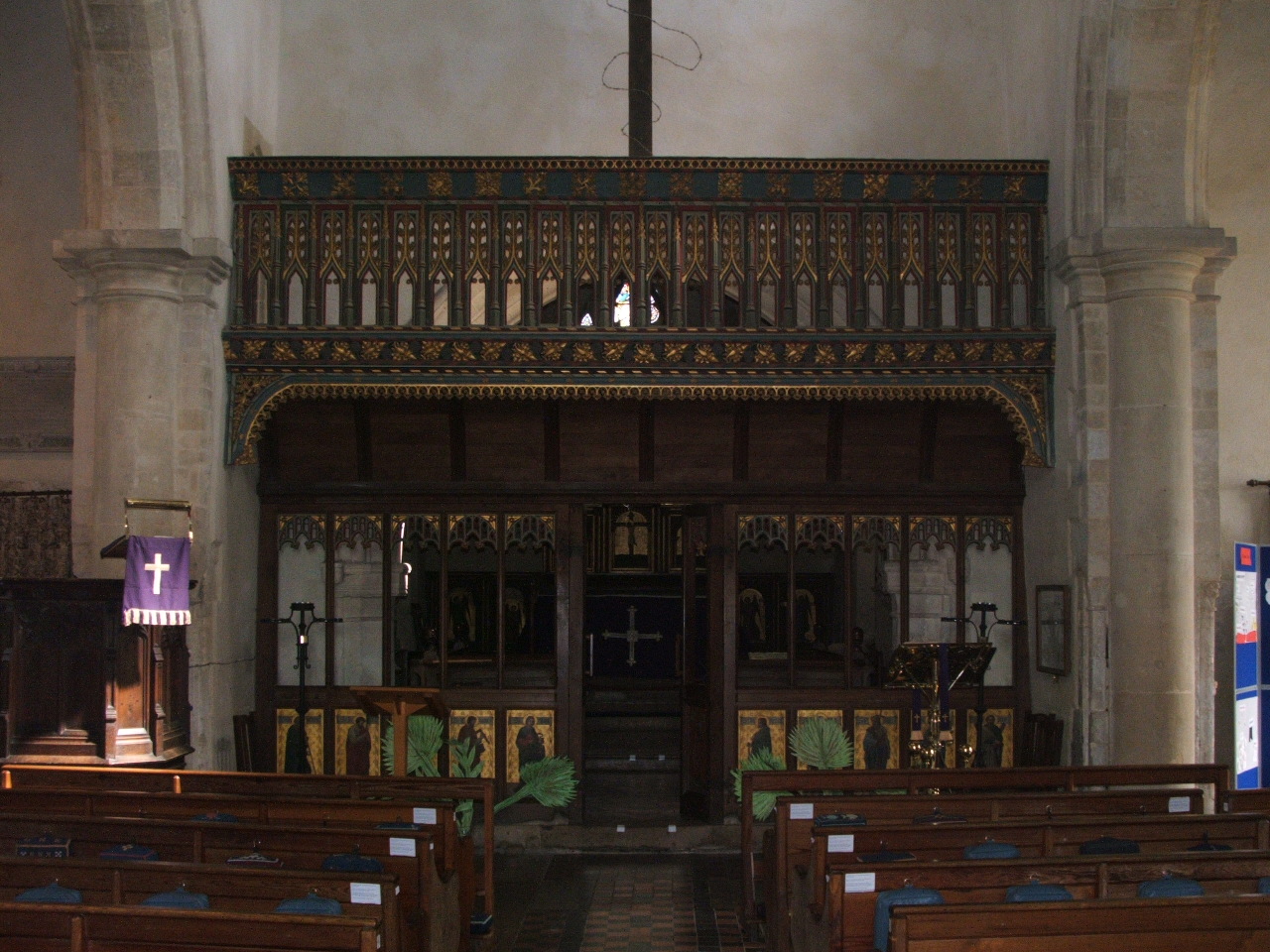
The magnificent medieval rood screen in Avebury - a barrier between God and the laity in medieval times.
Thankfully the thinking that erected these screens is now a distant memory and we have returned to welcoming all comers, lay and clergy alike into the presence of God. Of course, it is, and always will be, a moot point as to where one can or will encounter God - since it is He who determines the place and any effort on our part to confine Him or His Holy Spirit is doomed to failure. Theses screens are now curiosities, they make some of these beautiful old churches very difficult to use - and they serve as a reminder of just how little we really understand God or His sacred purpose.
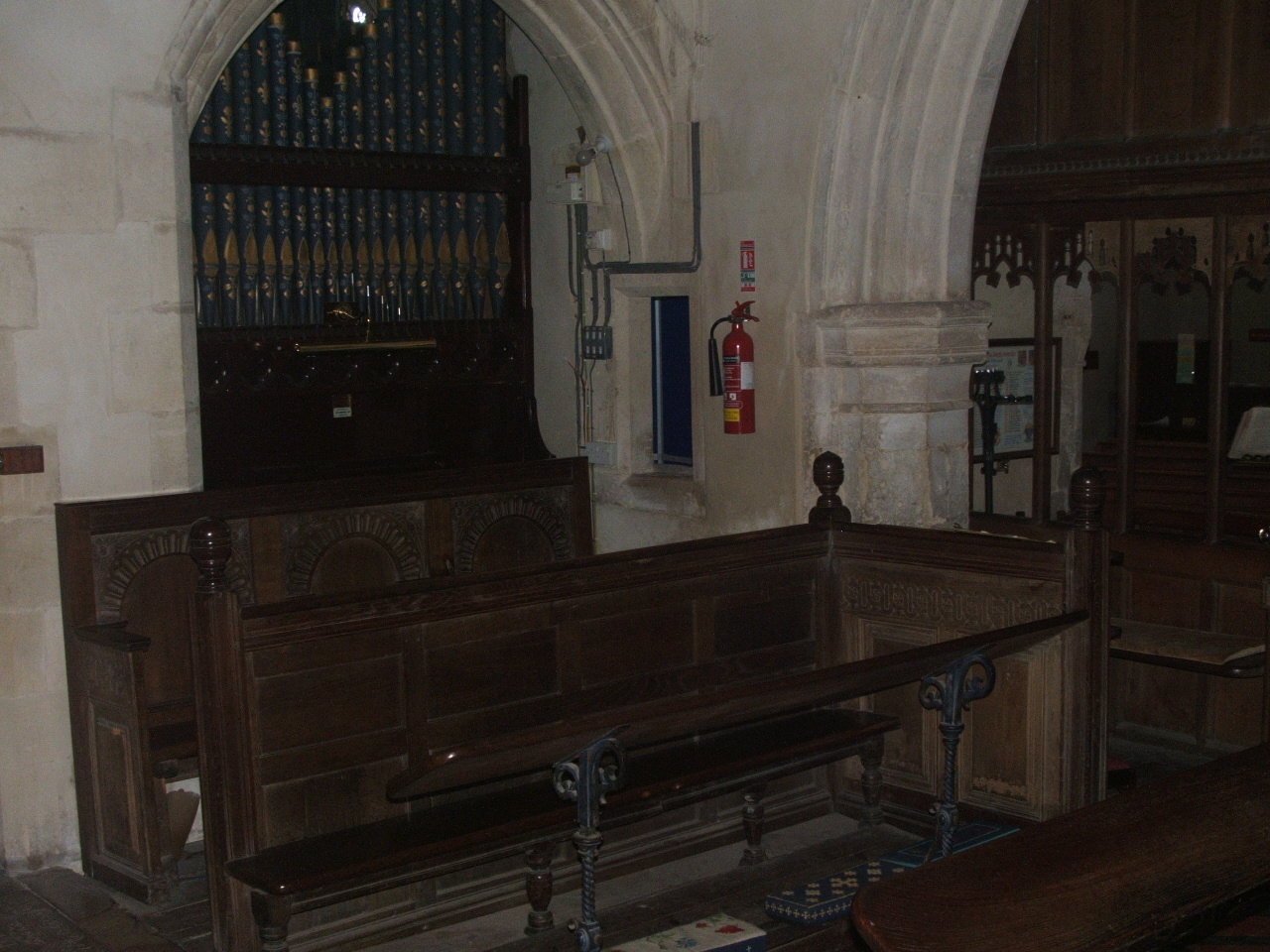
Beyond the Rood Screen tucked into an ancient chapel is this beautiful little organ with it's decorated pipes - note too the "collegiate" seating on the right of the picture for the clergy with their backs to the congregation!
Once all our churches were divided by these screens, some still exist in cathedrals, but the vast majority have been destroyed and while we may regret the loss of some of our history in the process, we can only rejoice in the fact that their passing signalled the realisation that God cannot be confined and that it is the whole people of God that makes up a congregation - not just the clergy!
Praise the Lord for that!
Posted by The Gray Monk at 10:03 PM | TrackBack
May 01, 2006
The light shines in the darkness.....
In this case the reflected light, but the picture neatly sums up the meaning of the passage from St John;
"the lights shines in the darkness, and the darkness comprehends it not."
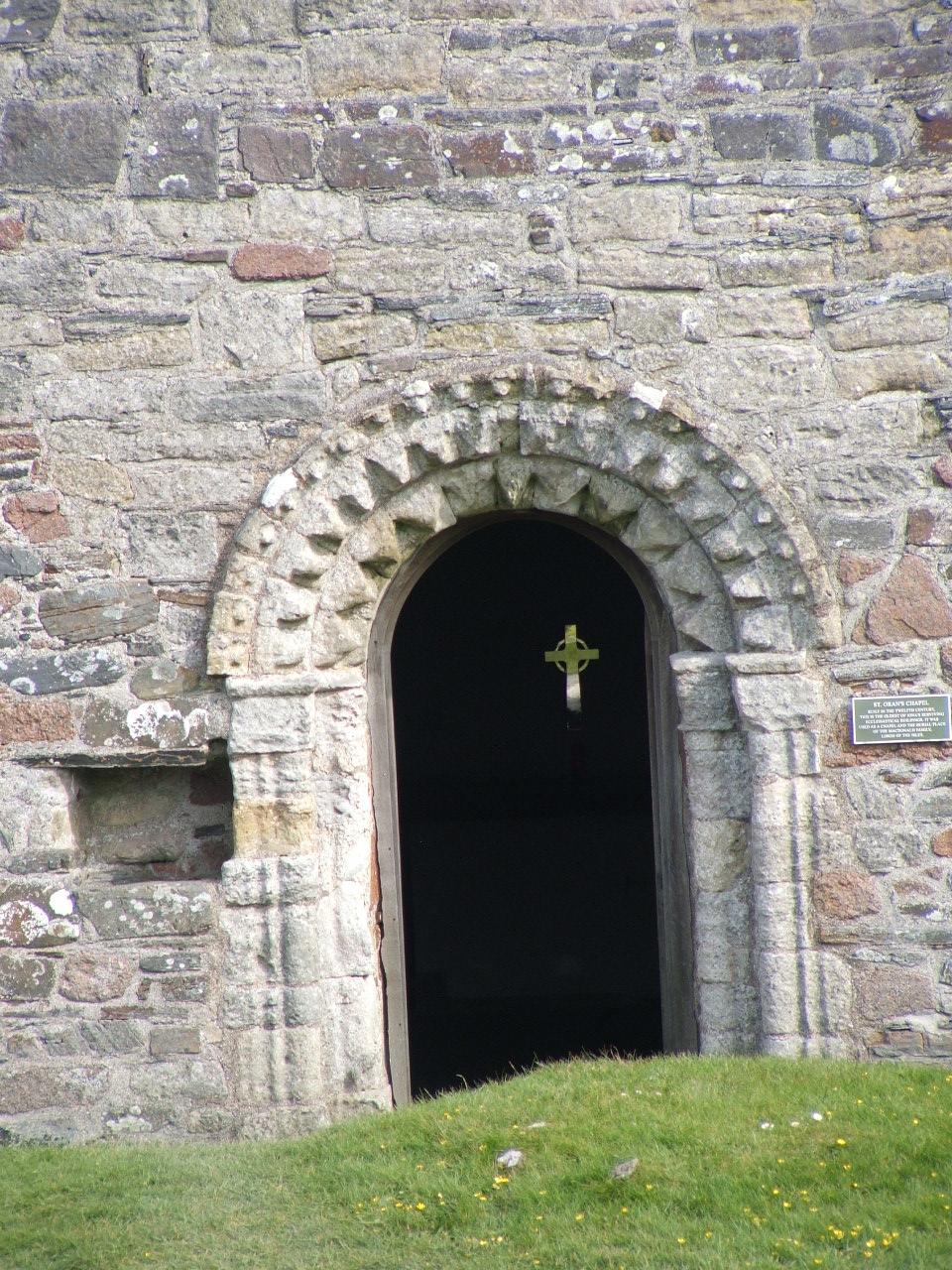
The simple cross reflecting the light through the doorway of the tiny Church in the graveyard of the Abbey on Iona.
For many this simple image of the light and dark, sums up the entire sweep of their faith, as indeed it does for me. If we truly believe that Jesus Christ is the Word of God incarnate, and therefore the light of the world, seeing Him in the simplicity and beauty of a setting like this does touch the soul. We left Iona with the feeling that the ancient Celtic Church blessing:
May the wind be always at your back,
May the sun shine always on your face,
May the road rise up to meet your feet,
May the rain fall always on your fields, and
Until we meet again,
May the Lord hold you safe in the palm of His hand.
had been bestowed on us. May His blessing be always with you.
Posted by The Gray Monk at 07:18 AM | Comments (1) | TrackBack
April 16, 2006
Christ is risen
The traditional greeting on Easter morning is "Christ is risen!" and the reply, "He is risen indeed! Allelulia!" should be shouted with joy. It is the resurrection of Christ from the tomb in which the broken body of Jesus was laid which sets Christianity apart from other faiths. It is in the resurrection that we are all made sons and daughters of God.
Those who see Christ as a prophet in a line of prophets make a fundamental error. A prophet comes to proclaim the Word of God, Christ was that Word. As the "God Bearer" - Theotokos, the Greek title of Mary His mother - Mary stands as the ultimate "prophet", the one who bore the Word into this world. The man who died upon the cross on Golgotha was no ordinary man, He was the Word of God made flesh in order to show us the way of God and to reveal God to us. His empty tomb is for us the place of the birth of hope and life beyond this one - in Him we are all dead and born again in the resurrection. His coming into the world was the ultimate moment in human history, the fulfillment of God's revelation and the milestone against which all subsequent actions must be measured.
As St John says; "The Word was made flesh and dwelt among us, and we beheld His glory, the glory of the one and only, who came from the Father, full of grace and truth."
May I wish you all a happy and blessed Easter Feast.
Christ is risen; He is risen indeed - Allelulia!
Posted by The Gray Monk at 06:45 AM | Comments (0) | TrackBack
April 15, 2006
Stations of the Cross
It is traditional at this season to perform an act of penitence and the Stations of the Cross provide the means to do this and to spend some time in meditation on the entire Easter message. My good and dear friend Ozguru has put up this link and website for those who have not the opportunity to go to a church where these can be found marked out for worshippers.
Posted by The Gray Monk at 08:47 AM | Comments (0) | TrackBack
Easter services
I think our Lord must have a terrific sense of humour. He made us, then He gave us religion ........
The Services over the Easter weekend are a complex set of liturgical events designed to focus our minds on the momentous events of Holy Week, Maundy Thursday, Good Friday and the ressurection at Easter Day. Naturally, as these are all uniques services they need pages of instructions for servers and ministers alike - and hours of rehearsal when no one else is around so that we don't mess it all up and destroy everyone else's opportunity for reflection, meditation and worship. These rehearsals can descend into farce as different groups try to blend in their actions and movements into the overall service plan. In a place like the Abbey the team is quite large and the number of tasks is proportionate. It is fortunate that the servers have a number of places where they are "out of sight" of the congregation - or the congregation would be surprised by the speed with which we sometimes have to move from one place or task to another - while the Deacon or Priest is leading prayers, reading a lesson or, as in the case of tonight, singing the Exultet!
The Server team always looks to see who is doing that as they have to get around the Abbey and light numerous candles, including those of the High Altar and the Lady Chapel Chandelier while he is doing it. Get someone who rushes it and you haven't time to get to everything and back to place - so we always pray for a slow singer and sprint like fury whenever we are out of sight! I am sure the Lord enjoys this - and occassionally throws in a wobbly, as on the occassion the Deacon turned two pages and skipped a huge section of the Exultet! Panic stations for the Serving Team!
The other bit we are always interested in preparing for carefully is the lighting of the Easter Fire at the West End. On occassion it has been known for the flames to threaten the Priest as he attempts to get a light from this to the Pascal Candle and to the Thurible for the incense. It is also not unknown for the wind to blow the candle out before we can get it indoors for the Deacon to proclaim "Behold the Light of Christ!" The congregation at large remain, fortunately, in blissful ignorance of some of the things the Servers have to do in order to ensure that we do not have an auto de feu among the Ministers, that the Paschal Candle is lit and stays that way and still manange to be everywhere we have to be in time to do whatever needs doing! Images of swans and the underwater activity spring to mind. Hence all the rehearsals - and we still have top be prepared for any little joke the Lord throws at us as well.
The last several days of services have gone extremely well - the congregations have left feeling truly uplifted and full of the Spirit, which suggests that the Servers and Ministers efforts have not been wasted and that the Lord has smiled on our poor contribution. As the serving team enjoy the first sprinkling (It's the Lord Abbot so we should get off lightly for a change!) of the new water of Baptism from the font as he asperges the church, uppermost in our minds will be the sacrifice of our Lord and Saviour - and His resurrection of hope and life of the world to come.
Amen
Posted by The Gray Monk at 08:28 AM | Comments (0) | TrackBack
April 14, 2006
Good Friday Liturgy
In a little over two hours time I will be taking part in one of the Church's most moving liturgical services. The Solemn Liturgy for Good Friday in which the veiled Crucifix is carried into the Church by a Deacon who makes four "station" as he (or she) travels from the West End to the head of the nave. At each station a part of the veil is withdrawn slowly revealing the cross and the figure suspended on it. At each station the Deacon chants "Behold the wood of the Cross, on which hung the Saviour of the World."
When the crucifix reaches the head of the Nave it is placed on a Priex Dieu and the President, Deacon, Sub Deacon and Servers kneel before it, kissing the foot of the cross in penitence and thanks giving for the great sacrifice it represents. The congregation follow while the choir sings a series of penitential psalms - almost every person who takes part in this liturgical act of worship is deeply moved by it. I can certainly say that it is one service of praise and worship which always leaves me in a spiritual state of grace tinged with sorrow, yet uplifted in a way I cannot describe adequately. Two years ago it fell to me to carry the crucifix from this position into the Quire for the choral clerks veneration and then to place it on the High Altar - it has left a permanent mark on my soul. I know exactly how Simon of Cyrene must have felt.
Once the Crucifix is placed on the altar, the consecrated elements of the Body and Blood are brought from the Lady Chapel and the congregation receive communion standing before the Cross. Then everyone leaves the sanctuary and Quire - scattering and without ceremony, just as the frightened disciples did on that very first Good Friday.
Worth pondering as we mark this solemn day.
Posted by The Gray Monk at 06:33 AM | TrackBack
April 12, 2006
Challenging philosophies.
The present debate about the provenance of the "Gospel of Judas" and its Gnostic origins has raised the question of "what is Gnosticism?" It has also raised the very real question of what do we all understand about the person of Jesus of Nazareth and how do we see the relationships between God, the World and our physical beings.
Taking one part at a time, Gnosticism arose in the 1st Century, indeed there is evidence that St John himself was involved in the original arguments and wrote his Gospel specifically to refute the arguments advanaced by a very persuasive advocate of this philosophy. Essentially the Gnostic case is that Jesus was not a man, but a God, and as such could not have suffered pain on the Cross or died. The nativity too was an illusion and the purpose of his coming was to impart "secret knowledge" to those "chosen" for "enlightenment". This is completely contrary to everything we know about the historical figure - and there is historical evidence which supports the story we have from the New Testament. Gnosticism is, in essence, a superimposition of the concepts of Plato regarding the nature of existence upon the Christian message, Plato's argument being that the world we see is but a shadow of another "real world" we see reflected around us. The Gnostic position is therefore "Dualist" in nature and separates creation into two parts - that of the physical existence we see around us, and another "realm" of purely spiritual existence bound by a different set of rules and "discorporate".
Of recent years it has made a serious comeback, particularly among those who have adapted to a "New Age" philosphy some of the teachings of the Gospels. It has seen a particular resurgence among some Christian Sects since the start of the Age of Enlightenment, in part due to the adoption, by the Protestant Reformers of a "literalistic" interpretation of Scripture. In many ways, the "Age of Enlightenment" (roughly the period from 1700 - 1900) was a counter blast to the fundamentalism that had pervaded the Protestant (and Catholic!) pulpits of that period. Martin Luther would have been appalled to see how the very things he argued against - the closed thinking and the narrow interpretations - had become the "norm" in the "reformed" churches which held sway in most of the British Isles and Northern Europe. The Bishop of Durham, Tom Wright, points this out very clearly and very much more lucidly in his book "The Challenge of Jesus". He points too, at the fact that the response to the secularism and atheism of the "Enlightenment" has led to the revival of the Gnostic ideas - people need to have a belief system and will invent or re-invent one if the latest gods and goddesses lose appeal. The Bishop's argument is one I have put before on this blog - science and religion are not in conflict, they are both a part of God's gift to us of understanding.
The second part of the debate is occassioned by the 20th Century attempts to take the historical Jesus out of the gospel and replace Him with a contemporary "visionary" and "New Age" Guru with feminist, sociological and political ideologies to impart. Through the 20th Century we have been encouraged to see Jesus as a "man born out of time", some sort of Socialist pioneer born twenty centuries too early. Nonsense! Complete and utter nonsense! To do this is to attempt to say that the universal God whom we worship is some sort of "Karl Marx in the Sky" and that the Gospel has been shaped by "Das Kapital" rather than the other way round. The historic Jesus is as important to our understanding of the Gospel as is the imperitive that we do develop our understanding of the manner in which He stands at the apogee of history. He is the centre point of all human history, everything before Him points to Him and everything after Him flows from Him. We are who and what we are in the Christian founded nations because of that historic figure and the Gospels we have proclaimed. He is not, and never was, some sort of 1st Century Che Guevarra, Lenin, Marx or any other of the many figures of human history who have tried to impose secular quasi-religious political philosophies upon humanity.
Wright argues that this is the natural result of disillusionment with the two extremes of fundamentalist Christianity (ably promoted by an atheistic media as being both the "mainstream" and "silly") and the realisation that science cannot explain everything - particularly cannot explain anything "other worldly". Even the fact that there have been a number of serious studies of "Near death experiences" by serious medical researchers suggests to me at least, that there is a desperate search for "proof" of a life beyond the grave. That is a result of the disconnection between the teachings of the historical figure of Jesus in the Gospels and the resurrection, and the introduction of the demand for "proof" required before any "scientific" theory can be accepted as gospel truth. Re-enter Gnostic dualism and the "secret knowledge" in the many guises it now assumes - New Age ritual, Wikka and even a number of "Fundamentalist Christian Sects.
One of the things I do find ironic is the rise of Masonic Orders since the Protestant Reformation with almost all their rituals being either Gnostic or their later manifestation, the Cathar practices. I also find it ironic that the most likely place to find a dualistic understanding of the creation and of the Bible is in the two extremes of Christian thinking - the Fundamentalist/Evangelical and the ultra-conservative Catholic. Equally ironic is the fact that both wings are the most vitriolically opposed to the Masonic ideas - yet gave rise to their formation.
Dualism, whether Gnostic or from some other source, is a serious problem for both science and the Church at large. Science does not accept a dualistic universe - it cannot since it breaks all the "rules" - and Christianity takes refuge in it at its peril since it is not sustained by the gospels. That was the major reason for the rejection of the Gnostic argument in the 2nd to 5th Centuries and the exclusion of much Gnostic writing from the Canon of the New Testament. Yes, it makes persuasive and interesting reading, but it remains a "mystic" dead end if studied carefully since it leads not to Christ, but away from Him.
The Bishop is right, we need to reconcile our understanding of the historical Jesus and we need to re-unite science and faith in order to restore a real understanding of the Gospels and of our faith.
Posted by The Gray Monk at 06:29 AM | TrackBack
April 10, 2006
The Gospel of Judas?
The latest brouhaha in the anti-religious press is about the so-called "Gospel of Judas" which paints Iscariot as Christ's favourite disciple and puts him in a position of "betrayer by request". An interesting proposition to say the very least, and perhaps the best example yet of an "assisted suicide". No doubt, in the absence of any political story to bump it off the front pages, it will run and run as the atheistic press try to use it to discredit the mainstream version of Christianity and it's founding fathers. Interestingly it was considered very seriously for inclusion in the canon of writings we now call the "New Testament" during the Councils of Nicea and others, but was rejected then because its provenance was suspect and it was also clearly Gnostic.
The book os Gnostic in its portrayal of Christ and in it's "Dualistic" understanding of creation - in other words it does not belong to either the Jewish or the Christian mainstream of thought on the nature of creation, the universe or of God Himself. It belongs to a collection of books known as the "Pseudepigraphica", books written at various times and attributed by their authors to people such as Nicodemus, Pontius Pilate (There is an "Acts of Pilate", which paints Pilate in a very good light!) and others both Jewish and Christian and all of them have very little provinence when studied closely. As one scholar who has studied the "Gospel of Judas" closely has said, it is a bit like finding something post Hiroshima purportedly written several centuries before the event which gives an eyewitness account of Hiroshima. The "Gospel of Judas" has several such passages which date it to much later than the first century and the early church. It may well draw upon several more authentic sources for some of its content, but the rest must be suspect, if for no other reason than that it stems from the Gnostic heresy.
The present document dates from 4th Century Egypt, and is Coptic in its origin. All it really shows is that the struggle between the mainstream understanding, founded on the Jewish and certainly adopted by the Islamic world, and Gnosticism, Docetism, Arianism and a number of other equally interesting "-isms" carried on from the early church into the late middle ages. Does this make these documents any more valid than the Biblical Canon we currently use? Certainly not, they have been rejected by scholars even in their own period - not least because the position they propose is untenable in any theology and owes more to pagan understandings than it does to the teaching of Christ Himself - or, if we want to get really controversial - Mohammed!
This new "discovery" may well shake the faith of a few waverers, but for the majority, I think it will be seen as "interesting but irrelevant". In the first place it isn't "new", scholars have been working on it for over twenty years, and in the second place the only reason it is now in the press is that the press is keen to attack Christianity and attempt to "disprove" religious belief. As I said at the beginning, nothing for the truly faithful to even get alarmed about, but, sadly, it will undoubtedly be used for malicious purposes by the many who wish to attack Christianity for whatever reason. The fact is that without Pilate, the Sanhedrin and Iscariot, there could be no cricifixion and with no crucifixion, there would have been no resurrection. The rest is immaterial.
I suspect that the only reason we even know of the existence of this "new" Gospel is that the academics need to persuade a legislature to part with some money for conservation and or further research on this or a related topic. That, and the fact that with all the policticans once more on an extended all expenses paid break, there was nothing else to make a fuss about. Pity, it could otherwise have been studied with much more objectivity than will now be possible.
Posted by The Gray Monk at 10:44 AM | Comments (1) | TrackBack
April 09, 2006
Finding faith ....
Thanks to the Anchoress, in her post entitled "Conversion is to turn 2 stories"I found this incredible piece of writing by someone searching for a faith they are comfortable with. Writing under the title of Molten Thought, the author is someone who has been born and raised in a Protestant tradition, but who, like many before and no doubt in the future, has found the spiritual fare in that tradition a little lacking in many respects. I am impressed by the amount of thought that has gone into this persons spiritual journey - not least by the careful consideration and obvious sadness with which it has been done.
There must be many others who listen to sermons such as those the writer of Molten Thought has described and wonder if this is really the message of the Gospel. As a child I too heard sermons condemning Catholics as "idolators" and, as I grew I began to question both the validity of that statement and the depth of understanding of the Gospel and its message in many such congregations. Happily I found my way to an Anglo-catholic congregation as a teenager and have happily served the Lord in like congregations ever since. It is never more true to acknowledge the saying that "every journey of a thousand miles begins with the first step" than in the context of anyone's journey in faith. The essential first step in this case is always the awakening realisation that there is a much deeper sense of faith outside of the pretty and comfortable Sunday School stories and platitudes one commonly gets in a fundamentalist understanding of the Gospel, the Bible and faith.
It is telling that a couple who regularly appear at the Abbey for Evensong and who live remote from this community, tell me that they are "Pentecostalists", but that they have not found in their own congregation, a reverence for the Word of God or its meaning to equal that shown in the Abbey.
I am of the belief that the Lord rejoices in all his children, including those who stand outside of the fold of any denomination or church, but I also believe that he rejoices even more in the efforts of those who seek to know him better and who actively seek to find understanding of his purpose. Like the Anchoress I do not necessarily seek to convert someone to my faith or my denomination, but if someone wishes to explore that path, I will certainly stand ready to assist in any way I can. It is, after all, a part of my own journey through and in faith.
The late Pope John Paul II was a great Christian and a very humble one, and, if there is one thing I hope I may share with him at journey's end it is his final words.
"All my life I have sought you, and now you come to me!"
Amen
Posted by The Gray Monk at 12:38 PM | Comments (1) | TrackBack
April 02, 2006
Recapturing faith
One thing the Christian faith needs to recapture, and recapture quickly, is the concept of a family centric faith and the inseparability of faith, work and worship. When we look about at Judaism and Islam we see faiths at work that are not centerd on worship or buildings or even necessarily on a book, but on the practice of that faith in everyday life and in every aspect of life.
Many years ago my mother worked for a Jewish owned company. The proprietors, Jewish emigre's from Eastern Europe and Germany, treated her, and the rest of our family as if we were a part of their family. We shared their celebrations and their tragedies, we went to the Synagogue at their invitation and we celebrated their Barmitzvahs. It has left me with a taste for Jewish food I will admit, and a knowledge of the laws of "Kosher" food, but most of all, it has left me with an impression of what faith in action can and should be! There does not have to be a Synagogue for a Jew to worship, he or she does so at home, with their family and in every aspect of their daily living. If there is no synagogue, it is a pity, but it is not a tragedy, it is an incovenience and it does not mean that worship ceases!
Christianity needs to rediscover this aspect, we need to re-establish the concept of worship as a family everytime we meet as a family. Look at the Jewish Shabat meal. It begins with the family gathered at the table, then the light is brought by the women of the house, prayers are said and the candles are lit. Once this is done the food is brought to the table, again by the women and the head of the household asks a blessing on the food and breaks the bread which is then shared among the participants. Once the main meal has been consumed, a cup of wine is poured and this is blessed by the boy nearest his Barmitzvah, and then shared among the table. The meal ends with another cup shared and the whole meal is an act of worship in itself. How many Christian households do this? I would suspect that, beyond saying "grace" to begin the meal, very few do more. Very few know that the whole is an act of worship once you add the prayers.
It is in the home too, and not just in the Church or the school that children in Jewish and Muslim households learn about their faith and about their holy books. Dare I suggest that, in many Christian households the Bible is something kept on a bookshelf unless one needs to look up a quotation or answer a question in a quiz, we simply do not teach it to our children - and we certainly don't discuss our faith in front of the children! Heaven forbid that we should influence them - or "brainwash" them as some of our "Educationists" term it - into believing that there might be a God or that Christianity might not be the cause of all the world's problems.
For Christianity, the problem really arose from the third century onwards as the faith came to be more and more a "ritual centric religion based on buildings and places" and so, for the vast majority of people became something divorced from the everyday. Yes, even the non-conformist churches fall into this trap, worship is too often based on a Sunday ritual of Church services followed by "Sunday" activities. And even the style and pattern of worship is a form of ritual - even where there is no "ritual", the mere fact of it's being set along certain lines makes it a ritual.
Recently I read an article by a Muslim scholar who described Christianity as being under the control of a "Priestly Caste". In a sense he is correct, yet, in the fullest meaning of the term "caste", he has it badly wrong. Our Priests are not selected by virtue of their having been born into a family of priests, far from it they are "called out of the congregation" to lead the faithful, yet, in many churches, this is the greatest stumbling block to the ministry of all the people. Its the priests job to pray, the rest of us only do it on a Sunday. In fact the vast majority of Christian Priest, Ministers or Presbyters are men and women who have heard a call from God, and undergone a rigorous selection process in order to be selected for training. They are certainly not "born to the job" and they come from all walks of life. But they are there to guide, to lead and to help us grow in faith, not to do it all for us!
Well, if we are serious about our faith, its time we changed the way we do it. The medieval concept of Church as something separate from the world of the mundane is no longer viable. Its time we brought our worship into our homes and centred faith, growth of the spirit and study of our beliefs on our homes and for every day, not just for Sunday. Church services and public worship have an important place, but it is in support of and not instead of, worship in our homes. Try it, you never know, you may find that it makes a huge difference to home and family!
Posted by The Gray Monk at 01:33 PM | TrackBack
March 30, 2006
Moderate voices of Islam
Yes, there are some out there - more than one would think, and certainly at least as many as there are Christian's who are not of a fundamentalist mindset. I recently discovered a piece on this written by The Anchoress which sets out a very clear and well thought through discussion on the question of wither Islam and the West?" She has quoted extensively from the original source, but that is good since it provides a most interesting insight into the debate that is happening inside Islam, and an even better proposal for how we can and should all help those within the Islamic fold to regain the high ground of their faith from the Ayatollahs and terrorists.
At the risk of being accused of being a "Link W***e" I will include another to a separate post which highlights the debate surrounding the Abdul Rahman saga. In case you missed it, Abdul Rahman is a convert to Christianity from Islam and currently faces execution (despite official "pardon") from his former faith because of this. Theose within Islam who feel that their religion is being turned into a monster need all the help they can get to bring to an end the sort of scene reported from Afghanistan when Mr Rahman was first placed on trial, to quote -
On Monday, hundreds of clerics, students and others chanting “Death to Christians!” marched through the northern Afghan city of Mazar-e-Sharif…
As long as the fundamentalist wing of any religion have that sort of power we are at risk of a re-introduction of totalitarianism in its worst form.
We, in the West, often argue that Islam must be reformed. To do so is to misunderstand the question and to completely misunderstand the principles of Islam. As The Anchoress has said, we may be well intentioned, but we are often acting in ignorance on this issue. What is needed is support for those who understand their faith and need to take it back from the extremists who currently have such a wide influence over it. Her original source stated -
Man has always come to the assistance of man. The Helpers of Medina to the migrants of Mecca; Indians to the Pilgrims; Ottomans to the Sephardigm; Albanian Muslims to the Jews of Europe. There are men and women in the West who wish to be of assistance to us. So what if they sometimes say things that you find offensive or incorrect. To correct them by way of friendship is much better than to sneer at them. We must judge them, not by their ancestors’ history, but by their love of the oppressed. We are clear, are we not, that there has been one too many Mukhtaran Mai? We are clear, are we not, that there has been one too many tyranny? We are clear, are we not, that there has been one too many Bin Laden? One too many 9/11, 3/11, 7/7, and Aksari Shrine and Shia massacre and Baha’i jailing and Jew-baiting. One too many Bamiyan Buddhas. One too many novelists accused. One too many suicides.
A sentiment I am very much in accord with. Blood has always called out for blood, so any bloodshed will simply lead to yet more bloodshed. Surely we, as Christians can understand that? Look only to our own "Reformation" which saw Catholics burning Protestants and Protestants burning Catholics, witches and anyone else who disagreed with whatever they felt was the "true" path. No one wants to see a repeat of this sort of approach, least of all in a region renowned for its volatility! Islamic fundamentalism is currently a problem for Islam in much the same way that the Inquisition was a problem for all Christians in the 15th to 18th Centuries. It was eventually put out of business by the rise of moderate voices and the realisation that our Gospel preached something very different to what the Inquisition was doing. So with Islam, there are voices and minds that are much more "enlightened" and "moderate" and they deserve our help in reclaiming their faith from the men of political ambition and violence who use it as a weapon in a war about power and wealth and which has nothing whatesoever to do with faith or religion at all.
Three cheers for a voice of moderation, now let's see what we can offer to help them!
Posted by The Gray Monk at 09:00 AM | Comments (2) | TrackBack
March 26, 2006
Talking to God ....
Many of us ramble through the Lord's Prayer daily, sometimes more than once a day and I often catch myself saying the words with my mind actually elsewhere! I thought about this recently when a friend sent me the item I have shoved into the extended post below - a conversation with God based around the Lord's Prayer. It is quite light hearted but there is a serious message underlying it.
Do we really think about what we pray for? Do we actually expect God to listen - or, indeed, to answer?
I think most of us would be seriously afraid if we did hear His voice filling our minds and our ears - and society would almost certainly send round the men in white coats to take you away - but God does listen and he does answer - and sometimes, in the stillness He speaks to us as well. Perhaps the simple answer to the age old conundrum posed by the challenge that to follow Christ we must become as children does not mean that we must be childish in our beliefs and expectations of God, but that we must accept, as a child does, that He will give us all the we need - which may not necessarily be all that we want.
We need to, to remember that it is a two way street. A conversation with God. Do we show Him the courtesy of listening to His comments? We should.
Our Father Who Art In Heaven.
Yes?
Don't interrupt me. I'm praying.
But -- you called ME!
Called you? No, I didn't call you. I'm praying.
Our Father who art in Heaven.....
There -- you did it again!
Did what?
Called ME.
You said,
"Our Father who art in Heaven" Well, here I am. What's on your mind?
But I didn't mean anything by it. I was, you know, just saying my prayers for the day. I always say the Lord's Prayer. It makes me feel good, kind of like fulfilling a duty.
Well, all right. Go on.
Okay, Hallowed be thy name .
Hold it right there. What do you mean by that?
By what?
By "Hallowed be thy name"?
It means, it means . . good grief, I don't know what it means. How in the world should I know? It's just a part of the prayer. By the way, what does it mean?
It means honoured, holy, wonderful.
Hey, that makes sense.
I never thought about what 'hallowed' meant before. Thanks.
Thy Kingdom come,
Thy will be done,
on earth as it is in Heaven.
Do you really mean that?
Sure, why not?
What are you doing about it?
Doing? Why, nothing, I guess. I just think it would be kind of neat if you got control, of everything down here like you have up there. We're kinda in a mess down here you know.
Yes, I know; but, have I got control of you?
Well, I go to church.
That isn't what I asked you. What about your bad temper? You've really got a problem there, you know. And then there's the way you spend your money -- all on yourself. And what about the kind of books you read?
Now hold on just a minute! Stop picking on me! I'm just as good as some of the rest of those people at church!
Excuse ME. I thought you were praying for my will to be done.If that is to happen, it will have to start with the ones who are praying for it. Like you -- for example.
Oh, all right. I guess I do have some hang-ups.Now that you mention it, I could probably name some others.
So could I.
I haven't thought about it very much until now, but I really would like to cut out some of those things. I would like to, you know, be really free.
Good. Now we're getting somewhere.We'll work together -- You and I. I'm proud of You.
Look, Lord, if you don't mind, I need to finish here. This is taking a lot longer than it usually does.
Give us this day, our daily bread.
You need to cut out the bread. You're overweight as it is.
Hey, wait a minute! What is this? Here I was doing my religious duty, and all of a sudden you break in and remind me of all my hang-ups.
Praying is a dangerous thing. You just might get what you ask for.
Remember, you called ME -- and here I am. It's too late to stop now.
Keep praying. ( . . pause . . ) Well, go on.
I'm scared to.
Scared? Of what?
I know what you'll say.
Try ME.
Forgive us our sins, as we forgive those who sin against us.
What about Ann?
See? I knew it!
I knew you would bring her up! Why, Lord, she's told lies about me, spread stories. She never paid back the money she owes me. I've sworn to get even with her!
But -- your prayer -- What about your prayer?
I didn't -- mean it.
Well, at least you're honest.
But, it's quite a load carrying around all that bitterness
and resentment isn't it?
Yes, but I'll feel better as soon as I get even with her.
No, you won't feel any better.
You'll feel worse. Revenge isn't sweet. You know how unhappy you are -- Well, I can change that.
You can? How?
Forgive Ann.
Then, I'll forgive you; And the hate and the sin, will be Ann's problem -- not yours. You will have settled the problem as far as you are concerned.
Oh, you know, you're right. You always are. And more than I want revenge, I want to be right with You . . (sigh). All right . all right . . I forgive her.
There now! Wonderful! How do you feel?
Hmmmm. Well, not bad. Not bad at all! In fact, I feel pretty great!
You know, I don't think I'll go to bed uptight tonight. I haven't been getting much rest, you know.
Yeah, I know. But, you're not through with your prayer are you? Go on.
Oh, all right.
And lead us not into temptation,
but deliver us from evil.
Good! Good! I'll do that. Just don't put yourself in a place where you can be tempted.
What do you mean by that?
You know what I mean.
Yeah. I know.
Okay. Go ahead. Finish your prayer.
For Thine is the kingdom,
and the power,
and the glory forever.
Amen.
Do you know what would bring me glory -- What would really make me happy?
No, but I'd like to know. I want to please you now. I've really made a mess of things.I want to truly follow you. I can see now how great that would be. So, tell me . . .
How do I make you happy?
YOU just did.
Posted by The Gray Monk at 11:05 AM | TrackBack
March 19, 2006
Sunday thoughts ....
My new "ministry" as Church Warden has meant that, over the last year, I have not had that much opportunity to preach. This Sunday is, however, and exception to that and I have some interesting readings to work with! Exodus, the giving of the Ten Commandments, St Paul to the Corinthians on the "foolishness of God" and from St John's Gospel, Jesus in the Temple predicting that he will rise again in three days. Find a link in that!
My final effort can be found in the extended post below!
+ May the words in my mouth,
on my lips,
and in my heart
be inspired by the Holy Spirit
Amen
“I am the Lord your God, you shall have no other Gods but me.”
Our lessons today give us an interesting insight into how God has interacted with His people across the ages. In Exodus, we hear of the giving of the Ten Commandments, the foundation of our legal system today – and the foundation of many others. In Corinthians we hear of the “foolishness” of God and how even God’s foolishness exceeds all the wisdom of creation – His creation. And in our Gospel reading we hear how Christ overthrew the money changers and expelled them from the temple, cleansing the Temple in preparation for His death, and resurrection.
John’s gospel places this story right at the beginning of the ministry of Jesus and identifies it with the celebration of the Passover. Clearly it was an incident that lodged firmly in John’s mind at least for he says
“Destroy this temple and I will raise it again in three days.”
To which his hearers respond in anger and shock, after all, at this time the temple had been undergoing construction – a bit like the Abbey it seems – for forty six years and was still not fully completed. Jesus is, of course, referring to the resurrection to come and not to the physical task of constructing the Temple – a point not understood by his hearers until after his passion according to John’s account. Looking at the gospel we have today read, you do not find the account of the Passion until you reach Chapter 18, so John is here trying to give his readers an indication of the Godhead of Christ at an early point in the initial ministry.
So what of the “foolishness of God”?
To the many who heard and followed Christ on his journey through ministry and to the cross and death on a barren hill, much of his teaching must have seemed interesting, but not terribly practical. A problem we face today as we try to apply the Gospel principles in a world that imposes secularism on faith, ignores the concept of the Sabbath and insists on making every day a working day so that the “shareholders” can be rewarded by profits and which strives to divorce the concepts of morality, justice and forgiveness from the divine and make them functions subject to human foible. Jesus spoke to a world like ours, multi-cultural, multi-faith and ruled by a secular government. His message of salvation was probably not what his hearers expected or wanted – after all the Messiah was supposed to be the son of the greatest Jewish King – David. Surely he should at the very least have come among them to impose a new religious purity, a rule of religious law and perhaps even a purely Jewish and religiously inspired earthly government. But instead, He chose to die upon a cross, at the hands of foreigners, so that all might have life and have it more abundantly. Foolishness indeed, to expect to conquer the Roman oppressor by allowing them to crucify the messenger!
Yet that is precisely what John and Paul are telling us He came to do, and the triumph that arose from the empty tomb is the essence of our faith and hope in Christ. Foolishness indeed.
To the world death is an enemy, to the Christian it is the gate to life – God’s weakness as Paul describes it, becomes God’s greatest strength.
“For the foolishness of God is wiser than man’s wisdom, and the weakness of God is stronger than man’s strength.”
Lent is a time of expectation and preparation. We go forward in the expectation of the celebration of Easter, and we go forward preparing ourselves for the ministry ahead as Christ did in the wilderness. Thos who have walked in a wilderness will know that they are never empty, there are always sounds, always bushes or scrub, there are scents, of heat, of dry vegetation, of animals that have been. Insects buzz, the wind sighs – in many ways a good place to listen to God in the silences between the sound, and in the silence within our own hearts. Seek the wilderness and the wild places and do not be afraid of what you may encounter, strength and understanding arise from making the space and the time to go there and to try to hear what God is saying in the stillness and quiet.
St John tells us that Jesus “did not need man’s testimony about man, for he knew what was in man.”
In preparing for Easter, we need to ensure that we have those things in our hearts, minds and lives which are acceptable to God and do not shut out the sacrifice of Christ or the inspiration of the Holy Spirit. If God’s foolishness exceeds our wisdom, how can we not follow where He leads us?
He has given us the Law, he gave us the prophets, and finally he gave us himself. Can we, dare we, refuse so rich a gift?
Amen.
Posted by The Gray Monk at 08:00 AM | Comments (0) | TrackBack
March 18, 2006
St Patrick for Ireland
Yesterday was the Feast of St Patrick and those in New York, Sydney and a number of other cities with large populations who associate themselves most closely with the country he converted to Christianity, will have enjoyed a huge "bash" and probably have woken today to a bit of a hangover!
Saint Patrick (or Padraig, Petroc and several other variants!) must have been a very interesting and forceful man in many ways. Legends tell us that he cursed all manner of people and things, from the tips of bullrushes (as a hayfever sufferer I do that regularly!) to snakes and other men and animals. Even some of the Kings were not proof against his wrath if the legends are to be believed. In fact, the legends make him out to be an almost fearsome figure, storming about the land smiting, cursing and seemingly always in a foul mood! Yet, these legends hardly accord with a man who has left such an indelible mark and whose contempories and disciples regarded with such affection and awe.
In recent years almost everyone from John O'Groats to Land's End has tried to establish a claim to be his birthplace and we do know quite a bit about his early life from various sources, but primarily from the two surviving documents that can authentically be traced to him and his authorship - the "Confessio" and his letter to the Welsh King Caratacus. Born of well to do Christian parents, his grandfather a priest and his father a deacon, the young Patrick seems to have been a bit of a rebel. Captured in his early teens, presumably while being somewhere or doing something he should not have been/done, he was carried off to Ireland and sold into slavery somewhere in the North Western corner of the island. His journey into faith and to becoming possibly the most successful missionary in the Western hemisphere, makes a fascinating study.
His successful escape from his slavery was largely due to his ability to work with and control the fierce dogs Ireland then exported to Europe as guard dogs - the huge Irish Wolfhounds of antiquity. Hounds which had a man killing reputation and which could take down wolves and defend any estate extremely effectively. The Vikings used them, the Gauls used them and they were even used in Byzantium and Rome itself.
He was not the church's first choice as missionary Bishop, in his own words, being "most unlearned". The Holy See wanted someone with a less colourful and more learned background as it's ambassador to the Irish. However, the first missionary selected went and came swiftly back, opening the way for Patrick. He wasn't universally welcomed, indeed, many of Ireland's "Kings" made life very tough for him, but his sheer doggedness and his unfailing acceptance of whatever they did to him, threw at him and to his followers intrigued them, and eventually won their grudging admiration and finally their hearts. It certainly left a mark on the nation and his legacy is with us still.
One does wonder though, what the Saint himself would have thought of the binges that usually mark his feast day outside of the island nation he won so surely for Christ.
Posted by The Gray Monk at 07:21 AM | Comments (0) | TrackBack
March 05, 2006
What does a priest do?
I have just completed a paper on the role of a priest in the modern church. It has certainly been interesting, but it has also been a challenge. The challenge has been to write, in only two thousand words, a summary of the role. The problem with that is that the role is so huge and so wide that it is almsot impossible to achieve.
The task required the use of a limited range of source books, yet even here, the first thing that became clear was the consensus also contained a divergence of opinion in the sense that the individual authors all brought their own perspective of particular aspects. I started before Christmas, and have only just finished the reading, digesting and finally putting my own thoughts on paper.
If you want to read these they are in the extended post below.
Job or Vocation?
In a secular world there is a temptation, indeed a deep perception among many, sadly including some churchgoers, that the “Vicar” is simply a matter of someone choosing to enter that role as a form of employment. Few in today’s society understand the concept of feeling a “call” to perform a particular role or function, and fewer still would associate such a call with their chosen careers or professions.
Sadly, many today see the Vicar, Rector or Priest in Charge as the person who “manages” the local Parish Church, wears some strange outfits on occasions and is “on call” for funerals, marriages and baptisms when required. It is equally true to say that, as the perceived status of the Church has declined, in line with the decline in practicing faith and attendance at public worship, so the value of someone’s feeling a need to spend time in prayer or at worship is also no longer perceived as either necessary or good by those outside the Church. There is equally a feeling that it is an anachronism, a symbol of a dying faith, useful on occasions, but not particularly profitable or practical.
This misunderstanding ignores the fact that the role is a scriptural one in the sense that it follows on from a long tradition of God calling people out to be His especial servants, to act as leaders in worship, as “pray-ers”, as absolvers, as reconcilers and as theologians (Ramsey. M; The Christian Priest Today). This theme is the principle thrust of Brown and Cocksworth’s work as they expand this stating that the priest is for Worship, the Word, Prayer, Reconciliation, Holiness and Blessing. Unfortunately, in today’s world, this is often forgotten amidst the demands of legal duties, “managing” the Parish resources and the ministries of the laity.
Clearly, such a person is not found in a Job Centre (although he or she might be if God is calling them and they hear the call!), but is called out by God and once satisfied that the call is a call to the ordained ministry, must then be prepared to put this to the test, to undergo training and to accept the discipline that it requires. As Brown and Cocksworth’s treatise clearly shows, the priestly role is a vocation, and a very demanding one.
Called out of the congregation
Clearly the “Call” and the response is likely to be almost as individual as the people called. As the Gospel says, “Many are called; few are chosen”, and if for no other reason each “call” needs to be tested to determine the ministry and the gifts the individual brings or offers. Since the priest is called to be a leader or “elder” in the congregation – presbyteroi may be translated to mean either – it follows that this person must also be in possession of the qualities to be a minister, reconciler, healer (in the spiritual sense) and leader.
In one sense, as Brown and Cocksworth point out, the one called is one “called out of the congregation, to become the parent of the congregation”. This would certainly appear to be the understanding attached to this process of “calling” and of “ordination” in the surviving examples of ordination ritual from the Early Church. It is still very much the understanding of the modern church, in that the priest is one who has accepted God’s call to undertake a role which calls for acceptance of a role which requires the person to live as a vessel for the Holy Spirit, able to reconcile factions, provide absolution, interpret the Word of God, bring comfort to the sick, the dying and the bereaved.
The ordination rite of Hyppolytus makes the relationship between priest and people clear in the declaration required of the people in response to the question: “Do you choose …. “ and the congregation is required to respond with the words “We choose him!” In this model the “Presbyter” needs the people in order to be a presbyter, and the people likewise need the presbyter in order to be the people of God.
Leader, disciple and living the Word
The book “Ministry in Three Dimensions” (Steven Croft: Ministry in three dimensions; 2005 Darton, Longman and Todd) describes the ordained ministry as “Charismatic”, thereby suggesting that it is an outgoing and empowering ministry of the Spirit. This is not to suggest that the priestly ministry is recognised by it’s being engaged in some of the more extreme expressions of worship associated with the term (in recent years) “Charismatic, but rather that it is a ministry enabled, lead and driven by the Holy Spirit throughout. It is in the charismatic expression of the spirit that the priest, deacon and Bishop all exercise the ministry of Christ in the congregations.
The ancient understanding of the role of the “Presbyteroi”, the Diakonia and the Episcope was that these were individuals “called out of their congregations by the Holy Spirit” to exercise leadership, demonstrate Holiness and to be teachers and livers of the Word of God. It is in this spirit that St Paul writes to the Ephesians saying that though he suffers from some un-named infirmity, the Holy Spirit uses that very infirmity to demonstrate God’s power. Likewise he writes to Timothy saying that he should rely on the Spirit to sustain and strengthen him for the task of ministry. Those called are, according to Brown and Cocksworth, called to:
• Be for the “other”,
• To be for God,
• To be for discipleship,
• To be lead worship,
• To preside at the Eucharist,
• To be for the Word,
• To be messengers of the Word,
• To listen to the “world”,
• To be men and women of prayer, and
• To reap the fruits of holiness.
There is, however, a secular dimension which intrudes upon this, in that the modern priest is also responsible for a number of legally imposed duties which include the running of the parish in a manner that ensures it’s solvency!
Examining the somewhat crude “list” above in a little more detail, one soon discovers that the modern priest is, in common with his historic counterpart in the early church’s presbyters, a person who must fulfil a number of interdependent and yet, sometimes contradictory roles. He or she must be a conciliator, a worshipper and a leader of worship, a bringer of absolution and a penitent, a bringer of the Word, and it’s upholder. As Ramsey says in “The Christian Priest Today” (Ramsey M: The Christian Priest Today; 1985 SPCK, London.) the priest is called to be both the preacher of the Gospel truth and the ready ear of the penitent for whom absolution should be given.
It is clear that, in order to preach and to teach the word of God in the modern world, indeed, in order to make it relevant to the receivers of that word, the priest must interact with the lives and the world in which his hearers live. They cannot be divorced from the reality of the lives of those to whom he or she is called to minister. Thus too, in preaching the word of God to a congregation it must draw upon the realities of their lives, yet retain the essence and the hope to which God calls us.
Leadership and discipleship are uneasy partners, yet there are times when the disciple must be the leader. In the case of the priest, their discipleship is to Christ and his Earthly representation in the Church, Apostolic and Catholick. Yet, in their own Parish, it is the priest who is charged with the Cure of Souls and is by both calling and statute the “leader” of the Parish.
Spiritual dimensions
Above all, the priest is called to be “the man (or woman) of prayer” in the community. In this they need to be diligent, to use the resources available to them and to encourage others by their own example. Prayer may be achieved in several ways as Ramsey, Dewar, Donovan and Brown and Cocksworth remind us. It is present in action as well as thought, and again needs to be a reflection of the realities of those prayed for.
St Paul reminds us frequently that the Spirit imparts many gifts to different individuals and within any congregation this soon becomes apparent as these are discerned and exercised on behalf of others. It falls to the priest to assist all those given to his or her care, to develop these and to “grow in the Spirit”. Thus, the priest is an “enabler” as well as a “leader” in the congregation. This must surely be one of the most rewarding and frustrating aspects of priestly ministry, in that while some are eager to grow spiritually, others hold back out of fear, uncertainty or simply because, comfortable where they are, they do not wish to grow.
It is in exercising the ministry of reconciliation that the priest’s true test may arise, for, in any community, there will always be jealousies, tensions and disagreements. In holding these together and in steering them towards a harmony there are many pitfalls, yet, in the fullness of the Spirit and in exercising what Brown and Cocksworth refer to as the “Fruits of the Spirit”, much may be achieved in bringing people together. In some sense this is related to the “People of prayer” calling since reconciliation involves a great deal of prayer, empathy and understanding.
As a person of prayer the priest is called to pray in several ways, including the Daily Offices, the Special Offices, The Eucharist, in private prayer and in action. The liturgy provides a framework for public prayer, but even private prayer needs structure and a certain amount of direction. Thanksgiving, praise, intercession are all part of the cycle of prayer the priest is called to exercise daily, yet, simply visiting the sick and spending a few minutes with the dying or the bereaved, even when words fail, may be considered a form of prayer.
In being a “person of holiness” it is important that we recognise that the priest is also human and suffers the same weaknesses, yet, in the power of the Holy Spirit is also able to exhibit the characteristics of holiness. As the current Archbishop of Canterbury is on record as saying, holiness is not static, but ecstatic! In living as someone under the Holy Spirit, the priest is called to practice the Word, to show the fruits of the spirit and the joy of living in the spirit. They can only do this if they are indeed committed to the life of the Spirit.
Preaching is an important task, albeit one now shared with many in “lay” ministries licensed by the Bishop. Again the preacher needs to connect with both their own life and experience and that of those to whom they preach. The example of George Herbert, John Donne, Cardinal Newman in using the Biblical text and connecting this to the reality of the world they spoke to, is a sound example of reaching out to illuminate the Word and inspire the hearer. Donne’s famous sermon which includes the words “send not to ask for whom the bell tolls, it tolls for thee” is a good example of the manner in which theology can be rendered more easily understood by a congregation in the way it connects the death of one to the life of all. Herbert’s hymns and poems are further examples of the transfer of Biblical thought to vernacular understanding. A good preacher must always be able to connect to the lives of the hearers; no point is served in praising the joys of a succulent banquet to a congregation of anorexics!
Secular dimensions
As in so many areas there is also a secular dimension to the priestly calling in the modern world – indeed it is difficult to imagine that there was ever a time when it could be completely ignored. The modern priest has many legal responsibilities within a parish and, in some cases, is almost the “General Manager” of a corporate operation, yet, in the exercise of these powers and duties it is the priestly traits and values which must guide the secular actions. Here, as in all matters to do with the priesthood, the priest must show the same holiness, reconciliation, prayerfulness and resolution of the Word and Spirit as in all else. In some larger churches and congregations he is also an "employer" as he heads the Parish and employs on their behalf the gardeners, cleaners and vergers.
Concluding thoughts
In conclusion, reading the five source books I have used for this exercise, I am left with the overwhelming conclusion that the priestly role is a complex mix, encompassing several important aspects of the Gospel, our faith as we have received it and our response to the world. Clearly the priest must be all of the following:
• Called out of the congregation,
• Called to be for God,
• Called to be an Absolver,
• Called to be for the Word of God,
• Called to be a man or woman of prayer,
• Called to be a conciliator,
• Called to be a worshipper and a leader of worship, in short
• Called to be a disciple of Christ.
It is important to recognise that it is in the exercise of the gifts the spirit bestows upon those He calls, that the individual’s weaknesses and failings may be made strengths. It is in operating within the community that is served, in “getting alongside” the people of a community that the priest is best able to fulfil the role of intercessor, liturgical leader and “holy man of God”. It is in responding to the needs of people for hearing the Word of God, in being reconciled to God, in worshipping God and in seeking to find God and to grow in the Spiritual gifts of God that the priestly role is enlarged and fulfilled.
The priest clearly has roles which are also definable as “tasks” and these include:
• Presiding at the Eucharist,
• Pastoral care of the souls in his charge,
• Preaching the Word of God,
• Leading the people in public and private prayer,
• Bringing hope and comfort to the sick, the distressed and the bereaved, and
• Enabling the development of gifts and ministries within the congregation.
The distinction made in the New Testament between the congregations and the presbyteroi, diakonia and episcope are still valid and still provide a distinct and important role for those called to leadership in any congregation.
Clearly the priest is called to be the “man of prayer, the man of the Word and the man of reconciliation” in the footsteps of the disciples and of Christ Himself. As the Byzantine ordinal indicated the priest is to be:
• The proclaimer of the Gospel,
• The exerciser of the Sacred Ministry,
• An offerer of Spiritual Gifts, and
• A renewer of the people by baptism regeneration.
A challenging role indeed, one that is dependent upon the heavenly grace bestowed by the Holy Spirit and by the support and encouragement of the faithful.
Bibliography
Brown R and Cocksworth C; On being a priest today; 2002, Cowley Publications.
Croft S; Ministry in three dimensions; 2005 Darton, Longman and Todd
Ramsey M; The Christian Priest Today; 2001 SPCK
Dewar F; Called or collared; 2000 SPCK
Posted by The Gray Monk at 08:04 AM | Comments (1) | TrackBack
March 01, 2006
Ash Wednesday
Ash Wednesday is a Mass of Obligation for those of us of a "Catholic" persuasion. It is the day we start our "fast" with the imposition of ashes on our foreheads and communion to start our fast. In the earliest days of the church many penitents would not only cover their head's in ashes, but wear sackclothe as a sign of their penitential state - a custom much in vogue in the High Middle Ages as well.
The season is primarily about preparing for the celebration of Easter and all that the resurrection promises. It is an opportunity to consider all that we have not done that we should have done, or done that we should not have done over the previous year. As we mark our Lord's own forty days in the wilderness, we should seek to explore our own ministry and growth - and find ways to advance it. The original Lenten Fast involved Prayer and Fasting, but for many of us in this day and age neither is completely practical, time is simply to constrained. So many of us now simply "give up" some small token for Lent, and some of us "take up" something as well.
This year I have much to consider as I prepare for Easter. This Lent could prove to be something of a watershed in my career, in ministry and for my future direction. Your prayers would be most welcome.
Posted by The Gray Monk at 10:21 PM | Comments (1) | TrackBack
St David's Day - Feast or Fast, now that is the question!
St David, the Patron Saint of Wales, is commemorated today by many, but it does, as a feast, conflict with the marking of Ash Wednesday, the start of the season of Fasting! The normal means of dealing with this in the Church's manner is to simply "move the feast" so that it can be celebrated by the faithful without the problem of having to break their fast for Lent. In our increasingly secular world, however, we find that the commercial and media interests just ignore the start of Lent and go for what makes them some money - a national Saint's Day!
This date is also "celebrated" as the "official" first day of Spring, which, considering that it snowed yesterday, then rained, then blew a near gale - and today we have forecasts for severe weather in the Northern half of the country - is something of a joke. To me it is yet another example of ignorant politicians and bureaucrats sticking their grubby fingers into matters they do not understand in order to increase their "control" over our lives. You cannot "order" the seasons to follow a set pattern any more than we can control the weather or any other part of our natural cycle. Weather patterns change, cycles change, and we have little influence over it.
In the days in which the Saint we commemorate as David brought Christianity to the people of Wales, humanity was much more inclined to live in a state that accepted the natural rhythmn, inconvenient though it was. Planting took place after the farmers had themselves determined that the seasons were changing and not at the dictat of some "guidance" from another part of the country altogether. Mind you, the sensible farmers still do, after all, they know their own land, and the local cycles and conditions far better than someone in an office in Whitehall ever will.
Our modern lives demand that we eat three times a day, that we eat a balanced diet, that we have variety in our meals - that we have available to us many fruits that are not native to these shores, or completely out of season for most of our year. The modern diet comprises meat, fish, poultry, root vegetables, leaf vegetables and fruit in a plenty virtually unknown in many parts of the world - even those that grow most of what we eat! So, perhaps this is what we should focus on as we go into Lent this year, considering as our focus for Lent, "who is going hungry so that I can eat as well as I do?"
In St David's time the seasons held an importance beyond our understanding of them today. Today they are little more than an inconvenience, it's cold and wet, when we long for the sun, or hot a dry when we long for rain - or, if you, like me, are a hayfever sufferer, everything is pumping out allergens when I would like to enjoy the sun, the open spaces and the warmth! Even in our grandparents day (Probably best described as Before Refridgerators!) the changing seasons meant that food had to be prepared to bridge the gap between one harvest and the next, particularly the vegetables on which we depend for variety and that lovely concept "roughage" are seasonal. Potatoes had to be dried and stored in dark, dry places, onions, beetroot, cabbage, beans and several other vegetables pickled and stored in sealed jars for consumption later in the depths of winter. Many of the things we today regard as "party" food, were originally essentials if we were to have them available during the winter.
The cycle of planting, growing, reaping and storing held a vital place in all our lives - and should still. As I commented in a thought on Shrove Tuesday yesterday, The choice of timing for the Lenten Fast probably had a great deal to do with conserving one's Winter food stocks until the first of the summer fruits and vegetables became available.
So for those who choose the celebrate St David today and Lent tomorrow, or who have marked David's Feast yesterday and will keep Lent today, I would say this; as we go through Lent this year consider the source of our food, consider the people who produce it. Consider too the implications for us if that source were to be removed through famine, plague (such as Bird Flu or some other pandemic) and ask yourself this question. "Can we survive without our imported supplies, and should we not consider how we would manage if it became a necessity?"
It could be a very important question for those of us now divorced from the seasons by our reliance on the plenty of the supermarket!
Posted by The Gray Monk at 08:13 AM | Comments (0) | TrackBack
February 28, 2006
Shrove Tuesday
Ever wondered where the tradition of having pancakes (or crepes if you prefer the French version) originates? There are several explanations for it, but, being a pragmatist the one I think is probably closest to the truth is that, it being quite lkate in the winter season, flour stocks would be starting to run low. Remember that it is really only in the last two hundred years that we have been able to stockpile essential food supplies in sufficient quantities to ensure a steady supply of wheat for flour through out the year.
Making pancakes instead of bread for the next six weeks probably served a dual purpose - you were able to observe the "fast" and conserve the floiur stock in the family store.
Shrove Tuesday marks the last "ordinary" day before the beginning of Lent, a "fast" of obligation for all Christian's, although these days it is more usually a case of "giving something up" for Lent, rather than a full blown "fast". In medieval times it was common for many to forgo any meat, fish or fowl and subsist only on gruel or a diet of vegetables. Sunday's however, are "feast" days all year round, so the "fast" could be broken on a Sunday without penalty. In many countries the "fast" was observed in much the same way that a Muslim would observe Ramadan, that is by abstaining from food during the day, then eating a full meal in the evening. However it was done, it was also usual to attend the Confessional before the commencement of Lent and then to serve your penance during the fast. Hence the name of the last "ordinary" day - "Shrove" Tuesday means literally that the penitential have been "Shriven", or granted conditional absolution for their sins.
Lent, for many in this day and age, is less a "fast" and more an opportunity to do something positive, such as attend a lecture series, read a new theological book or attempt to "take up" something which benefits us and the community we work in in a positive way. Whichever way you do it, remember that it is a commemoration of Our Saviour's own fast in the desert before commencing his ministry, and that it is an opportunity to consider the implications of the final days of his ministry as we prepare to celebrate His resurrection from the tomb.
Posted by The Gray Monk at 10:43 PM | TrackBack
February 26, 2006
More thoughts on Genesis
The responses I have had from various commentators on the subject of understanding Genesis have made interesting and lively reading. I doubt we will ever agree on everything, but I think we certainly have some common ground on some of it.
There are two things that I always keep in mind when I am reading the Bible. First, that I am reading a translation, and, while I am not a Hebrew or Greek scholar, I do speak, read and write two other languages besides English and can make some progress in at least one more with the help of a dictionary, a patient speaker or a written text to read from. So I have some understanding of the difficulty of conveying the actual meaning of something from one language to another. Secondly, I am conscious of the need to understand the society and the people who wrote the original. All to often we try to associate the written word with our own understanding of society, rather than the society from whence it came. This is perhaps especially true of the Pentateuch, but it applies equally to the rest of the Bible. To truly understand it you need to understand the culture, the people and the events that wrote it, create it and gave rise to it. This is why the Islamic Faith regards any translation of the Quran as "informative, but not authentic!"
I think that what has brought this home to me more clearly than anything else, is having grown up in Africa, and having had the opportunity to observe the tribal cultures at first hand. Seeing that, and then seeing the desert tribes and cultures of the Near and Middle East certainly brought home to me the need to see much of what is written in our version of the Bible in the context of the peoples who lived it and wrote it. That is not to say that it is not God inspired, for that it certainly is, but I do say that it is interpretted and written down in the imperfect understanding of humanity and therefore may not be the entire story - after all, our lifespan is but a second in the endless time span available to God.
Does it matter to me whether a word means literally "a day" or some span of time measured in millions of years? Does it matter to me whether "Adama" - literally "Men" - and "Eva" - literally "women" - were created in one movement or at the end of a long evolutionary chain. No, it matters not one jot, because what does matter is that we are, through Jesus Christ, the adopted Children of God, redeemed through His death and Resurrection and living today in the full and glorious hope of the life everlasting.
The arguments over the apparent conflict between the geological and fossil records and the story in Genesis are an irrelevance if we believe that God tells us what is true and correct, since to argue that the fossils and the geological evidence were "created to mislead us" suggests that God is capable of lying and deceit. If that were to be true, then all of the Bible could be nothing more than an elaborate deceit - and that is not a God I am prepared to contemplate - much less worship. Scientific advances are, after all, yet another gift of God, He made us to be His companions according to Genesis and so would want us to strive to expand our horizons. Even the most arrogant among us should be prepared to admit that the more we learn, the more we discover that we have to learn. Therein, surely, lies the real purpose of science.
It is only by seeing the links between the evidnce, the scriptural accounts and by bridging the gaps with great leaps of faith that we can begin to understand the whole. To do otherwise is to remain, forever, locked in ignorance.
Posted by The Gray Monk at 09:25 PM | Comments (1) | TrackBack
February 07, 2006
Reply to KY Packrat
For some reason the MT comment blocker won't let me post this as a comment - it says it is "questionable content", so I am having to reply as a post! This isn't the first time it has happened, usually when I am trying to respond to someone, but as it won't tell me what the "questionable" content is, I cannot adjust it to beat the block! So, here goes .....
I suspect that we will never fully agree on this. I do not read Genesis in the absolute terms that you do obviously, and I think that Day 1 saw the beginnings of formation, not a firmament and fully formed planet. Also "the earth was without form" could be reconciled with the accretion disc postulated in planetary formation. Both "firmament" and "waters" have different interpretations open to them, and could as well say "elements" and "moving surface" without losing the apparent intent. Chapter 1 of the book is also, in my view, a construct, in that it ends with the creation of men and women, but Chapter 2 specifically starts with the Garden of Eden, a story found also in the infamous Ballad of Gilgamesh. (Interestingly, Romanian Gypsies argue that they are the children of these men and women and not the children of Eve - and therefore not subject to the curse on the children of Eve to work and feel pain!)
While I do not accept the literal interpretation of the beginning of this Book, I do accept the hand of God in the overall act of creation, and, just as He is for you, Jesus Christ (or if you prefer, Yeshua bar Joseph) is my saviour and Lord, the only begotten Son of God. In fact the only way to understand His position in our common faith is in the opening words of John's Gospel, "In the beginning was the Word, and the Word was with God, and the Word was God ..."
As you point out, "Yom" is a word with dual meaning, and general rules dictate that it is a specific meaning with a number, however, there are exceptions, and these were pointed out to me by a Hebrew speaker who finds our arguments over this amusing. I have not seen any of the research you refer to, I'm afraid my normal work is in the realms of the scientific, primarily forensics which means I am not normally in contact with the sort of research they appear to be doing, and I would wish to study these carefully before commenting on them. It is, however, my experience (and my disappointment) that many such researchers in the past have fallen into the trap of only including in their researches those things which support their hypothesis, something that is all too easy to do if you start from a particular viewpoint and a determination to "prove" the correctness of the view. (This applies in my discipline as well - all to often the investigator will "see" only what he or she is expecting to see or wanting to see!)
My faith is built on the simplicity of the declaration of Faith known as the Apostle's Creed and a lifetime of exploration and wonderment at the diversity and magic of the creation all around us, not on whether a piece of poetic description contained in a book gathered from several different sources is scientifically (or any other form of examination) accurate. God has worked and is working His planned Creation through any means at His disposal, that is all I have to hold in mind and sufficient for my faith.
As a Rabbi once said to me, "Science is for the things we can work out and understand; Faith is for everything else!"
Posted by The Gray Monk at 04:33 PM | Comments (2) | TrackBack
Creationism
Reading a passage from Genesis at a service recently, I was again struck by the fact that there was nothing in what I was reading which in any way conflicts with the scientific explanantion of how the Solar System, the Sun, the planets and, indeed, the universe was formed. Genesis is, after all, a poetic version of an event so vast and so magnificent in its execution that it is, even now, almost incomprehensible to anyone who has not had the opportunity to look through a telescope or study any of the "Earth Sciences", geology, geography and so on. Written probably from an oral tradition sometime around 600 - 500 BC, it is a fairly good explanation for nomads and country folk whose lives revolved around food production and the daily needs of the community. Science hardly came into it.
Another version of this story, a more scientific one, is to be found in the Apocryphal books of Enoch. It is these that St John quotes in his Gospel, particularly the opening lines of Chapter 1, "In the beginning was the Word .... (In some translations more accurately "the Deed" ...). Many minds across the ages have wrestled with the problem of reconciling the Scriptural version and the observations they were making regarding the movement of stars, planets and even the changes in the sun or the moon. The Earth itself is constantly changing so the origins of science lie in our attempts to make sense of these. Why does one side of a mountain get better rain than the other is a question which affects crop growth, and consequently why one agricultural community may thrive and another starve!
As we have learned more about our environment we have come to realise - several unsuccessful experiments in creating "Ecospheres" have certainly helped - that the world we live in is filled with symbiotic relationships, as is the entire universe. Remove any one of the pillars of any given ecosystem, and it all rapidly begins to unravel! Certain plants depend on bees for pollination, other on birds, you simply cannot remove these aspects from the system and expect it to continue in the same form. Even the dreaded and irritating mosquito has a place in the ecosphere and removing it upsets the food chain in an escalating cascade until suddenly the higher order animals are starving.
A good example is Australia's Koala Bear (incidently not a member of the Ursus or Bear family at all!) which is so specialised an eater that it eats only some of the Euchalypts and not others. In fact, with regional variation, the Koala population in one area cannot readily move to another because the Euchalypts in the new area may not provide the diet they need. We simply do not, at this stage, understand the interrelationships of all the creatures who populate this planet with us.
For me, Darwin's great work on Evolution is as much a revelation of God's work in the ongoing act of creation as is the poetry of Genesis. For it is in Darwin that we begin to see the infinite slowness and the infinite patience that is the "work in progress" of Creation as a whole. Homo Sapiens is currently the pinnacle (as far as we know - some would say it is dolphins or the orca family who are simply too intelligent to let us know it) of the creation here on this planet, but are we the final product, or a "work in progress" destined to adapt and change (as the dinosaurs have done as the ecosystem changed with the climate, ice ages and comet impacts, becoming alligators, rhinocerii, lizards and snakes) as the work progresses. I rather hope and think the latter, that we are in the process even now of evolving a higher species who may take us that one step closer to God than we are now.
The current debate among those who favour "Creationism" or "Intelligent Design" I think misses several points, the most important being that God has at His disposal infinite resources, time and space. We can only know that nothing is impossible to Him however improbable it may seem and however unlikely it may appear. He may use any method he desires to achieve His ineffable plan - and evolution is as much one of His tools as is gravity, the air and water - even the food we eat. Homo Erectus, Homo Habilis and Homo Neanderthalis have all had their place in our ascent, the next stage may already be underway and it is really exciting to think that they may even be among us now.
The poetry of Genesis expresses the understanding of creation as received by a nomadic people - a people, moreover, who understood the world to be a sphere as witnessed by the writings of ancient Egypt from whom the Israelites drew a great deal of their traditions. Our understanding of the mechanics of creation has since been expanded and we have access to sights and tools the writers of Genesis could not have dreamed of. Does this degrade any part of our faith?
Not unless you have so narrow a view and so shallow a faith, that it cannot stand up to scrutiny and review. That is a terrible shame and an indictment of our refusal to allow God to reveal Himself in anyway but those we choose. Ultimately, that path leads to dissappointment and stagnation in faith, perhaps even to loss and separation from God. Embrace all means to understanding creation and we embrace the fact that God is trying to show us the full majesty of what it all means, reject the science that enlightens and expands our knowledge and we are very much the poorer for it.
The choice is ours.
Posted by The Gray Monk at 11:58 AM | Comments (3) | TrackBack
February 05, 2006
Candlemass
Candlemass is the day on which we remember the presentation of the infant Jesus in the Temple, the day on which, as St Luke tells us, the aging Simeon and even older prophetess Anna recognised the Godhead in the infant. It is celebrated on the 2nd of February every year because this is exactly forty days after Christmas and accords with the Old Testament requirement for a woman to make an offering for purity and sin forty days after giving birth. This tradition was maintained in the Early Church where, insetad and a burnt offering, the woman presented herself and her new child for the first time following the birth in the congregation.
The 1662 Common Prayer Book of the Church of England continued this tradition and had a special service for the "Churching of Women following Childbirth". Thankfully, we have now moved on from viewing both the act of procreation in a loving relationship and the act of childbirth as being somehow "dirty" and "sinful". Instead we greet both mother and child when the parents bring the child for baptism.
Candlemass then, is, alongside the Epiphany, another feast of "revelation". Another step in the recognition of Christ as the Saviour of the World. Simeon greeted the child presented to him in the Temple with the words St Luke has given us:
"Lord, now lettest thou thy servant depart in peace; For mine eys have seen thy salvation, Which thou hast prepared before the face of all people, To be a light, to lighten the Gentiles, and to be the glory of thy people Israel."
The prophetess Anna also had something to say, words which again Luke recorded, and which tell us that this child was recognised from the start by those whom God gave to understand His purpose. As St John would later write,
"The Word was made flesh, and dwelt among us; and we beheld His glory, the glory as of the only begotten Son of the Father; Full of grace and truth."
So, as we mark the feast we pray ....
Lord God, you are the source of everlasting light. Your son, our beloved Lord Jesus was presented in the temple 40 days after his birth. He was recognised by Simeon and Anna, and welcomed as the promised Messiah. May we like them, behold the glory of the Lord Jesus. Grant that we may stand before you with hearts cleansed by your forgiving love. May we serve you all our days and make your name known as we worship you as our Lord. So may we come by your grace to eternal life . Amen.
Posted by The Gray Monk at 01:26 PM | TrackBack
February 03, 2006
When are the Scriptures not the Scriptures?
Well, according to some, it depends on whether they are "Apocryphal" or not. In fact, I have heard an Evangelical member of my own congregation declare, after reading a passage set for the lesson from the Wisdom of Solomon, that "I cannot say this is the word of the Lord because as it is from the Apocrypha, which isn't the true word of God". I almost shouted "Oh yes it is!" from my stall, but bit my tongue and had a quiet word later! I am thus interested to find a piece on this very subject at Catholic Apologetics of America.
The author of that article makes the very good point that this division arose at the Reformation when Erasmus, Calvin, Knox and others decided to reform the Biblical canon - particularly of the Old Testament, to bring it in line with the Jewish accepted Canon for the "Babylonian" Torah. The original version on which the Vulgate Bible is based is based on the Hellenic version of this Canon which includes Sirach (Ecclesiasticus), Maccabees, Tobias, Judith, Wisdom of Solomon and Baruch. Their reason for doing this was that the Babylonian Canon was "more authoritative" and that Jewish scholars regarded the "Apocryphal" books as "instructive, but not authentic in their attribution". Yet both Canons include in the Old Testament the Books of Job, Esther (which makes no mention of God at all!) and Ruth, all variously described by scholars as being part of a "Pseudepigraphical" canon. In other words not written by the supposed author and not factual but philosophical debates. In the case of Job it is part of a discussion on the nature nof sin and the nature of evil, not a factual account of the suffering of a single man at the hands of an arbitrary God rather more in the mould of the "gods" worshipped in the Greek or Roman pantheon than the God with who we are familiar with from the teaching of Christ. What makes these any more valid than the books of the Apocrypha or, for that matter, the Gospel of James, The Acts of Pilate or the Gospel of Mary Magdalene all at various times read and used by different branches of the Christian faith?
The simple truth is that the entire matter is not as simple as it seems, since the Gospel writers quote liberally from these books as do the writers of the various Epistles. In fact, if we are to exclude books on the "doubts" held by certain scholars at certain times, then we find ourselves loosing one of the Gospels, five of the supposed "Letters of Paul", two by St John, Judes letter, two of Peter and the Revelations - one I personally would not mind losing at all since it is frequently misquoted and misused. St John's Gospel in fact opens with a quote from 2 Enoch, so if he thought, and indeed the early Church thought, that these books were authoritive, we should take more notice of them today. Personally, I love the Book of Sirach/Ecclesiasticus, it is filled with simple but telling wisdonm and is a wonderful set of advice for negotiating ones way through the minefield of living!
I believe that we should approach the Bible and all the associated writings - even sopme of the more modern ones - as being God inspired. That we may not fully understand the thrust of them is down to two important things; firstly, the limitations of human language, and secondly, our own limitations of understanding of matters so vast (or so miniute!) as to be almost beyond our comprehension. I constantly find things in the Bible which I might once have understood in a very superficial way, but which, now that I have the benefit of experience and a wider understanding of several scientific discoveries, the thinking of a wide range of very respectable theologians and philosophers, my understanding of these things has developed and grown and I can now see much more in some parts of scripture than ever before.
It was pointed out to me again recently that it is a great mistake to read the new testament without looking up the relevant references in the old. A classic example is our modern understanding of the Last Supper, famously portrayed in paintings as a "men only" affair, yet, reading three of the four Gospels clearly tells us that it was a Passover meal.(The fourth clearly says it was the Eve of Passover and thus equally unlikely to be an "exclusive" affair since it assumes the character of a Meal of Fellowship.) Reading the Old Testament makes very clear that the Passover meal (or a Fellowship Offering Meal) is one that cannot be exclusive - friends, neighbours, children and, above all, women HAD to be there. Again, a too literal understanding without looking at the background trips up many readers who do not look at the whole, but see in part only. As St Paul famously says, we see through the glass "darkly" and do not see the full glory for the "glass" of our humanity distorts the vision.
The Reformers of the 15th and 16th Centuries did many things in their efforts to remove "superstition" from the Christian Faith, and in much of this they were probably motivated by a genuine desire to reform a church which was, at theat time, badly in need of reform. In fact, the Church of England's Bishops broadly supported Henry VIII in his break with Rome because they saw it as an opportunity to reform, retaining the best "Catholick" thinking and practice, and removing the "superstition". Hence the Canon Laws that require every Minister, Church Warden and Sidesman in the Church to "labour for the spread of true religion and the teaching of the Gospels." It was a battle they almost lost when Cromwell and his Presbyterians seized power, imposing the worst of Calvinism on the populace. Fortunately it never, as we say, "took".
So I return to my original question; when are the Scriptures, not the Scriptures? Clearly there is no definitive answer, since there is no agreement on what the authentic Canon is between the various factions debating this. For what it is worth, I would say that all of Scripture is valid, it is only our present use and understanding of it that is flawed when we do not read all as a valid whole, or when we fail to take notice of the purpose underlying the authors inspiration and intent. Only when we see Ruth in the context of a counter argument against the "Racial Purity" arguments of the post Babylonian exile period of rebuilding and reoccupying of Jerusalem, does it begin to make sense in the context of the history of the nation and in our understanding of the purpose of God. So to with Esther, the Jewish heroine who saves her people from the deceit of the Babylonian Court - yet makes no mention of God at all and in fact almost appears to praise deceit and revenge.
Scripture is best understood when read without preconception, without prejudice and when the heart and mind are open to God. As pilgrims through this world and on the road to growth in both mind and spirit we have to be prepared to have our faith tested, tried and siometimes changed as we study our Scripture on the road to Emmaus or Damascus. No pilgrimage is ever easy, and this one is littered with the political ambitions of the 16th and 17th Century, overlaying the politics of the 4th to 7th Centuries and further muddied by our own limited understanding of the culture in which these books, letters and philosphical debates were produced.
One thing I have learned in a long pilgrimage through scripture on my own journey in faith, is that there is no room for blinkers and certainly no room for prejudice when seeking to understand God's message and His plan for creation. As I said at the outset of this piece, we understand only partially the scriptures because most of us read them in poor translations, and even then, our understanding is limited and affected by our own limitations, some imposed by our approach to scripture and some the limitations of our mental ability to tackle such vast and almost unknowable subjects.
All scripture is valid, all understanding of it may contain flaws. The best we can do is to read, attempt to understand and to pray for enlightenment as and when God thinks we need it!
Posted by The Gray Monk at 05:38 PM | Comments (0) | TrackBack
January 15, 2006
Religious tensions
I note that Ozguru has posted a well presented and well thought out piece covering the territory I raised on the subject of the Australian Beach Riots. It is very well put and, coming from someone who is both an Australian who traces his orignins back to the First Fleet and one of the most fair minded people I have the privilege of knowing, I recommend that you visit his site and read it.
This is not a phenomenon confined to Australia, in fact I am readily prepared to predict that Europe is about to suffer the same sort of intolerance from it's many immigrant cultural alternatives. As Ozguru points out, only one culture (read religion) seeks to impose its vision of decency upon non-believers. This is what will make the enforcement of much of the UK's well-intentioned, but frankly insane, sex/race/religious/hate legislation. You simply cannot create fairness with legislation. As a Barrister friend frequently tells his clients, the law is an extremely blunt instrument, at its best, it achieves balance, at its worst, it creates injustice.
That is what we face when the Politically Correct Brigade start to abuse us with their twisted visions of fairness and dignity. I wonder if Mr Blair or any of the other promoters of this biased view of society will take any notice of the recently published report from a well respected "think-tank" which states that Political Correctness, far from having made anything better, has actually widened the gulf between communities and promoted the creation of ghettos for people of different cultures. The real problem with the laws introduced to promote PC is that they invariably are dishonest in their intention. The public is told that these measures are for one purpose, but are then written in a way which imposes legal restrictions and gives powers to enforce these to the central organs of the state. In this way our much vaunted "freedom of expression" - one of the supposedly "basic" "Human Rights" we hear so much about, has been so eroded that we are in fact not permitted to speak freely or express our opinions - unless, of course, they happen to be in accord with what the Thought Police think they should be. I confidently predict that the next UK flashpoint between the moral code of Islam and the secular "Rights" of our Society will in all probablity be in one of our major cities and involve the Gay bars and clubs. Islam's moral code simply does not tolerate the existence of "Gays".
The tensions between Christianity and Islam run very deep indeed, as shown by the trial - under Mr Blair's "Promotion of Race Hate" laws - of Abu Hamza, the terrorist Muslim cleric who used to preach his hatred freely from the Finsbury Park Mosque - until someone had the guts to bring charges. After 7/7 as it happens! But there is a further problem, for, as Ozguru points out, Christianity has grown up quite a bit in the last 1,000 years. We may not like what we see happening around us in society in terms of the apparent breakdown of morality and the absence of respect, but we have learned that, if it offends us, we should walk away and make our protest known through peaceful channels. We have learned that we cannot impose our views and our moral code on non-Christians and that we have to live with that. Islam does not share that view - in Islamic countries their moral code is imposed on everyone, and now they wish to impose it even on non-Muslims in the West. Abu Hamza's statements on his recorded addresses make chilling listening even if a majority of decent Muslims reject these statements out of hand, there will always be those who agree with him. No law passed by our Parliamentary Puritans who have no "Christian" allegiance but who have not learned that morality is not a legal matter, but a personal one, will ever address this.
The law cannot create a "moral" society, simply because morality has to be founded in a belief code which supports those who strive to live a moral life. Our society does not. It has replaced faith with State dictat and a new puritanicalism which seeks to replace belief in God and in God's supreme law, with a mishmash of psycobabble, Humanism and New Age Tarot reading - and tries to pass this off as a free and fair" Multi-cultural Society when it is none of those things - hence the explosive tensions which erupted in Sydney recently.
We live in a secular society, perhaps we always have, but at least, in the past, those who made moral judgements, made them from a convistion based in faith and their religious leanings. That is no longer the case, the laws which Christianity brought to fruition in the West, founded on the principles of the Law of Moses are now being perverted by those of no faith, who try to drag everything down to a secular understanding of life - that it is short, brutish and full of strife - unless everyone bows down to their vision of a just and fair society ruled by an all-powerful Socialist elite.
This will not heal society, it will further divide it.
If our culture of freedom of expression, freedom of worship (or not) and freedom of choice is to survive, we need to rediscover the origins of the principles of freedom, of fairness and of justice, based not on the whim of men and women, but upon God's teaching and upon genuine desire to live in a free and fair world where all are treated with equal dignity and respect. The current attempt to promote Gay, Islamic, Minority, or Racial equality by draconian laws to "prevent" the incitement of "hatred" will end in failure and in further polarisation of society.
The very opposite of what they intended. And it will be a tragedy!
Posted by The Gray Monk at 01:22 PM | Comments (1) | TrackBack
January 11, 2006
Epiphany at the Abbey
A sense of deja vu crept over me on Sunday as I gazed upon this years displays for the candlelight layouts that accompany our annual Epiphany Carol Service. The team that do this always keep their designs under tight wraps until the day they lay them out in the Ambulatory Chapels, Presbytery and the Lady Chapel - so I had no hint that they would be attempting to illustrate the carol I wrote about only a few days ago!
To do this, they use around 2,500 coloured "votive" candles - rather like big tea-lights in coloured plastic tubes - and several dozen ordinary candles of various sizes and shapes. These last are laid out in niches, on ledges, on corbels once graced by statues of saints or angels, in the tomb alcoves and among the effigies and on candelabra stands around the Abbey.
This year the Presbytery held the start point - the Partridge in the Pear tree, from there you had to go through the Beauchamp Chantry and round to St Edmond's Chapel for the Two Turtle Doves, then St Dunstan for the Three French Hens, St Faith for the four Calling Birds and the six Geese, Edward Despenser's Chantry of the Holy Trinity held the five Golden Rings, St Catherine and St John, the seven Swans and the eight Maids, with the floor of the South Transept Lady Chapel holding the nine Ladies, ten Lords, eleven Pipers and the twelve Drummers. Huge fun and a very much appreciated display for the congregation who came from all over Gloucestershire and from all sections of the Christian community.
The partridge in a pear tree - the centre piece in the Presbytery as seen from the Milton Organ's playing loft.
This year the Lord Abbot had made sure that this service was widely advertised on local and regional radio - and the size of the congregation certainly showed the result as we had filled every seat by the time the service started with the choir singing an ancient carol from the East end of the Ambulatory. With the nave and the aisles full to capacity and the Quire seating in the Presbytery filled with visitng clergy - again representing the full spectrum of denominations and the Diocesan heirarchy - an estimated 800 people joined in the worship. Our Bishop graced the service with his leadership and we processed and sang so that every part of the congregation had, at some point, the focus of the music and the worship.
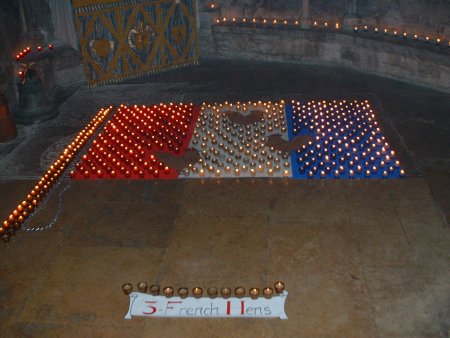
Three French Hens strut their stuff in St Dunstan's chapel.
One element which still surprises some of our visitors is the blessing and use of chalk at the end of the service. The Blessed chalk is used to inscribe the threshold of the church door with C*M*B 2006 and four crosses. The initials stand for the medieval names of the "three" wise men, Caspar, Melchior and Balthazar - whose supposed remains are contained in an elaborate reliquary on display at Cologne Cathedral - the year since their visit to the stable in Bethlehem and the crosses mark the traditional emblems of consecration for a church or any sacramental furnishings. The custom comes from the Eastern Orthodox hurch and is one the Lord Abbot likes to include. After the service everyone is offered a piece of chalk to mark their own entrance doors in this way - a tradition again from the East to show that God is welcomed into our homes and visitors will be treated with Christian hospitality.
Fantastic music, great fellowship with all our congregation and a wonderful period of worship and renewal. What more can anyone ask? Now all we have to do, is retain this spirit of unity through the coming year.
Posted by The Gray Monk at 02:07 PM | TrackBack
January 06, 2006
Epiphany
Today is the Feast of the Epiphany, the twleth day after Christmas in the Western Church, the day that many Eastern Orthodox countries celebarte as Christmas. A discussion on the radio this morning reminded me of the "old" carol "The twelve days of Christmas" and I wondered how many of those who sing it lustily - frequently in many Protestant Churches - these days realise that it is in fact a very clever allegorical rendition of the Catholic Catechism!
The symbolism is very interesting as it refers us to the message of the Gospels and to the teachings of the Church and the creed. It was dressed up as a "Love Song" for use by Catholics in 16th, 17th and 18th Century Britain where the practice of the Roman Catholic Faith was proscribed in law until the Reform Acts of 1836 gave Catholics the right to freedom of worship and religious practice. It was taught across Ireland for the three centuries of Catholic suppression, and in England, Scotland and Wales, by the "Hedgerow Priests" who risked imprisonment at least, and death at worst, to keep the Catholic Church alive in the hearts of those who refused to accept the "new" forms of worship decreed by the Protestant Reformers. An example, I think, of how Christianity needs to rediscover the faith and the fact that it can and does survive when it is centred on homes, families and the hearts of it's faithful.
The allegorical references are plain if you look for them - and I find it difficult to believe that some at least of the Protestant churchmen and rulers didn't grasp the message. Perhaps that explains its popularity today. Many of you will have heard the wonderful spoof version of this which has a lawyer writing to the sender portesting at damage and threat to the health and mental wellbeing of the recipient - perhaps a truere reflection of how people respond to the message it represents today.
The references are as follows:
My true love is God,
The Partridge is His Son, Jesus Christ,
The Two turtle doves are the two sections of the Bible, the Old and the New Testaments,
The three French Hens are the three "Theological" virtues which St Paul wrote about in his letters - Faith, Hope and Charity,
Four calling birds are the four "Evangelists" - the Gospel writers,
The five golden rings are the first five books of the Old Testament, the "Pentateuch" of the Jewish canon,
Six geese give us the "Six Days of Creation" from Genesis,
Seven Swans refer to the seven sacramental gifts of the Holy Spirit,
The eight milking maids are the eight "Beatitudes" from the sermon on the Mount,
Nine Ladies dancing is a reference to the nine fruits of the Holy Spirit,
Ten Lord's leaping remind us of the Ten Commandments (in the 16th to 18th Centuries the Lord's was the primary Legislative House and the seat of the entire Judicial process!) thus a perfect reference to the Law of God.
Eleven Pipers was a way of remembering that eleven disciples were faithful to Christ and became the first Apostles, and finally,
the Twelve drummers, recall the twelve points of Doctrine in the Apostle's Creed.
Neat is it not? A wonderful summary of almost the entire Catechism in a form which was (and is) enjoyable to recite and formed the basis of a memory aid to the recall of all that was necessary for the schooling of children in the Catholic Faith. In an age when the vast majority had no ability to read, nor access for the most part to books, this fun rhyme gave them the opportunity to expand their knowledge and to practice their faith.
Today we greet the first of the Gentiles to recognise Christ, their coming signalled to the world that this was a gift from the God of all Creation to the whole of mankind. The waiting was over, salvation had arrived.
Perhaps we need to look again at the way the Catholic faith was kept alive in England and Ireland by use of fun devices such as this carol, and rediscover the real meaning of the season we celebrate at this time. We certainly need to assert the faith and constancy of our forebears as they struggled to keep the faith they held.
On the first day of Christmas, my true love sent to me A partridge in a pear tree.On the second day of Christmas,
my true love sent to me
Two turtle doves,
And a partridge in a pear tree.On the third day of Christmas,
my true love sent to me
Three French hens,
Two turtle doves,
And a partridge in a pear tree.On the fourth day of Christmas,
my true love sent to me
Four calling birds,
Three French hens,
Two turtle doves,
And a partridge in a pear tree.On the fifth day of Christmas,
my true love sent to me
Five golden rings,
Four calling birds,
Three French hens,
Two turtle doves,
And a partridge in a pear tree.On the sixth day of Christmas,
my true love sent to me
Six geese a-laying,
Five golden rings,
Four calling birds,
Three French hens,
Two turtle doves,
And a partridge in a pear tree.On the seventh day of Christmas,
my true love sent to me
Seven swans a-swimming,
Six geese a-laying,
Five golden rings,
Four calling birds,
Three French hens,
Two turtle doves,
And a partridge in a pear tree.On the eighth day of Christmas,
my true love sent to me
Eight maids a-milking,
Seven swans a-swimming,
Six geese a-laying,
Five golden rings,
Four calling birds,
Three French hens,
Two turtle doves,
And a partridge in a pear tree.On the ninth day of Christmas,
my true love sent to me
Nine ladies dancing,
Eight maids a-milking,
Seven swans a-swimming,
Six geese a-laying,
Five golden rings,
Four calling birds,
Three French hens,
Two turtle doves,
And a partridge in a pear tree.On the tenth day of Christmas,
my true love sent to me
Ten lords a-leaping,
Nine ladies dancing,
Eight maids a-milking,
Seven swans a-swimming,
Six geese a-laying,
Five golden rings,
Four calling birds,
Three French hens,
Two turtle doves,
And a partridge in a pear tree.On the eleventh day of Christmas,
my true love sent to me
Eleven pipers piping,
Ten lords a-leaping,
Nine ladies dancing,
Eight maids a-milking,
Seven swans a-swimming,
Six geese a-laying,
Five golden rings,
Four calling birds,
Three French hens,
Two turtle doves,
And a partridge in a pear tree.On the twelfth day of Christmas,
my true love sent to me
Twelve drummers drumming,
Eleven pipers piping,
Ten lords a-leaping,
Nine ladies dancing,
Eight maids a-milking,
Seven swans a-swimming,
Six geese a-laying,
Five golden rings,
Four calling birds,
Three French hens,
Two turtle doves,
And a partridge in a pear tree!
Posted by The Gray Monk at 11:40 AM | Comments (1) | TrackBack
January 05, 2006
Intelligent design?
The great debate in certain circles in the US centred on the teaching of the Theory of Evolution versus "Creationsim" or "Intelligent Design" has just been underscored - and not for the first time - in a court room battle. Happily I think, the Judge ruled that Darwin's Theory has more scientific credence than the alternatives, but equally happily, he also declined to rule on what people may or may not choose to believe.
Speaking for myself, I find it incredible that there are still a seemingly very large body of otherwise intelligent people whose "faith" in God seems to hinge on whether or not the world was created in a matter of days 6,004 years ago (A 17th Century Irish Prelate calculated this by adding up all the ages of the people in the old testament and then adding the "post Christ" number of years. I suspect though that he used the Julian and not the Gregorian dating so was probably a few more years out in that as well!) or came into being over a much longer period involving a lot of accidents, huge galactic forces and something like 5 billion years to get to where we are today! Does it really matter? Is this really what the entire Christian, Jewish and Muslim faiths hang on? Of course not, the creation story in Genesis is a very poetic description - an explanation for nomads - of vast events which even now we do not fully understand! The more we learn, the less we really know, or think we know. The study of genetics is unwrapping ever more enigmas, and ever more proof that Darwin's theory - and a scientific Theory is something that is accepted only after rigourous testing, challenging and quite a lot of evidence - is probably, give or take a few deviations here and there, largely spot on. Life has evolved and is still evolving.
Look back through the fossil record - and no, I do not accept that they were put there by God to confuse us, or by the Devil to distract us - the earth has been several degrees warmer than it is now, and a whole lot colder. Polar Bears evolved during the last ice age and the warming of the oceans and melting ice caps will probably spell extinction for them and us, but God's purpose and His ongoing creation will see the evolution of new animals adapted to the new age and climate - and these will adapt and change again as the earth moves away from the sun in another 10,000 years or so and cools once more. The orbit is eratic, the heat output from the sun changes and this planet is habitable to us in our present form only as long as our climate stays within the parameters that allow us to have liquid oceans (water is actually a gas when you think about it!) and a moderately narrow temperature range. If we were to lose the moon, the earth's balance would be disturbed and we would develop a severe wobble which would give us such extremes of temperature at the poles and the equator that human and animal life would be almost impossible. Is this proof that there is no God? Of course not, but neither does it "prove" that there is one!
Those who prefer to keep their ideas on the creation of the planet and the rise of the species we belong to and are familiar with, simple, should consider carefully the evidence around them. The argument for a "Creator" using "Intelligent Design" is a blind alley, a distraction from true understanding of God and of His creation. It's major flaw is that it assumes that humans have reached their evolutionary peak and can get no better! What does it matter that He chose to throw a galactic chemistry set on the ground and stood back to see what emerged? Did he "engineer" our genes? This is stepping perilously close to the "Aliens from outer space impregnated monkeys to create humans" argument - and about as valid.
Reading the book Darwin's Watch by Terry Pratchett and a pair of scientists has been very entertaining and very enlightening, everyone should read it, because it does put the science into a language stripped of all the media hype and gives a case we can all understand quite easily. The protagonists of "Intelligent design" might also learn to their advantage to consider a little more carefully the flimsiness of the argument they advance. In fact, they might begin to look afresh at the "logic" applied by the 17th and 18th Century theologians who devised it in an attempt to stem the tide of "Enlightenment" as pure sciences began to move the discovery of how the planet actually functioned forward.
It is popular today to blame the mainstream churches for this promotion of the untenable, in fact it is not strictly true. The Catholic Church has long sponsored scientific studies - Copernicus was a priest and very highly regarded in Catholic circles, as were many more of the leading "scientists" of the Renaissance. Much of their work was suppressed in the sense that it was not widely published, because it was felt that, like the Theory of Evolution, it would serve only to alarm the general populace. Unfortunately it is also true that many of the leaders of the Church of England and other "mainstream" Christian "Reformed" churches were so prejudiced against the Catholic Church that it was a case "if they think that, we have to think the opposite!" Hence the attempts to beat science at it's own game by evolving a "theological" explanation which does not stand up to scientific scrutiny.
The problem with God, according to some writers, is that He resolutely refuses to "prove" His existence - thereby frustrating everyone, both believer and unbeliever!
Frankly, I think this is a debate which is both pointless and a distraction from the real issue, that the Church - in its widest sense - exists to provide a vehicle through which we may discover our own routes to God and begin to understand the greater meaning of the Gospels. There is, as Pratchett's Wizards remark, an absence of "Deitivium" and "Narativium" in our world - both "elements" in abundant presence in the Discworld. Because of this lack, we have science.
A much wiser head than mine once said that science is what we use to explain the explainable and to seek explanations for the bits we can explain but not fully understand. Faith is for the gaps between. I know what he meant and it does not shake my faith one bit knowing that I have evolved from a "proto-hominid" who lived in Africa some 3.5 million years ago. It doesn't worry me that that homonid may have evolved from something that crawled out of some warm ocean 20 million years before that. I know that dinosaurs walked the earth for several million years before homonids even began to evolve, I also know that asteriods have crashed into this planet and wiped out promising evolutionary strains several times - and that doesn't bother me either.
I am a man. I cannot know the mind of God and I fully accept that I may actually be simply yet another stepping stone in a vast experiment which will ultimately give rise to yet another chain of beings adapted to the conditions of a changing and evolving planet. My faith is founded in the Gospel of Jesus Christ and not in the creation stories put together for shepherds and wanderers a little over 3,000 years ago.
That faith tells me that, as a Christian, and as one of God's created sons, I can expect to be welcomed into a new and hopefully less fraught life at the end of this one. That, and that alone, is what really matters. Any arguments about whether Darwinism is "scientific" or whether "Intelligent Creationism" is more accurate, belong in the same dustbin of history as the wonderful "element" many learned gentlemen argued over in the "Age of Enlightenment" - Phlogiston.
It really is time for all men of real faith to put aside their nice comfortable "Sunday School" images and embrace the real challenge of faith - to learn to know God through prayer, deed and understanding of everything we can learn about the creation we are a part of. Let us hope that the promoters of "Intelligent Design" stop flogging their dead horse and look at how God is really working in science for the good of us all. If they really believe that God is present in everything, then prove it, by looking at how He is working through ongoing evolution in everything - including us!
Posted by The Gray Monk at 03:51 PM | TrackBack
December 25, 2005
Merry Christmas
'Tis the season to be jolly - and for most of us it will be, but we should also keep in mind the many who will be alone or neglected at this season. At the Abbey we have been trying to encourage everyone to check on who they know who will be alone - and to try to include them in at least one meal over Christmas. It seems to have had some effect as more and more families are combining and including single members of the congregation.
Our Lord was born in a stable, as the Gospels tell us, in an overcrowded "inn" (in the English translations of the story), but more likely the stables beneath the principle building of a "caravanserai" outside Bethlehem. As the majority of dwellings of that period were double storey structures with the stables, stores and cattle pens beneath and the single room "living" area above (some buildings like this can still be seen in the Middle East) it is most likely that, when Mary went into labour, the lower floor offered the only clear space and the privacy for the birth. Be that as it may, the child born on that night - and tradition rather than any real evidence says it was Winter - has changed the world in ways we still do not fully understand.
He came into this world as the "New Adam", and changed our understanding of God, of our relationship with God and of our life as children of God. I doubt very much that any of that was evident on the night, except to a very few who were present, or had a sense that something special had just happened. The Star, the Kings and the recognition in the Temple all come later.
I believe that St John has his finger firmly on the nub of it in his rather allegorical rendition
"He was in the world, and though the world was made by him, the world did not know him."
Later, during His ministry the world would learn to recognise Him, but the fear that that knowledge generated drove many to deny it. Again to quote John:
"In Him was life, and that life was the light of men. The light shines in the darkness, but the darkness has not understood it."
As we celebrate this Christmas, we need to pause and consider, have we understood fully the impact that this child, born in that stable, in a dusty little town in the Middle East 2000 odd years ago, has had upon us and our understanding of life itself? Have we really considered the message of the Gospel He brought us, and the impact it can and does have upon those who choose to live by it?
May all who visit this site over the Christmas period, receive the blessings of the Christ Child at this season and throughout the comming year.
"The Word was made flesh, and dwelt among us, and we beheld His glory, the glory of the only begotten Son of the Father, full of grace and truth."
Posted by The Gray Monk at 10:10 AM | Comments (1) | TrackBack
Frohe Weihnachten
There is not much I can add to what The Monk has already said today - just my own personal wish for a very merry and peaceful Christmas time for all of you out there.
Posted by Mausi at 09:21 AM | TrackBack
December 24, 2005
Christmas lights
Browsing a few of my regular read blogs I found an item at Hatshepsut's blog on the little seven candle lights now so popular as Christmas decorations. I knew they were based on the Jewish Hanukkuh lights - themselves a version of the great seven branch lamp that once graced the Sanctuary of the Temple in Jerusalem and the inner tent of the Ark of the Covenant before the temples were built, but the spread of the popularity and the route of their adoption, was a surprise.
Even more interesting is her account of how the little lights have become a very important feature of the Icelandic Christmas. It speaks volumes about just how far reaching the teachings of Christianity have been that the cultural exchange is now returning to its roots in many ways, not least in the rediscovery of the ancient symbology that once formed a vital part of the whole. It is fitting too, to remind us of the fact that our faith has deep roots in Judaism - roots we would do well to understand better.
In fact, we need to discover, as the Jews have done, that our faith is not about buildings, but about people. People, families, children and the teaching and traditions of worship and respect that go with them.
Posted by The Gray Monk at 03:55 PM | TrackBack
December 18, 2005
St Mary-le-Bow for a carol service
A couple of weeks ago, I attended the annual Carol Service of the Worshipful Company of Fire Fighters in St Mary-le-Bow in London. This is one of Sir Christopher Wren's churches, entirely rebuilt after being fire bombed and destroyed in the Blitz, with the reconstruction following Wren's original floor plan and decoration exactly. The famous bells were also damaged in the Blitz, but were recast and restored along with the church which was completed and rededicated in 1961. At that service the famous "Great bell of Bow" once again rang out and another generation of Cockney's could claim to have been born "within sound of Bow Bells".
The service itself was well attended by the Freemen, Liverymen and Masters of the Company and our guests, with the Bromley Ladies Barbershop Choir - despite their name a full choir of ladies voices - accompanying our congregational carols and performing a number of choir carols for us. As a new Freeman I was asked to read the first of the lessons chosen for the occassion - the Annunciation from St Luke's gospel - and this was followed by a lesson read by a new Liveryman (I have to serve for another two years before I can become one) and that in turn followed by a lesson read by a new "Clerk of Court".
Wine and mince pies followed the service and we had time to catch up with old friends, renew acquaintances, make new ones and generally share the fellowship that goes with our profession.
St Mary-le-Bow is an interesting building for a variety of reasons, for one, it has two pulpits - called Ambos when doubled - and is almost square in plan. The organ, a magnificent instrument, is mounted on a gallery at the West end and the layout reflects very much the churchmanship of the early reformation years in England. The Wren Church replaced a Norman one, the crypt of which is still there, having been restored. It is the crypt chapel which gives rise to the name of the church, for it has Norman "Bow" arches supporting the floor above. It is in this chapel that the Court of Arches meets to elect new Bishops and to confirm the choice of Archbishops of York and Canterbury.
The Court of Arches is a council of ecclesiastics which includes the Archbishops of Canterbury and York, the Bishop of Winchester, London and several other of the more ancient Sees. Technically, they may "elect" a Bishop, but the final assent comes from the Crown itself.
All in all, if one is visiting London, a little detour down Cheapside to visit this beautifully restored and historic church is well worth the effort.
Posted by The Gray Monk at 11:35 AM | TrackBack
Messiah by candlelight
My annual Advent treat is the English Symphony Orchestra and St Michael's Singers (Coventry Cathedral) rendition of the Messiah by Candlelight. Absolutely stunning performance with a sell-out audience in the Abbey, branches of candles between the huge Norman drum pillars and soft lighting in the aisles and over the high altar. I sat among the 600 or so people and listened yet again to the glorious sound of Handel's masterpiece.
One of the most effective parts of this performance each year is the trumpet passages - from the West end of the Abbey in Part 1 and then from the pulpit in the recitative "And the trumpet shall sound!" The building resonates to the clear notes of the trumpet and picks up beautifully the rich blend of the orchestral backing to the soloists and choir.
My batteries are recharged, and now I am ready for the Christmas onslaught!
Posted by The Gray Monk at 11:17 AM | TrackBack
December 11, 2005
Sunday's sermon notes!
With my additional duties as Church Warden, I have been somewhat relieved, of late, to have less preaching to do. So, it was with a bit of a time pressure that I have had to put together my thoughts for a sermon for Sunday evening.
The week has certainly given me plenty to consider, some of which has filtered through into my sermon notes in the extended post below. It picks up on the thoughts I had earlier this week on the subject of the search by many who are "unchurched" for something spiritual to hold onto. It is a tricky area - and one which, I suspect, the Christian churches have helped to create by their emphasis on being "saved" or "unsaved" depending on whether you are inside a church or not.
As we run towards the Christmas celebration and the reminder of the birth of the child Jesus, we should all be asking what have we done, and what can we do, to help those who seek the Lord, to find the path to His grace.
Peace be with you all in this Advent tide.
Evensong Advent 3 2005
Tewkesbury Abbey
+ May I speak and may you hear in the Name of Him who was born and who died for us, the same Jesus Christ the Saviour of the world.
Amen
Ps 68 verse 19 “God is for us the God of our Salvation: God is the Lord who can deliver from death.”
This week I seem to have spent a lot of time waiting. For a delivery to my home yesterday, for a train to get home from London on Friday night, for visitors, lecturers, students and management meetings of one kind or another. While doing so I have had ample opportunity to ponder on the phenomenon of what seems to be a growing form of cult worship centred on celebrities – usually dead ones! Consider the way in which John Lennon’s death has been marked during the last week, or the way the death of Princess Diana is marked by her devotees each year. What is going on? What is that these “followers” seek? What drives their devotion?
The prophet Malachi speaks to a people whose leaders had begun to deviate from the path God had directed. Certain practices had begun to fall by the wayside, religious observance had fallen to a mere tokenism among many and certainly the “tithes” due to the Levites and the temple were not being paid in full. The argument was “we have waited, we have prayed, yet the Lord has not come to help us.” An argument we hear today every time some natural disaster strikes somewhere in the world and causes devastation. “Ah ha!” Cry the Humanists and Atheists – “See; there is no God or he would have prevented/stopped it!”
Now, as then, there are none so blind as those who will not see! Malachi answered his generation with the charge –
“You have wearied the Lord with your words.”
Malachi was dealing with a generation that had become self satisfied, materialistic and somewhat detached from religion. In fact somewhat like our own generation, as the doubters cried “Where was God?” whenever anything threatened their cosy world, and some even tried to portray evildoers as “good in the eyes of the Lord”. In essence a generation who had lost the heart of their faith and were now adrift looking for something to believe in.
In the week just past I found myself pondering anew the fact that as the gospel message has become less and less heard in the streets and workplaces of our nation, our young people – and some older ones – have begun to search for a new spirituality. I listened in amazement at the scenes of what one can almost describe as religious worship at various shrines set up to commemorate John Lennon to mark the 25th anniversary of his death. Look too at the numbers of devotees of the Elvis Presley cult, some of whom actually do believe that he will return from the dead! Then there is also the annual outpouring of grief for Princess Diana, whose devotees seem to me to get more bitter and more strident as the years pass.
What do they seek? What do we seek as we mark the passing of this Advent season? Do we expect the Lord Jesus to return in some Apocalyptic form, at the head of a host of warrior angels? Or are we simply in the habit of marking the shopping days to Christmas and the fun of exchanging gifts, separating the kids as they squabble over the latest video game, without any real expectation that the march of the seasons will radically change our lives? If so, we need to urgently rethink our faith! As Malachi told his listeners -
“Then suddenly the Lord you are seeking will come to his temple; the messenger of the covenant, whom you desire, will come.”
In this last week, those who have followed the lections set for daily worship, will have noticed that it was a little difficult to get away from John the Baptist at times. He seemed to be in every set of readings, even today, we are reminded of his mission with Asperges at 1100 and the passage in our first lesson that reminds us that God will send his messenger and that the Lord is Himself a messenger! Both seek to bring us to the fountain of spiritual refreshment so that we need no longer seek but may know the salvation and comfort that awaits all who turn to God for refreshment.
It struck me as I waited and listened or read yet another report on the way people were flocking to mark John Lennon’s death, that this is where our society has begun to suffer the same problem that Malachi’s generation knew. If the spiritual development of the nation is stunted, or in some way restricted, then soon enough, other forms of spiritual search begin to take precedence over the established religions. If the people who remain in the churches, synagogues or temple are not practicing what they preach, if they are not setting an example that inspires and makes others hungry to share in the banquet, they will go elsewhere. I put it to you, that, in our generation, the Baal totems and idols have been replaced by the John Lennon’s of pop fame or the George Bests of football, by home-made quasi-religious philosophies borrowing from Humanism, Jainism, Hindu-ism and even from 20th Century re-inventions of Druidism.
In this mishmash one does indeed find that there are those who defend the doers of evil by claiming that the evildoer is good in the eyes of the Lord and He is pleased with them. But, more importantly, what does it say to us? What does it say of us and of how we have managed our stewardship of the message of God in the gospel of our Lord Jesus Christ? Can we be called good stewards when we do nothing in the face of increasing secularisation? Can we be called good stewards when our schools ban any representation of our faith? Can we be good stewards when there are those who will be alone this Christmas and who face a year without the warmth of friendship or in hardship?
I confess that it seemed to me to be a little strange, to find that the lectionary links the reading from Malachi to a buoyant message of hope in Philippians, until I looked more closely. “The Lord is near” says Paul to his readers, and in Advent this is especially true.
Advent is the time of the messenger, the time in which we should, as Paul puts it, “present our requests to God.” The messengers have been, all the old testament prophets, the patriarchs and the Apostles. John the Baptist came as, in the words from St John’s gospel:
“a voice crying in the wilderness, make straight the way of the Lord,”
And we know that in John’s lifetime Our Lord Jesus did indeed follow and bring about the fulfilment of the prophecies. Now it is our turn to play the messenger and carry the message. As we wait his coming in Glory, as is promised and predicted; we must, in our turn, proclaim the good news and bring those who seek spiritual nourishment – even those who don’t know what it is that they seek – to the Lord.
If we are to call ourselves the people of God, then we must be the people of God. If we believe that our Lord Jesus is the Christ, then we must proclaim it and show it in our lives. We dare not fall into the same trap that seems to have ensnared Malachi’s generation and become smug in our faith, for then it is no faith. Impatience is a difficult thing to deal with, it becomes more so in a generation who live by sound bites and visual stimulation, we need to engage their hearts so that we can give them the direction they need in their spiritual search. If we are to be the effective messengers we should be, we must be fully prepared to embrace all that this demands of us. We need to be prepared to engage with those who seek; to find ways to show them how Jesus is the hope and the life that they seek. That Christianity is relevant to this world and to our society. We need to show them the way to find God in His Son and not through pop-stars and other celebrities.
Malachi charged his hearers with the reminder:
“Who can endure the day of his coming? Who can stand when he appears?”
Advent is our time when we need to remind ourselves of this and to prepare, lest he come upon us unawares and we fail to recognise him. That would be frightening indeed. We need, instead, to make sure that we are prepared, that we do carry the message of the gospel faithfully, helping others to find the truth and the path. And we need to prepare ourselves, so that, when he appears we both recognise him and he us. Perhaps, even more importantly, we need to make sure that we are the effective messengers He asks us to be.
We prepare for his coming and live in hope that
“the peace of God, which passes all understanding will guard our hearts and minds in Christ Jesus.”
Amen.
Posted by The Gray Monk at 07:36 PM | TrackBack
Searching for a spiritual meaning?
Listening to the radio recently, I was reminded that it is 25 years since John Lennon was shot. What surprised me was that there are still people out there who make an annual event out of remembering him, that they arrange special "remembrance events" such as the one to be held here in the UK which will see the release of hundreds of white balloons with "messages to John" tied to them. This is on a par with the annual sackclothe and ashes performance of the press (whose smoking gun is still smoking!) and the Diana Cultists who gather to revile the Prince of Wales and other Royals while indulging in a display of grief at their loss of the "Fairy Princess".
I am constantly amazed at the cult that has grown around Elvis Presley as well - there really are people out there who believe he will make a "second coming" and return if only his fans remain faithful. Then we have also just seen the huge outpouring at the funeral of George Best, a man the press were reviling only a few months ago for having had a liver transplant and then returned to his alcoholism. Anyone would think that we had just witnessed the burial of some truly remarkable person, a saint perhaps, certainly someone of the stature of a head of state or possibly even a leader of a religious movement - not an alcoholic footballer who, however good he was on a playing field, was destroyed by the trappings of his success.
Look around at the various "fan clubs" that gather around pop-stars, film-stars and sportsmen, many of whom have real problems dealing with reality and many are also very poor examples for young people to model themselves on. Strangely, this is the modern "culture" we have created - or allowed those in power to create - based on secular "values" which are founded more on a set of "ethics" and "moralist" principles which one could be excused for thinking, are based on no particular religious teaching, yet borrow from many. In fact they are the atheistic "Humanist" moralist ideas which assume that the human being is the ultimate creation, the pinnacle of life "born good, but everywhere debased by evil". For "evil" in this thinking read any form of Judeo-Christian teaching.
I find it increasingly difficult to come to terms with the mindset that preaches "religious freedom", but restricts Christianity, while promoting other religions in schools, universities and in all matters cultural. A recent example being the school which excluded a teenager for refusing to take off her crucifix - she is a practicing Christian - on the grounds that it is NOT a religious symbol as it is not "required symbolism". Sikh scholars, on the other hand are allowed to wear all the religious jewellery including a small dagger and Muslims are allowed to wear the Hijab and any other mark of their faith at the same school. Surely this is an assault upon the girl's faith and upon her "Human Rights" as well? The wearing of the cross is not a requirement of any Christian denomination as a mark - I wear it anyway as it is marked on my forehead from my Baptism and Confirmation even though it is invisible to the human eye - but it is a matter of religious freedom to do so if I, or anyone else, wish!
Even stranger is the fact that more and more of the sort of activity that the Lennon fans seem to be engaged in is attracting more and more of a following. It is almost as if the medieval attraction to pilgrimages and the visitation of "shrines" has been recreated. I find myself wondering if it is perhaps a manifestation of a deep human desire to believe in a life beyond this rather short, frequently difficult and - if you are poor and starving - often miserable existence. Look back in history to pre-Christian times, almost from the very dawn of civilisation there is evidence of a search for "spiritual" life rather than the reality of the everyday grind. Is this new creation of the cult of stardom perhaps concealing something that our politicians and "thinkers" have overlooked? Could the spirit of God be breaking through in a new way and stirring people to look again at the secular creation which promotes the idea that there is no life beyond this one? If so, can we, in our beautiful and emptying churches, afford to ignore what is happening?
I do not suggest that we jump on any of these bandwagons, frankly the thought of canonising John Lennon, Elvis Presley or George Best is enough to drive me out of the church, but surely we, as people who claim to be spiritually seeking through scripture and worship, study and prayer for the truth of God and the life to come, should be looking at how we have failed to preach the gospel effectively, to show it in our lives in ways that would provide those who seek reassurance in their present search for the spirit or essence of their heroes, how to come to Christ and find what they really seek? Where is the St Paul to go out among them and proclaim as he did to the Atheneans, "I come to reveal to you the Unknown God to whom you have erected an Altar in your temples".
It seems to me that there is a desperate search among our young, our not so young and even among the elderly who have never been given the gospel or the spiritual understanding that goes with real teaching of the Christian message, and the Churches really need to look at why they are failing to get the message of the Gospel across. It is a question I will be taking back to my congregation and it is one I will keep teasing with them until we find a way to answer it.
"Feed my sheep", said Our Lord, and He wasn't talking food for the stomach but food for the soul. Are we doing it? The signs seem to indicate that we are not getting the spiritual food to the spiritually starving! We had better look carefully at why this is so!
Posted by The Gray Monk at 10:01 AM | TrackBack
December 06, 2005
St Nicholas, Bishop of Smyrna
Today is St Nicholas' day, the saint responsible for the frenzy of gift giving we indulge in at this season. According to the legend he was passing the home of a family which lacked the wealth to pay the dowry for the daughters of the house to marry and so secretly made up purses which he then had delivered to the house as a gift to each daughter. The legend has grown a little in the telling, but the fact is that he was known in his own time for his generosity to all in need and his willingness to give even what he needed to someone he judged in greater need than himself.
He was Bishop of Smyrna, now part of modern Turkey and is regarded as one of the best examples of Christian living of his time. Interestingly, in some parts of Europe, including Holland, St Nicholas' Day is the day on which gifts are traditionally exchanged and Christmas is kept as a feast dedicated purely to the Christ Child.
May St Nicholas give to everyone the gifts they need to deal with the year ahead.
Posted by The Gray Monk at 09:06 AM | TrackBack
December 02, 2005
Music for Advent
Advent marks the Church's New Year and the Tewkesbury Abbey Advent is a busy one, as befits the Catholic tradition. Last Saturday evening saw the annual Advent Carol service in the Abbey performed by three choirs as a moving feast as they move about the Abbey to sing singly, jointly or in counterpoint. The service began in 1947 as a joint thanksgiving for the pupils of the Blue Coat School in Birmingham and the Prebendal Singers from Worcester for the hospitality received when many of their members, as children, were evacuated to Tewkesbury for the duration of the war. The three choirs now involved are the Blue Coat School Choir, the Prebendal Singers and the Abbey School Choir and they combine to produce a stunning musical entree to the season of Advent.
The service begins with the Church lit by candles and some subdued lighting in the nave and aisles. The Blue Coats and the Prebendals assemble in the South Transept Lady Chapel with the Abbey School Choir in the North Transept at the Grove Organ. The Crucifer, two acolytes, a Cantor and the Vicar assemble before the High Altar and process slowly down the Quire and into the Nave while the Cantor sings the verses of the "Royal Acclamations of Christ" and the choirs respond with the chorus of
Christus vincit, Christus Regnat, Christus imperat
which is alternated between South and North as the procession moves down the church, Cross, Acolytres and Ministers in the centre nave, the choirs in the North and South Aisles led by four Acolytes and a Priest or Deacon on each side and keeping pace with the Cross in the nave.
Exaudi Christe, Ecclesia sancta Dei, supra regnorum fines nectenti animas: salus perpetua!
One can feel the presence of the old monks as the latin is intoned!
At the West End, between the font and the Entrance doors, the choirs assemble facing each other and the Abbey School Choir sings the Matin Responsory, "I look from afar", which is adapted from a version of the "Magnificat" used only in Advent. This is followed by a reading from Isaiah 2 v 5 - 11 read by a member of the Blue Coat School and this is followed by the Prebendal Singers singing a Motet, "O Lord, I lift up my heart to thee" by Orlando Gibbons. A second reading from Isaiah 40 v 1 - 11 follows read by the Headmaster of the Blue Coat School and then a congregational carol is sung as the Cross and Acolytes lead the choirs up the central aisle to the Choir screen.
In the area in front of the screen, the choirs turn to face the congregation and the Abbey School Choir sings "Adam lay y' bounden" to the Warlock setting (Not the version used by the Medieval Babes!) and that is followed by the Blue Coats and the Prebendals singing the Motet "Rorate coeli desuper!" a Scottish Traditional hymn set to music by Stephen Wilkinson. The third lesson is read by a member of the Abbey School Choir from Zechariah 2 v 10 - 13 and this is followed by the Carol "Tomorrow shall be my dancing day", and English Traditional Carol set to music by Karl Rutti, and another congregational carol, "Hark what a sound, to divine for hearing".
The fourth lesson is read by a member of the Prebendal Singers from Isaiah 11 v 1 - 10 and the choirs then move into the Lady Chapel (Blue Coats and Prebendals) and into the North Aisle at the Beauchamp Chantry (dedicated to St Mary Magdalene) while the organist plays the introduction to "Wachet auf!" Once they are in position, the choirs sing the two verses to this lovely hymn one verse from the Lady Chapel and the other from the North Aisle, the effect is stunning! This is followed by the fifth lesson read by one of the Abbey Church Wardens, and is the Annunciation passage from Luke 1 v 26 - 38. Only one hymn or carol could possibly follow that - "Velut maris stella.", the words from the latin canticle written in 1300 and set to music by Benjamin Britten in a mixture of English and Latin. That is in turn followed by the Motet "Ave maris stella" and the Carol "Gabriel's message does away".
During the singing of the next congregational carol, "Once only for this troubled world", the choirs move into the Quire proper for the final lesson, taken from Mark 1 v 1 - 11 read by the Headmaster of the Abbey School. The combined choirs then sing the Anthem from Handel's Messiah "And the glory of the Lord." The congregation then join in singing the carol "Long ago, prophets knew" while the choirs move to the steps of the High Altar for the saying of the Advent Vesper Responsory and the prayers which are followed by the final Anthem sung by the combined choirs, that great Advent anthem from the 3rd Century, "Hail gladdening light, of His pure glory poured".
The Blessing is followed by the Recessional Hymn and the Cross, Acolytes and clergy precede the choirs to the West End where the final "vestry" prayers are said.
The only thing left to say is that the whole was topped off by our organist delivering a flawless rendition of Widor's "Allegro" from Symphonie VI! Advent well and truly announced!
Posted by The Gray Monk at 08:24 PM | TrackBack
November 13, 2005
No man is an island
A meditation on the state of man
by
John Donne
Dean of St Paul's Cathedral London
(Originally part of a sermon delivered in the Cathedral)
Perchance he for whom the bell tolls may be so ill that he knows not it tolls for him; and perchance I may think myself so much better than I am, as they who are about me, and see my state, may have caused it to toll for me, and I know not that. The Church is Catholic, universal, so are all her actions; all that she does belongs to all. When she baptises a child, that action concerns me; for that child is thereby connected to the Head which is my Head too, and engrafted into that body, whereof I am a member. And when she buries a man, that action concerns me: All mankind is of one Author, and is one volume; when one man dies, one chapter is not torn out of the book, but translated into a better language; and every chapter must be so translated; God employs several translators; some pieces are translated by age, some by sickness, some by war, some by justice; but God's hand is in every translation; and his hand shall bind up all our scattered leaves again, for that Library where every book shall lie open to one another: As therefore the bell that rings to a sermon calls not upon the preacher only, but upon the congregation to come; so this bell calls us all....
No man is an island, entire of itself; everyman is a piece of the continent, a part of the man; if a clod be washed away by the sea Europe is the less, as well a promontory were, as well as if a manor of thy friends or of thine own were: Any man's death diminishes me, because I am involved in Mankind; and therefore never send to know for whom the bell tolls; it tolls for thee.
c 1623 following the death of a friend.
Posted by The Gray Monk at 12:00 PM | TrackBack
November 11, 2005
Remembrance Day
On the 11th day of the 11th month of 1918 and at the 11th hour of the morning, the guns across the Western Front in Europe fell silent. According to those who were there, the silence was unnatural, not even a bird dared to disturb the stillness for several minutes. There were no cheers on the Somme or Ypres salients, nor on the rest of the Allied frontline. Right up to the final minute, the artillery continued firing at targets on the German lines and received return fire. One of the most senseless actions of those final minutes, was a cavalry charge by German cavalry across open and well defended ground which was stopped, well short of the Allied positions, by machine-gun fire. Almost the entire troop and their horses died in that final act of war.
The exhausted troops were simply too tired to cheer, or too traumatised by the events they had witnessed - or just grateful that they had survived. They had almost nothing to cheer about, too many friends had died, too many lay crippled and too many had lost their minds in the senseless slaughter of the preceding five years. Yet, within a generation, the same protagonists would be at each others throats again. Perhaps it is time to remember that the price of peace is vigilance and strength, something proved so graphically by the fear of further conflict that drove the appeasement movement between the wars.
My grandfathers, a great grandfather and great uncle all fought in the First Great War, so did an uncle. Two of the five were very underage when they joined up, all were marked by diseases contracted in their campaigns or by injuries received in battle. Two fought in Flanders and on the Somme, one in East Africa and two more in German South West Africa and in Palestine. Three were gassed, one almost died at the Somme - yet, a generation later, two were again in service, albeit in training duties and their children were abroad in North Africa, Burma and Europe. All of them suffered wounds and some less obvious scars - deep one's that have affected everyone who knew them. Until I began to study the campaigns they fought, I never really understood any of it, but now I think I have at least some understanding of what it was they underwent.
We live in a free society today, one they paid for in blood to keep free. We owe it to them all, every soldier, airman and sailor, every nurse aid, every volunteer to keep that freedom and to never surrender to those who would impose their dictatorial visions upon the rest of us. As the words of memorial say:
They shall grow not old, as we that are left grow old: Age shall not weary them, nor the years condemn. At the going down of the sun and in the morning We will remember them.
And in remembering them we must also resist every attempt to take from us the freedom that they won at such great cost.
Ecclesiasticus/Sirach 44 vv. 1 – 15 RSV
1 Let us now praise famous men, and our fathers in their generations.
2 The Lord apportioned to them great glory, his majesty from the beginning.
3 There were those who ruled in their kingdoms, and were men renowned for their power, giving counsel by their understanding, and proclaiming prophecies;
4 leaders of the people in their deliberations and in understanding of learning for the people, wise in their words of instruction;
5 those who composed musical tunes, and set forth verses in writing;
6 rich men furnished with resources, living peaceably in their habitations-
7 all these were honoured in their generations, and were the glory of their times.
8 There are some of them who have left a name, so that men declare their praise.
9 And there are some who have no memorial, who have perished as though they had not lived; they have become as though they had not been born, and so have their children after them.
10 But these were men of mercy, whose righteous deeds have not been forgotten;
11 their prosperity will remain with their descendants, and their inheritance to their children's children.
12 Their descendants stand by the covenants; their children also, for their sake.
13 Their posterity will continue forever, and their glory will not be blotted out.
14 Their bodies were buried in peace, and their name lives to all generations.
15 Peoples will declare their wisdom, and the congregation proclaims their praise.
Posted by The Gray Monk at 03:22 PM | Comments (1) | TrackBack
November 09, 2005
Theological discussion
I belong to a "Theological Forum" which our Lord Abbot has set up to promote study and theological debate among the Ministry Team and some other members of the congregation who have a specific interest. Each of us is invited to produce a paper on a theological subject or aspect and to present this to the forum. Debates can, as you would expect, be quite lively as we argue each others points and try to find a common understanding.
We have had papers on "Relics", on "Profiling" on the ethos of Ministry, the principles of Islam and Sacrifice. Mine, which I offer in the extended post below for those with an interest in these matters, is on "Dualism", the concept that there are "parallel" existences of "spirit" and "body", that the two are somehow co-existent, but separate. This is really the Platonic and Gnostic understanding of God and it is in conflict with received understanding from Christ and indeed, from Judaism.
It is a persuasive and beguiling philosophy - all the more so because it seems to offer an explanation of the unexplainable. Read, if you wish too, enjoy, and if you you wish to debate it, let's start a forum!
The supernature of humanity – the dichotomy of the nature of the existence of spirituality and corporeal life.
Or
Non fui, fui, non sum, no curo!*
An exploration of the Dualistic philosophy.
A paper prepared for the Tewkesbury Abbey Theological Forum
1.0 Introduction
When I accepted the challenge to prepare this paper, I little suspected the extent of the material available on the subject of Dualism nor the scope and range of the debate. Dualistic argument extends across a wide spectrum of human studies including psychology, theology and even into sociology. Arguments on the dualistic nature of materials and elements abound and even extend into the study of Quantum theory. It is my intention to focus here on those aspects which relate directly to the theology of the nature of the human “soul”, in particular to the nature of the human state; that is, is the material body by which we are defined as “Homo Sapiens” inhabited by a separate spiritual being in much the same way as the hermit crab inhabits an available shell, or is the body and the spirit one single entity which will continue into the life hereafter?
In selecting references from the plethora of sources a simple search of the world wide web, I have tried to find those which offer a balance between the position of the Catholic/Orthodox traditions on the one hand and the Protestant/Evangelical traditions on the other. Between these two positions, I have selected a few who represent the “anti-church” faction and who are non-Christian, pro-pagan, “wikka”, or simply “New Age” and who prefer to promote the “alternative” versions of the Christian doctrines and literature as being “more valid” than the “official” canon. Several other sources have been useful as they show up the thinking in Islam, Buddhism or other Eastern religions.
My research has identified the fact that such luminaries as Plato, Aristotle, Cicero, Manes, Origen, Arius, Augustine, Thomas Aquinas, Descartes, Wittgenstein, Weber, and a wide range of Eastern philosophers have all addressed various aspects of the Dualist philosophy, either propounding it or refuting it. (Reaction to 17th Century Dualism: Article published on the Internet @serendip.com) To this list should be added the Cathars or “Cathari”, described as the last of the Gnostic adherents, and the modern Christian Scientists who argue that the body is irrelevant and the spirit is the sole “reality”. It has been discussed by the early church fathers and even formed a crucial part of the debates in the Council of Nicea. It forms a key part of the Zoroastrian beliefs and is an element in others including Hinduism, Buddhism and some related faiths. Even Islam has elements of Dualism in some of its teachings, in fact it could be argued that the Islamic concept of purity is Gnostic in origin and therefore entirely dualist. Manes, in particular, founded a Christian based movement combining Zoroastrian dualistic creeds with Christian teaching to found Manichaeism, a variation of the Gnostic heresy. Arius, also followed a form of this dualistic creed and was specifically refuted by the introduction and adoption at Nicea of the Nicean and Athanasian creeds. (History of the first Council of Nice: Dudley D, Peter Eckler Publishing 1925, reprinted 1999) From the 13th Century Albertus Magnus and Thomas Aquinas argued that the Aristotelian view, though subjected to some important modifications, was the correct view.
Rene Descartes (1596 – 1650), the French mathematician and philosopher is credited with the revival of Dualistic theology and philosophy in the 17th Century. Known as Cartesian Dualism, his theory of the Human Machine raised the question of the division between metaphysical and physical existence. Put simply, saying that the “soul” was res cogitans, totally independent in existence of the physical body.
Dualism, it seems, has haunted theologians and scientists, an argument raised by Elizabeth Newman, Assistant Professor of Theology and Ethics at St Mary’s College, Notre Dame, Indiana, in her paper “Theology and Science without Dualism”. (“Theology and Science without Dualism”, Elizabeth Newman, published in Cross Currents and accessed at http://www.crosscurents.org/newman.htm ) In this she argues that all current theological and scientific thinking is influenced in one way or another by the Gnostic dualist understanding of the spiritual relationship with the material. Yet, ultimately, I find that there is still an element of dualism embedded within her argument as she does not address the question of the difference between “spiritual” and “material” other than to indicate that she sees the two as integral – yet God is seen as standing at the head of creation. In it, but not “corporate”. Perhaps most interesting in this argument is the pointing to the fact that the Hebraic interpretation of the “Word” is that Word is also Deed. Therefore, as pointed out in Newman’s paper, St John’s opening statement can be translated as:
“In the beginning was the Deed, and the Deed was with God from the beginning.”
In this argument, it is necessary for us to return our thinking process to the Abrahamic “Covenant” process in which it is necessary to return to a “creation” and “covenant” in order to create an alternative central mythos in which we can construct a new philosophy free of dualism. I remain to be convinced, as this seems to suggest a return to a fundamentalist vision which may be unsustainable.
2.0 What is Dualism?
Dualism is defined, theologically, as the concept of the existence of two separate entities, equal in power and status, one good, one evil. (http://www.gotquestions.org/dualism.html and Basic Theology: Charles Ryrie, 1992) This theory is most fully developed in the Zoroastrian creed, but it has echoes in Zen, Buddhism and other Eastern pantheistic religions which teach of a balance to be maintained between forces of good and evil in the world. The Routledge Encyclopedia of Philosophy (http://web.gc.cuny.edu/cogsci/dualism.htm ) states inter alia;
“Dualism is the view that mental phenomena are, in some respect, non-physical. The best known version is due to Descartes, and holds that the mind is a non-physical substance.”
Underlying this concept is the view that the functioning of individuals is of two fundamentally different means – those functions associated with the autonomous and physical, and those functions which are on a “higher” order. In short, the two are in different categories and must therefore be centred on different “physical” existences. As, according to Descartes concept, the mind has neither spatial properties, nor physical reality it is a separate entity. The Cathars, whom some authorities consider to be lineal descendents of the Manichǽans, were rigid Dualists, perceiving all material things – and by definition, the human body – as being the creation of the “evil” spirit and the spiritual realm being the creation of the “good” spirit. In this sense they argued that the believer had to mortify the flesh in order to achieve purity and thus prepare for reception into perfection or heaven. (www.newadvent.org/cathen/03435a.htm Catholic Encyclopedia: Cathari.)
3.0 The Origins of Dualism
Zoroastrianism has existed for 3,500 years and embraces a wide range of thought. Only once, from 250 – 650 AD, when it was the “state” religion under the Sassanian Persian Empire, has it had a centralised control of its doctrines. From the first, Zoroastrianism has embraced a form of dualism, but, while little of Zarathustra’s original writing survives, some fragments are preserved in later texts which indicate his position. To quote Zarathustra himself from one such source,
“Now when the two mentalities first got together, they created “life” and “not living”. Until the end of existence, the worst mind shall be the wrongful, and the best mind shall be for the righteous.” (Deism: God and reason without Revelation; Dualism: Shapero, Hannah M G. extract from http://sullivan-county.com/z/dualism.htm )
Further examination of the teachings of this religious movement show that there are similarities with the “Yin/Yan” concept found in many Eastern religions, the “Good” mind being portrayed as “progressive” and the “retarding” one as holding back or even degrading the efforts of progress. Thus the two cannot agree or be compatible.
Classical dualism
In Greece, the Eleatic School, led by Parmenides, propounded a concept of a universality of being. In their view, everything exists in the singular, changes and plurality of beings are merely superficial. Plato proposed a dualistic vision in which he propounded a concept of “God” – and “un-produced matter”. The two existing side by side, the “un-produced matter” being chaotic, indeterminate and subject to fluctuation, but existing for eternity side by side with God. Order is due to God’s intervention and control, while disorder and chaos is due to the resistance of matter which God has not altogether vanquished. (Routledge Encyclopedia of Philosophy)
A further book, The Jewish Roman World of Jesus by Dr James D Tabor, (Extract found at http://www.religousstudies.uncc.edu/jdtabor/dualism.html ) describes “Hellenistic dualism” as
“a dualistic view of the cosmos and the human person so that salvation is seen as “getting away” from the world and the body.”
He points to the tomb inscriptions and prayers on tombs of the period and their evidence of belief in an “underworld” in which the dead reside in a non-corporeal state. Indeed, Plato’s allegory of the cave is said to be an example of the dualistic view of the world as a shadow of heavenly reality. (The allegory of the Cave, The Republic; Book 7: Plato) This concept is continued in Cicero’s “Immortal Soul” in which he describes the dream of Scipio Africanus in which he encounters his dead father in heaven and is given the secrets of the afterlife.
In Phaedo Plato postulates that true substances are not physical bodies, which are ephemeral, but the eternal “Forms” of which bodies are but imperfect copies. In his view, these “Forms” make the world possible and intelligible. Frege refers to these Platonic Forms as “concepts”. It is, in Plato’s thinking, the connection between intelligibility and the philosophy of mind that is relevant. He also argues for the immortality of the soul, but again it is the immaterial existence of thought that is relevant here as this he relates to the immaterial existence of Forms.
In the Platonic philosophy the immortal soul exists independently of the body, an entity it is imprisoned within, and which it strives to leave in order to live in the “realms of the Forms”. Interestingly he also argues that it may take many reincarnations to achieve this ambition! The major problem with this philosophy is that although he describes the body as imprisoning the soul, he has no clear concept of what it is that “imprisons” the soul. (History of Dualism: Stanford encyclopaedia of Philosophy: Accessed at http://plato.stanford.edu/entries/dualism/)
Aristotle did not accept the concept of the Platonic “Forms” having an independent existence, apart from their entity. Instead he argued for a vision of “forms” as the “natures” and “properties” of things and as existing embodied in those things. Many philosophers have interpreted this as a “materialistic” view, based on the apparent concept of the soul being a “property” of the body. This would be wrong, because what Aristotle is in fact implying is that the “intellect”, though a part of the “soul”, is different from other functions or properties of the body because it is not tied to a specific organ. His argument is therefore, that the intellect must be “immaterial” because if it were “material” it would be limited in the same way that the eye “sees”, but cannot “hear” and the ear “hears” but cannot “see”. Augustine preferred the Platonic vision of “matter” and “non-matter” Dualist approach in his theology which also supported his ideas on Pre-destination. Thomas Aquinas, on the other hand preferred the Aristotelian concept and developed his theology on that arguing that the soul, the intellect and the body are all one.
Later philosophers, notably Ryle (1949) and Kenny (1989) have argued that Aristotle is making a case for the soul being equivalent to dispositions found in a human body – but this is the anti-Cartesian approach. In fact Aristotelian thinking makes the “form” the substance. This is also the basis of the arguments put forward by Thomas Aquinas for the treatment of the soul, intellect and form as one – the substance of a living person.
The Dead Sea Scrolls also venture into the debate, a typical example being the references in the Scroll designated 1QM (also called the “War Scroll”) to the struggle between the “Sons of Light” and the “Sons of Darkness” which are not found in the Hebrew Bible, the Pseudepigraphica or the Apocrypha. Further references to “two spirits” are to be found in 1QS and are frequently referred to as evidence of the sect’s view of dualism, with the only similar passages to be found in Daniel 10:20 – 21 and the Testament of the Twelve Patriarchs and the book of Jubilees. (Found at: http://deliriumsrealm.com/religion/dualism_1qs.asp ) The Scrolls are also concerned with the origins of evil, with the author attributing all evil actions to an “Angel of Darkness”. This does not solve the problem of the origin of evil precisely because the author of the scroll asserts that the Angel of Darkness is subordinate to God. Thus, it suggests that God is ultimately responsible for the creation of evil.
These and other related questions continued to exercise the minds of the Early Church fathers and gave rise to a number of “heretical” movements including Arianism, Manichaeism, Gnosticism and Docetism. It is suggested by many scholars that the interchange and adoption, of ideas and philosophic concepts was inevitable away from the “purity” of the Mosaic Law as interpreted by the Temple priests in the vast melting pot that was Hellenic Asia Minor.
The teaching of the Greek philosophic schools would have been a familiar source to all living in Asia Minor and the early church seems to have adopted a number of Aristotelian and Platonic theories from quite early. Under Thomas Aquinas the concept of this dualistic existence of God and “matter” was rejected, the concept of the separate existence of the human soul did receive further development. In this, the concept of an eternal world existing side by side with God is rejected. The concept of the Spiritual world, however, was given further definition and development. The soul was seen as “animating” the body and their separability was emphasised. (The Catholic Encyclopaedia: Accessed at: http://www.newadvent.org/cathen/05169a.htm ).
The Cathars, possibly the most well known medieval Dualists, based their philosophy on an interpretation of St John’s Gospel which suggested that there were two equal forces struggling for domination, the one, worldly and material, evil, the other spiritual and pure, good. Their following was divided into Croyants (believers) and Parfaits (Priests). The Parfaits led an aesthetic lifestyle, eschewing meat (but consuming fish!) and presiding at the ritual meals. Both men and women were elevated to this status and celebrated the sacraments equally. Central to their belief was the understanding that “evil” had imprisoned “good” inside the bodies of humans. Under their teaching the entry to heaven was through the soul and the “spirit” had to first enter the soul to ascend to heaven. To do this, devotees had first to detach themselves from the material world, perhaps explaining the willingness of the captured Cathari in the purges of the 1200’s, to willingly submit to the pyres! (Mysteries of the Cathars: Cathar Doctrine: Southern France Guide. http://www.le-guide.com/catharindex.html )
The problem of dualism was raised to a new position however, by the postulation of Rene Descartes, and his concepts have underpinned a number of scientific and religious debates since his time, even spilling over into the field of psychology. In Descartes thinking (Cartesian dualism), the mind stands in a “cognitive” relationship with the world, and in a “causal” relationship with the body. According to Descartes, the soul is the thinking part, the res cognito, a temporary resident in the body, which is little more than a complex machine under its control. (The Catholic Encyclopaedia) The mind has nothing in common with the body, but is, according to Descartes, connected to it at a single point which he decided was the pineal gland, right at the centre of the brain. Thus, soul (the mind) and body are two completely disparate and merely allied beings.
It is the Cartesian Dualistic philosophy which has fuelled much of the debate on the subject of dualism throughout the 18th and 19th Century – and to an extent still fuels the debate with the scientific community of the nature of God and of the immortal and eternal element of life.
Cartesian dualism
Descartes certainly rocked the world view with his separation of mind and body. In his thinking, bodies are like machines. They function well and in accordance with a set of “laws” which govern them. As a “mechanist”, his view was that matter would proceed in a deterministic fashion unless a mind interfered with it. In this view, the “mind/soul” is the machine operator pulling the levers that make the machine deviate from its deterministic path. The principle problem with this view (and one which exercised Descartes and his fellows for some time) is not so much where the interactions take place, but how two such different things interact at all. Yet, his arguments seem to me to be more a development of Plato and perhaps Zarathustra.
Arnold Geulincx and Nicholas Malebranche argued that all mind-body interaction required the direct intervention of God. This is a causal view and is founded on the concept that the mind-body interaction depends on occasions for intervention and thus all causation is dependent on God.
A much more enduring attempt to overcome this impasse came from the work of Benedictus de Spinoza a Jewish lens grinder who was expelled from his synagogue for his radical ideas on metaphysics. Published posthumously as De ethica he attempts to maintain God as the one and only “true” cause without actually dropping the idea of causality as being operative in mental and physical activities. He abandoned Decartes “two substances” view and promoted what has become known as the “Double aspect” theory. In his theory, God is the only substance, the universal essence of all that is in existence. (The 17th Century: Reaction to dualism of mind and body: Accessed at http://serendip.brynmawr.edu/Mind/17th.html )
This theory would later be developed into a further vision called “parallel-dualism” but which I do not intend to address here!
Varieties of Dualism
The dualistic view of humanity (and a few related matters of time, space and eternity!) is pervasive. An example is the “Dark Matter” theory postulated in Astrophysics to explain the fact that the universe is heavier and has higher gravitational forces than can be accounted for by the amount of visible matter. Careless use of language often suggests a dualistic approach in our worship as well, examples abound of hymns, particularly from the late 18th and early 19th Centuries which use the phraseology “body and soul” as if they were two entities.
The best known “modern” “Christian” version of Dualism is the “Christian Science” movement, or “First Church of Christ Scientist” which has some interesting teachings on this subject. The website “Christian Apologetics and Research Ministry” in an item entitled “What does Christian Science teach” (http://www.carm.org/christian_science/doctrine.htm ), raises several points of doctrine among which are:
• Christ is the spiritual idea of sonship
• Jesus Christ is not God, as Jesus himself declared
• Jesus did not reflect the fullness of God
• Jesus did not die,
• The Holy Spirit is divine science,
• There is no devil,
• There is no sin,
• Evil and good are not real,
• Matter, sin, and sickness are not real, but only illusions,
• Life is not material or organic,
• The sacrifice of Jesus was not sufficient to cleanse from sin.
Most interesting for this debate are the last three items, which seem to set out a singularly un-Christian position in the context of accepted teaching. Certainly the position that matter, sin and sickness are “not real”, but only illusions seems to reflect the position of both the Cathars and some of the earlier philosophers! I find myself unable to identify with any of their principle teachings, certainly the statement “God is infinite...and there is no other power or source” would seem to suggest a “Monoist” position, but this cannot be sustained in view of their position that “material” and “Spiritual” are separate, if illusory!
The medical field, particularly the field of psychology, has made use of the concept of duality to explain certain attitudes or mental anomalies as well. Some examples of Dualistic Theories are given below: -
Predicate Dualism – the theory that psychological predicates are essential to a full description of the world and that these are not reducible to physical predicates.
Property dualism – where “Predicate Dualism” deals with attributes or qualities, this theory states that there are two different kinds of property in the world. This theory steps in where physics is inadequate to describe what is there or what is happening; ie: the introduction of a “vital force” for an event to occur.
Substance dualism – postulates that there are two important elements, both a substance and the dualism of the substance, in short that it may have both a physical and a non-physical existence. Not so much the properties possessed as the thing which possesses.
To these can be added:
Interactionism,
Epiphenominism, and
Parallelism.
Other explorations in the realms of dualism include “Are Quantum Physics and Spirituality related” (Thompson Ian, Physics Department, University of Surrey. UK: Accessed at http://www.newdualism.org/papers/I.Thompson/qps.htm) which looks at the Quantum Physics and Wave Particle Duality and seeks to explain apparent anomalies in the behaviour of particles by exploring New Age assertions that quantum physics tells us about spirituality. Another paper by the same author explores “The Consistency of Physical Law with Divine Immanence” the abstract of which states:
“A model to show how the existence of physical law could be a reasonable consequence of Divine Immanence in the world of natural phenomena. Divine Immanence is seen as the continual production of the principal causes or dispositions which enable created things to act and change. It is argued that this is a physically consistent, philosophically coherent, and theologically sound.”
Perhaps the modern position on Dualism is best summed up by the Swami Jnaneshvara Bharati who says:
“We may believe in one or other philosophies of Dualism or Non-dualism. We may see these as contradictory or complimentary. However, when we want food or sex, or feel threatened, we automatically respond from Dualism, not Non-Dualism. If we watch a person die, or look at a corpse, are we not all struck by the mystery of apparent matter and consciousness? The higher truth quickly goes out of the window in such moments and we find we are faced squarely with dualistic, conditioned response of the stuff of our mind.”(http://swamij.com/dualism.htm )
4.0 Soul and body? One being or two?
The modern view of the “soul” is flavoured by the secularisation which has seen steady growth over the last century or more. It has become a generic term for that “invisible essence” of the human being frequently regarded as a religious indulgence – or as Marx put it – something to deaden the oppressed peoples sense of pain and alienation. It is, in fact, in discussing the nature of the soul that most religions diverge! If one accepts that there is a spiritual nature to our lives, then it raises the question of whence it comes and where it goes at death. The atheist does not, of course, acknowledge the existence of any spiritual being at all and maintains that once the chemical processes that constitute a living body cease to function in “vital” way, the individual ceases to exist. No believer can accept this position, so the question of the existence of the soul, and what precisely it is and how constituted arises.
The Catholic Encyclopaedia has this to say:
The question of the reality of the soul and its distinction from the body is among the most important problems of philosophy, for with it is bound up the doctrine of a future life. Various theories as to the nature of the soul have claimed to be reconcilable with the tenet of immortality, but it is a sure instinct that leads us to suspect every attack on the substantiality or spirituality of the soul as an assault on the belief in existence after death. The soul may be defined as the ultimate internal principle by which we think, feel, and will, and by which our bodies are animated. The term "mind" usually denotes this principle as the subject of our conscious states, while "soul" denotes the source of our vegetative activities as well. That our vital activities proceed from a principle capable of subsisting in itself, is the thesis of the substantiality of the soul: that this principle is not itself composite, extended, corporeal, or essentially and intrinsically dependent on the body, is the doctrine of spirituality. If there be a life after death, clearly the agent or subject of our vital activities must be capable of an existence separate from the body. The belief in an animating principle in some sense distinct from the body is an almost inevitable inference from the observed facts of life. Even uncivilized peoples arrive at the concept of the soul almost without reflection, certainly without any severe mental effort. The mysteries of birth and death, the lapse of conscious life during sleep and in swooning, even the commonest operations of imagination and memory, which abstract a man from his bodily presence even while awake-all such facts invincibly suggest the existence of something besides the visible organism, internal to it, but to a large extent independent of it, and leading a life of its own.
The many philosophers who have looked at the nature of matter versus the nature of the spirit all find themselves at a loss at some point to explain the link between spirit and body, or put another way between consciousness and reason and the all to mortal flesh that houses it. Philo of Alexandria developed the Platonic Dualist theory, teaching the Divine origin of the soul, its pre-existence and transmigration. In doing so he contrasts the pneuma or spiritual existence with the soul proper, making it responsible for the occurrence of certain phenomena and giving it a “home” in the blood. He also attributed original sin and transgression to the union between material and non-material. It was left to Christianity to sift through the various strands of German, Greek, Roman and other writings to see if anything in particular gave rise to further thought on this matter. Augustine, Thomas Aquinas and others of the medieval church around the early Middle Ages wrestled with this strenuously and finally agreed the present dogma. Descartes on the other hand, postulated on the separation of mind and body and those of Plato and his followers that the soul is somehow “imprisoned” in a body from which it seeks to escape do not address either the issue of what the spirit is, nor how it functions in relation to the supposedly independent material body.
It was this dichotomy which gave rise to Monism, particularly among German philosophers following on from the work of Weber. In this view, the mind or “intellectual coherence” is firmly rooted in the real world, tied to the flesh and body in which it has its supposed origins. (Immanent dualism as an alternative to Dualism and Monism: The world of Max Weber; Aeschlimann S S, Eastern University. Pennsylvania, USA: Accessed through http://www.asa3.org?ASA/topics/worldview/Worldviews4-00Steiner.html ).
Returning now to the thinking of the early Church and to the work of Thomas Aquinas, we find that for the Christian Church at large there is clearly a view within Theological circles that the soul and the body are one and the same. As I remarked earlier in this paper this is not always the suggested view in some hymns which reflect the Body/Soul divide postulated by Plato and Cartesian Dualist thinking. Clearly, among the majority of the laity, this is not given a great deal of thought and perhaps the question should be “what is the soul?”
Here again we come up against several diverging arguments.
Thomas Aquinas wrote a treatise on Aristotle’s De Anima explaining his views, and incidentally, the views of the Church since, on this important topic. Thomas postulated that the Aristotelian position was close to the truth – that the intellect is a property of the soul. Ergo, the soul is an integral part of the body to which it gives “anima”. The dogma of the Catholic Church declares that the soul will, after death, be re-united with the body at the resurrection of the dead. However, for much of the 20th Century the ideas of Werner Jaeger have re-opened this debate with a revisionist view of the interpretation of Aristotle’s views on the work of Plato. To quote Jaeger’s own assertion:
“One might indeed raise the question whether first philosophy is universal, or deals with one genus, i.e. some one kind of being; for not even the mathematical sciences are all alike in this respect, — geometry and astronomy deal with a certain particular kind of thing, while universal mathematics applies alike to all. We answer that if there is no substance other than those which are formed by nature, natural science will be the first science; but if there is an immovable substance, the science of this must be prior and must be first philosophy, and universal in this way, because it is first. And it will belong to this to consider being qua being — both what it is and the attributes which belong to it qua being.”( Stanford encyclopedia of Philosophy: St Thomas Aquinas – Beyond physics)
Further reading of the texts I have been able to access suggest that even the great Aquinas experienced some difficulty in explaining this, before finally settling on the exposition we have today.
If we adopt the position of pure Cartesian Dualism we are in effect saying that the body is nothing other than a Homunculus, a shell totally without a mind of its own; capable of living but only in the animistic sense, that is; incapable of independent or “higher order” thought. Yet here too, we run into the question of what precisely is meant by “higher order” thinking. What do we mean by sentience? For, if the measure of what has and has not a soul is sentience and higher order thoughts we have to reconsider our measurements of these things in the light of modern medical discoveries and the work of men such as Pavlov.
On the other hand, if we adopt a strict Monist approach we are in effect saying there is no separate spiritual existence and the mind, the intellect which is the essence of who we are, dies when the body ceases to live.
A further question which needs to be addressed is the question of when exactly the soul begins to be the person. Many now argue that it is the moment of conception, while the legalistic position is that a person has no legal existence until birth. The position of the Church is quite clear, the soul and the body are one whole. The soul may leave the body after death, but will, at some point be re-united with a new and perfect body in the life to come. In essence the Cartesian debate on the division between “non-material” and “material” is not entertained.
I find that my own position on this is quite clear; I believe that my intellectual being is one and the same as my physical being.
5.0 Is God responsible for the creation of evil?
It follows that if God is the single Creator of all things in the Universe, then He is also the creator of evil. If one follows the Dualistic approach, saying that God represents the ultimate “good” and this is balanced by the ultimate evil, thus God = Good and Satan = Evil, with good balanced by evil. Thus the universe is in balance, an echo perhaps of the Yin and Yang beliefs of Zen, Confucianism and other Eastern religions. However, this is not what Dualism is suggesting, since there is a tension between good and evil and Biblically there must be a triumph of good. Ergo, theological Dualism argues for a situation in which the soul, the divine “intellect”, is free to choose between the Good or the Evil. Thus it is the Creator’s permitting the freedom to choose that allows evil to flourish.
Many authors have struggled with this concept, some more successfully than others. Papers I have accessed in studying this topic include “Immanentism in Modern Dualism as the root of Western Secularisation” by Dae Ryeong Kim and “Dualism” by Lisa K Stors. Both they and several others do not even attempt to go beyond mentioning the difficulty this presents and then do not address it. Many other authors arguing for a Dualist approach seem to consider that it is the result of human or divine choice.
It is an uncomfortable thought for many that God may well, as the Creator of all, be the creator of evil as well. To argue for any other position is to argue that Evil is a parallel creation – one that is created by itself as a counterpoise to “Good”. Such an argument is supportable only in Dualistic terms.
6.0 Life beyond life?
The accepted Christian view is that the body and the soul are one entity, the soul, whether labelled the “mind” or the “intellect” arises within a particular body and is the person. At death, we, as Christians, are taught to believe that the soul continues and will at some point be reunited with the body in a renewed and incorruptible form. Dualism suggests that the soul, which is a separate entity to the material body it has just escaped, continues – but as a separate entity with new properties, characteristics and form.
Here again, we run into a suggestion of an element of Dualism, in the question what becomes of the “soul” after death and before the resurrection of the body in the life to come? Certainly the ancient Egyptians believed in a physical body being required for the after-life, hence the extensive and comprehensive attempts to preserve the corpse after the death of an individual. Judaic teaching suggested that the body, once buried, need not survive in any great degree for the deceased to be brought back to life from even dried bones (See Ezekiel 37: 1) – if God willed it. Their concept of a life beyond the grave was restricted to a vision of an existence in an underworld supported by the Pillars of Faith. This “afterlife” was limited to a very selective band of those who had fully complied with Mosaic Law in every particular and by the first century AD, the factions of Sadducees and Pharisees had polarised on the question of life beyond death.
Christian Dogma states that the soul leaves the body at the point of death and then remains “in waiting” for the resurrection of the body at the end of the ages. This is open to interpretation as a form of “Dualism” in its own way, since this again suggests that the soul (Descartes “Mind”) can exist separated from the physical body it was formerly a part of. Interestingly the Catholic Encyclopaedia has this statement as part of a longer argument on whether or not a soul goes directly to heaven or hell:
Even as in bodies there is gravity or levity whereby they are borne to their own place which is the end of their movement, so in souls there is merit or demerit whereby they reach their reward or punishment, which are the ends of their deeds. Wherefore just as a body is conveyed at once to its place, by its gravity or levity, unless there be an obstacle, so too the soul, the bonds of the flesh being broken, whereby it was detained in the state of the way, receives at once its reward or punishment, unless there be an obstacle. (Catholic Encyclopaedia: Summa Theologica; Are souls conveyed there immediately after death? Accessed via http://www.newadvent.org/summa/506902.htm )
Again there seems to be an element of Dualism in the thinking underpinning this, as again the suggestion is that the soul may have a separate existence away from the body in which it “lived”, or as Thomas Aquinas described it, to which it gave “anima”.
The Hindu and Buddhist faiths also believe in a “Spiritual” existence outside of the body and the various levels of “Nirvana” and the assent in reincarnation from one state of existence to another as one “progresses” in the acquisition of spiritual knowledge and purity is clearly dualist in its concept. Even in the Muslim faith, the concept that “those who die in defence of the faith” will enjoy the company in heaven of 24 “perpetual virgins” or “houris” smacks of a Dualistic approach, something borne out by the fact that 12th Century Muslim scholars expended a large amount of their energy attacking the Christian Church’s writings and thinking on the Aristotelian model of unity of mind and body. This seems to have been based on the original, misinterpretations of Aristotelian writings then in use in the Church. Once these had been corrected the position became much clearer and Bonaventure and Aquinas were then in a position to refute the Islamic writers. The Catholic Encyclopaedia states on this issue:
The logic of Aristotle had indeed been rendered into Latin by Boethius and had been used in the schools since the end of the sixth century; but the physics and metaphysics of the Stagirite were made known to the Western world only through the Arabian philosophers of the thirteenth century, and then in such a way that Aristotle's doctrine seemed to clash with the Christian religion. This fact explains why his works were prohibited by the Synod of Paris, in 1210, and again by a Bull of Gregory IX in 1231. But after the Scholastics, led by Albert the Great, had gone over the faulty Latin translation once more, had reconstructed the genuine doctrine of Aristotle and recognized the fundamental soundness of his principles, they no longer hesitated to take, with the approval of the Church, the pagan philosopher as their guide in the speculative study of dogma.(Catholic Encyclopaedia: History of Dogmatic Theology: accessed at http://www.newadvent.org/cathen/14588a.htm ) Certainly the earlier dogmatic thinkers, such as Anslem of Canterbury and Bernard of Clairvaux were influenced by the Platonic arguments rather than those of Aristotle, suggesting that a certain amount of the Dualist thinking was, at this time, deeply ingrained into Christian theology. (Catholic Encyclopaedia: History of Dogmatic Theology: A First Epoch, Beginning and Progress of Scholasticism (800 – 1200)).
7.0 The Communion of the Saints – physical or metaphysical?
The doctrine expressed in the second clause of the ninth article in the received text of the Apostles' Creed: "I believe . . . the Holy Catholic Church, the Communion of Saints".
The doctrine of the Communion of the Saints acknowledges the ongoing communion between all the members of the faithful both living and departed. This “bond” exists for all believers, as a bond between the material existence and the spiritual – suggesting a Dualist approach as it seems to have an element of Platonic “material” and “non-material” about it. According to the Catholic Encyclopaedia the Church believes:
The communion of saints is the spiritual solidarity which binds together the faithful on earth, the souls in purgatory, and the saints in heaven in the organic unity of the same mystical body under Christ its head, and in a constant interchange of supernatural offices. The participants in that solidarity are called saints by reason of their destination and of their partaking of the fruits of the Redemption (I Cor., i, 2-Greek Text). The damned are thus excluded from the communion of saints. The living, even if they do not belong to the body of the true Church, share in it according to the measure of their union with Christ and with the soul of the Church. St. Thomas teaches (III:8:4) that the angels, though not redeemed, enter the communion of saints because they come under Christ's power and receive of His gratia capitis. The solidarity itself implies a variety of inter-relations: within the Church Militant, not only the participation in the same faith, sacraments, and government, but also a mutual exchange of examples, prayers, merits, and satisfactions; between the Church on earth on the one hand, and purgatory and heaven on the other, suffrages, invocation, intercession, veneration. These connotations belong here only in so far as they integrate the transcendent idea of spiritual solidarity between all the children of God. Thus understood, the communion of saints, though formally defined only in its particular bearings (Council of Trent, Sess. XXV, decrees on purgatory; on the invocation, veneration, and relics of saints and of sacred images; on indulgences), is, nevertheless, dogma commonly taught and accepted in the Church. It is true that the Catechism of the Council of Trent (Pt. I, ch. x) seems at first sight to limit to the living the bearing of the phrase contained in the Creed, but by making the communion of saints an exponent and function, as it were, of the preceding clause, "the Holy Catholic Church", it really extends to what it calls the Church's "constituent parts, one gone before, the other following every day"; the broad principle it enunciates thus: "every pious and holy action done by one belongs and is profitable to all, through charity which seeketh not her own".(Catholic Encyclopaedia: Communion of Saints accessed at http://www.newadvent.org/cathen/04171a.htm )
The suggestion here is that the “Body” under which this “communion” is facilitated is the Body of Christ; that is, the Church, but this is not necessarily the only interpretation of this doctrine. Indeed, a Dualist would argue that it is a doctrine which supports entirely the principle of there being a “Duality” of existence, that of the material or corporeal world and that of the spiritual.
The Westminster Confession further muddies the water, speaking of a “fellowship” being bound together with those before and those to come in Christ as their head. Yet this and other similar “Confessions” admit of this link with the “saints” while dismissing the concept of “Purgatory”, which again raises the question, where are the “disembodied” souls with whom we are in “communion”, if not in a spiritual existence? Does this not suggest a “duality” of existence this side of, and through, the grave?
8.0 Summary
Classic Dualism occurs in Zoroastrian literature around 3,000 years ago and permeates almost all Eastern religious thought. Plato developed the concept of “material” and “non-material” in Greek philosophy to describe the world, dividing it between “material” – the world we inhabit – and “non-material” a perfect and ordered dimension of which this world is an imperfect copy. Aristotle refuted this concept, arguing for a unitary system in which “intellect” and “material” were inextricably linked.
The early church favoured the Platonic view with such luminaries as Augustine arguing that it explained the imbalance and the separation between this world and the next. Later scholars refuted this and reverted to the Aristotelian model building on the work of Augustine, Anselm and Bernard until it reached its apogee in the work of Boniface and Aquinas. However, neither of these scholars seems to have confronted the problem still presented by “disembodiment” of the “soul” at the time of death, other than to adopt the position of the Church as reproduced above in extract from the Catholic Encyclopaedia.
The Cathar teachings seem to have been based upon a continuance of the early Gnostic, Arian and Manichǽan movements. There is some evidence too that their teaching may have influenced later thinkers, and seems to be enjoying some popular credence since the publication of the book the “Da Vinci Code” by Dan Brown. Even before this, as evidenced by the wealth of material available on the internet on this subject, interest in their teaching and philosophy seems to have a wide following. It is possible that it was also an influence upon the thinking of Descartes and his followers.
In the 17th Century Descartes again argued for a Dualist concept, arguing that the intellect was independent of the body except that it had to be centred on the pineal gland in the centre of the brain. In his model, the soul or intellect becomes an unwilling prisoner in a body which is little more that an animated machine. A container for the soul which the soul is forced to use until it can escape.
In the 19th Century, Mary Baker Eddy founded the Christian Science movement, adopting many Dualist ideas and adapting these to her philosophy embodied in the treatise (some argue that it is the Christian Science “Bible”) “Science and Health”. Under the thinking embodied in this, the material is an illusion and reality – indeed the only – reality, is God. Thus her world is divided between the “real” and the “unreal”.
9.0 Concluding thoughts
Dualism in one form or another permeates a number of areas of religious thought. It is certainly a central plank for many of the Eastern Religions, and, as already discussed occurs in various guises in elements of Islamic thought. It has been, and still appears to be, a factor in many aspects of Christian thinking, even though it is officially contrary to the accepted doctrines and dogmas of the Church as a whole. It is certainly suggested in some of the language of hymns and prayers, even though this is not what the authors may have intended.
The argument centres on the question: “What is the soul?” and can then be extended to a second question; “Is it capable of existence without a body?”
If one argues that the “soul” is the personality of the person while they are in a living breathing body, the question then arises as to whether the soul is born afresh – that is a “new” soul is created – when a human being is conceived, and further, are human beings the only animate possessors of souls? If the answer to the first question is “yes”, then one must face the possibility that, as argued by the Sadducees and atheists since then, that the soul dies with the body at the moment of death. Ergo, there is no after life. If one argues that the soul can continue in existence after the body has died, and, as Christians, Muslims, Jews and others believe, does, then one must explain how, and if so, does this depend on the body being physically recreated in some form, though now, as promised in scripture, in an “incorruptible” form. Dualism would present an arguable case for the continuance of the soul independent of the body, and argument not inconsistent with elements of the Creed. However, if the soul is dependent on the resurrection of the mortal flesh – even in an immortal state – this suggests that the resurrection must include the material needs and spaces required for billions of the faithful returning to a material existence.
The problem for most believers is a simple one. As Human Beings we tend to think in dualistic terms. Something either is, or it isn’t. This is particularly so when we are touched by the death of a relative or friend. To quote Swami Jnaneshvara Bharati again:
“If we watch a person die, or look at a corpse, are we not all struck by the mystery of apparent matter and consciousness? The higher truth quickly goes out of the window in such moments and we find we are faced squarely with dualistic, conditioned response of the stuff of our mind.”(http://swamij.com/dualism.htm )
In many ways, Spinoza’s “Parallel dualism” in which the only real substance is God and all of Creation is a part of Him either “in potentia” or “material” is possibly how many would describe their thinking. But, even here, Dualism has the problem of how to explain the links between one state and another. This is the major flaw in Descartes arguments and in all subsequent models, the link becomes ever more tenuous the further one probes.
Thus, one author can sum up the argument thus:
“Just as Materialism is usually associated with Atheism, so Dualism is associated with Theism (or more specifically Monotheism). Theism, from the Greek theos, "God", is the belief that there is a higher personal power, God or whoever, who is running things. This may be thought of in a naive way as a vague "higher power"; in a dogmatic religious way as the Deity of one's particular religion or sect; or in a mystical way as the all-embracing Godhead, conceived of as a personal entity. Existence therefore has a purpose beyond the merely mundane, and the fate of the individual and the universe does not have to be a meaningless existence ending in a total extinction.”(Found at http://www.kheper.net/topics/worldviews/dualism.htm)
However, in an article entitled “The death of Dualism” Ibrahim bin Isra’il al-Hinjew can write:
“I have always found it ironic that despite his undoubted genius in such varied academic fields as mathematics, science and theology, Rene Descartes never once realized that sipping a glass of wine caused his mood to change.”(The death of Dualism: Ibrahim bin Isra’il al-Hinjew; accessed at www.geocities.com/freethoughtmecca/dod.html?200512 )
He argues powerfully that the advances in modern medical science, and in particular in the fields of psychological and neurological medicine show conclusively that the “mind is inextricably a function of the body and not independent. He calls this a “new materialism” and argues in his closing statement to this paper that:
“We are all materialists for much the reason that Churchill gave for being a democrat: the alternative seems even worse.”(The death of Dualism: Ibrahim bin Isra’il al-Hinjew; accessed at www.geocities.com/freethoughtmecca/dod.html?200512 )
Yet the problem remains as stated in the foregoing extract from the Kheper website: if God has no “material” existence in the sense of seeing, touching and feeling, in short in a human shaped form, yet His believers are restricted to a material existence – we are forced to acknowledge a Dualist view of the cosmos and of Creation. Even Wittgenstein’s Tractus keeps metaphysics and the ontological world at arms length, presenting a very monistic vision. Yet Tulley, in the paper Tractarian Dualism, argues that Wittgenstein’s monistic vision is nonetheless Dualistic!
Herein lays the dichotomy. If the Cartesians, neo-Cartesians and other Dualists are right, then we must accept that the whole of creation is a balance between “Good” and “Evil”, the Yin and Yang of the Confucian philosophy. Yet, if “good” – or God – is equal to “evil” – or Satan – then Satan must be a co-equal “Creator”, assuming that Creation is a created thing and not an accidental collection of gravity, matter accretion and chemical accidents which have led to the impromptu emergence of life forms. Patently, if God is a creator of everything good, then Evil (whom I shall call Satan for this exercise) must be the creator of everything that is evil. That raises the question of who created humanity then – capable of both great good and great evil? By this logic we become the joint creation or a hybrid creation trying to exist between to opposing forces! Patently this is absurd and it flies in the face of all that we know of God and creation through the scriptures.
Equally the Cartesian hypothesis that the “mind” or “intellect” is in some way the independent being that is the individual cannot be sustained for the very reason that it is impossible to explain how such a being would be “imprisoned” within a “machine” that is the body in Descartes rationale. Patently the “mind” of the individual is unique, but it is formed and grown with the individual from the moment of self awareness until the moment of cessation of this body. Neither Descartes nor any of his followers or students has provided an explanation of the point beyond the death of the body, except to say that the “intellect” escapes the prison of its material body.
Buddhism, Hinduism, Jainism and their related family of religions project a series of reincarnations in which a “soul” may be elevated or demoted according to the spiritual growth achieved during the life just ended. Again this may be attractive as an explanation but it rests at least for some on the assumption that no “new” souls are created in the process of procreation and that all births are the result of a soul transferring upwards or downwards. This form of Dualism also has a problem with explaining the links between old soul and new body.
Protestant and particularly Evangelical Churches also have problems with aspects of theology and some espouse various forms of Dualism even though they are officially and doctrinally monists. An example is the monist treatise written by Wittgenstein which has elements that are distinctly Dualist! Perhaps the Swami Bharati is right – we can believe it or not – but when it comes to the crunch we adopt a dualist solution!
Even in aspects of the received teaching of the branch of the Christian Church to which we belong, I find that there are many aspects which appear to be Dualistic in concept or at least in presentation, though perhaps this is more a case of poor presentation or lack of explanation of some aspects of theological concepts.
For me this is brought into focus by the realisation that, if I accept that God is wholly good and wholly spirit, then his being must be both vast and embodied in every living thing if we are not to wander into the Platonic field seeing God as existing on a plane removed from ours! To accept that Plato is wrong and that the first preposition is correct, I must then ask myself if the sun, moon stars and planets – and all the other suns and planets – are all living beings created by the one Living God. Because if not, then we are back at the position that only animate life has existence and therefore only animate life can be the “Body of God”. Even more difficult is the attempt to ascribe a “material” “body” to God. This would suggest that God is therefore bound and limited by the same physical restrictions that limit us – time, place and gravity. This is why I have difficulty with the Michaelangelo image so many Christians cling too.
Then we have the evidence that evil exists. If God is wholly good and is the single creator of everything, does this mean that He also created evil? Or does He simply permit evil as part of allowing His creation free will? As with the Dualist approach there appear to be a number of unanswerable questions here!
I suspect that the Dualist argument will continue for a very long time despite the Church having a singular Monist doctrine.
10.0 Where do I stand?
I find myself unable to deny that in some aspects of my faith I must accept the label of Dualism, yet in others I find that it does not describe nor even begin to explain my understanding of God. It would be true to say that it is largely in the life to come that I remain close to the Dualist position for I find that while I believe in “the life of the world to come” (Apostles’ Creed) I am uncertain as to the meaning of the “resurrection of the Body” having always understood this to mean the resurrection of Christ’s body from the tomb, and not the rather limiting and limited body I, as a human being, have grown and developed within.
I do not subscribe to the reincarnationist positions of the Hindu and Buddhist family of religions, nor to the Cathari, Cartesian and Platonic understandings of Dualism. Here I am closer to Ambrose, Anselm and Aquinas than to anything else. I suppose I shall just have to wait, with all trust in God, and hope for enlightenment and understanding in the fullness of time.
The more I learn about genetic research and the revelation of the role genes play in our physical and possibly mental make-up, the more I find myself wondering about the possibility that there may even be some aspects of “Pre-destination” which can be explained by “predisposition”. This is certainly true when one examines Myers-Briggs outcomes and human behaviour, addiction and many other areas of human behaviour that are still under research. As understanding in these areas increases it may well be that we begin to understand the questions posed by monism and dualism better.
All in all, in writing this paper I have learned again that I have much to learn. My faith is in God the Father who created us, in His Son Jesus Christ who has given us eternal life in His death and resurrection and in the Holy Spirit who guides and teaches us. I believe too in the life of the world to come and in the resurrection of Christ’s body from the tomb – I have some reservations about my own form post death and the transition to the next life which have yet to be resolved. I can but hope that one day He will provide me with some of the answers these questions need!
As for Dessau’s statement, the alternative title of this paper, I can state categorically that I do not subscribe to his third and forth declarations. I was not, but the Lord created me, I am, because the Lord has given me life, I will be because the Lord has promised me this in the resurrection of His Son, and I do care, because He cares.
*Dessau said: Non fui, Fui, non sumo, no curio! "I was not, I became, I am not, I don't care!"
References:
The Catholic Encyclopedia
http://www.newadvent.org/cathen/05169a.htm
The Stanford Encyclopedia of Philosophy
http://plato.stanford.edu/entries/dualism/
Papers by John Belof on Philosophy
http://moebius.psy.ed.ac.uk/~dualism/papers/
Kheper Website – various papers and religions
http://www.kheper.net/topics/worldviews/dualism.htm
The Skeptics Dictionary
http://skepdic.com/dualism.html
Cross Currents Website – Theology and Science without Dualism – Elizabeth Newman
http://www.crosscurrents.org/newman.htm
New Dualism Archive Website
http://www.newdualism.org/
Phaidea Website – Metaphysics Tractarian Dualism Robert E. TullySt. Michael’s College, University of Toronto
http://www.bu.edu/wcp/Papers/Meta/MetaTull.htm
“About” Website – general papers http://ancienthistory.about.com/od/philosophy/g/dualism.htm
Arthur Custance Library website: The Mysterious Matter of Mind: Chapter Two: Cartesian Dualism: Mind and Brain Interaction
http://custance.org/old/mind/ch2m.html
New Dualism Website: Why must homunculi be so stupid? Eliot Sober; Mind, 1982 & Taking consciousness seriously: a defence of Cartesian Dualism; Frank B Tilley 2004
http://www.newdualism.org/newdualism.htm
The Columbia Encyclopedia, Sixth Edition. 2001-05.
http://www.bartleby.com/65/du/dualism.html
Serendip Website: The 17th Century: Reaction to the Dualism of Mind and Body
http://serendip.brynmawr.edu/Mind/17th.html
The Death of Dualism: Ibrahim bin Isra’il al-Hinjew
www.geocities.com/freethoughtmecca/dod.html?200512
The legend of the Cathars: Judith Mann
http://gnosistraditions.faithweb.com.mont.html
The Catholic Encyclopedia: Cathari
www.newadvent.org/cathen/03435a.htm
The perfect heresy: Stephen O’Shea
www.briancreese.co.uk/cathars.htm
Mysteries of the Cathars. Languedoc. Southern France Guide: Cathar Doctrine
www.le-guide.com/catharindex.html
Christian Apologetics & Research Ministry: What does Christian Science teach?
http://www.carm.org/christian_science/doctrine.htm
Christian Apologetics & Research Ministry: What are the doctrines of Islam?
http://www.carm.org/islam/islamic_doctrine.htm
The New Lion Handbook: The World’s Religions; Editede Partridge C; 3rd Edition 2005
Posted by The Gray Monk at 07:16 PM | TrackBack
November 04, 2005
Requiem for All Souls
Last night we celebrated a Solemn Requiem for All Souls at the Abbey. This is an annual service of commemoration for us and members of the congregation are invited to add the names of those they would like to have remembered to a list which is read out during the prayers of intercession.
The service is sung by the Abbey School Choir, at present sixteen boys and twelve men, under the Direction of Benjamin Nicholas their Director of Music. Last night's service was sung to the music of Gabrielle Faure, accompanied by the Milton Organ in the hands of Carleton Etherington, the Abbey Organist and Choir Master. It is a stunning setting - one of my favourites - and sung in a church such as the Abbey it is breathtaking!
The church is kept under subdued lighting and the congregation - around 100 people - sit or kneel in silence during the singing of the various motets. On this occassion I had included in the list the names of several friends, my immediate family members including my mother, father and grandparents and Church Mouse under her own name.
I can think of no better way to remember them than in the context of the Mass and uplifted by the music of the Faure Requiem. May they rest in peace and rise in Glory with Christ.
Posted by The Gray Monk at 09:36 PM | TrackBack
October 30, 2005
Sunday sermon
Preaching today for the 0915 Parish Eucharist, always rather a relaxed service and congregation, but a fun challenge as it is also All Saints Sunday.
So who are the Saints, and, perhaps, what makes one? Researching for this I came across a number of different ideas on both scores, but essentially, we are all "Saints", the ones we publically recognise with the title happen to be outstanding examples who have made a larger than usual mark, but essentially almost all of us, have, at some time or another, made a positive difference to someone's life - the mark of a saint.
My sermon notes are in the extended post if you wish to see it.
Parish Eucharist
All Saints 2005
+In the name of the Father,
And of the Son,
And of the Holy Ghost.
Amen
“After this I looked, and there was a great multitude, that no one could count, from every nation, from all tribes and peoples and languages, standing before the throne and before the lamb, robed in white, with palm branches in their hands.”
What is it that distinguishes a Saint? What, in the minds that attach the epithet “Saint” to one person and not another, is it that attracts the accolade and the acknowledgement? Easy, you may say, it is the fact that one person has led a life fulfilling all the attributes we have heard in today’s Gospel reading. Or you may prefer the manner in which the Roman Church identifies a saint – one who has performed at least three miracles post mortem. Others among you may choose to cite martyrdom as a mark of sainthood, and still others may choose to identify it with those who have suffered great disability or hardship and have still shown great faith.
But are these the measurements God applies when looking for saints? Somehow I doubt it very much, although He may choose to show some specific gift through someone in a particular way that causes us to label someone a saint.
I suggest to you, that, in the eyes of God, there are many more things that make a saint than we would normally count. Perhaps we should consider some of them.
Let us start with the Beatitudes, those qualities listed in St Matthews Gospel and which, in our translation, all begin “Blessed are the …” If you take them as a list of saintly virtues you would think that a saint is one who is poor in spirit, in perpetual mourning, meek, searching for righteousness, merciful, pure in heart, a peacemaker, persecuted and probably constantly insulted as well. However, I suggest that that is to take the meaning of these attributes at far too basic a value. In fact, the Beatitudes are intended as attributes of the perfect disciple, a model of perfection few, if any of us, can ever reach.
So, if these are the attributes of a disciple, what hope have we of achieving sainthood? Again this depends on how you measure saintliness.
Outside the Sacristy door there is a ledger slab which extols the virtues of a lady who died sometime in the 1690’s in this Parish. The late Father David Harding once quoted it in a sermon and I will attempt to do so now. It says:
“She was the mirror of her sex for virtue and true piety, a pattern for meekness and sobriety”.
And, as Father David remarked, she must have been impossible to live with. But is that the true mark of a saint? That they should be difficult to live with? That they should always make you feel inferior or inadequate? I do not believe that that is the case, in fact, I rather suspect that it may well be the mark of the Pharisee instead. I think that real saints are fairly ordinary, people who help others without expectation of reward, people who show kindness when none is expected, people who go out of their way to make others feel good or to feel comfortable. People who help others find a way through difficulty sometimes at some cost to themselves.
Consider for a moment how you deal with someone who is injured. You use your hands to stem the bleeding, to tie a bandage or to apply pressure to the wound. Then you use your voice to give comfort while you do what you can to alleviate any other injury and finally you may use your hands to help the person back onto their feet and into an ambulance or onto a chair. Take a look at your hands; they may well be the hands of a saint. Think about how you use them and what you have used them for – I can tell you that mine have helped deliver new babies, held the dying, helped the injured, and recovered the dead. My hands have also inflicted injury and they have dispensed what healing and comfort it has been in my power to give. Are these the hands of a saint?
If we look at what we know of most of the people we have labelled Saint you could say the same of their lives as told through the use of their hands, what makes them different from you and me? Their hands have made music, written letters, books and cooked meals, done the housework, washed clothes, changed nappies. Look again at your hands – are these the hands of the saints? Perhaps it is in how we help those around us to find God, to experience God through our lives and actions that makes the difference.
We celebrate saints and look up to these special people who have, through their faith and their use of their lives, changed the world for the better. Just as we are called to do today and in our lives. All believers who put their faith in God are part of the fellowship of the saints – and part of the multitude St John wrote of in Revelations. In every age we face new challenges and old ones, in every age it is faith which guides and shapes the saints we are all called to be. The distinguishing mark of the saint is that they make a difference to the lives of those they encounter – you all know them, many do not belong to any church or congregation, yet they are, if anything, more Christian than many who do. The saint is the one who always has time to listen, who always makes the person they are speaking to feel richer for having spent time in their company. Mother Theresa once remarked that she really could not understand all the fuss about her work, it was, after all, only what God had called her to do. That, I would suggest, is what marked her as a saint in the eye’s of God.
So I suggest to you, that a saint is one who has a depth of spiritual grace which leads them to give freely of their themselves to everyone they encounter. Someone who loves the Lord so deeply that they can draw upon that love and share it with those less fortunate and less wealthy in spirituality, and they do it without realising that they do. I put it to you, that St Patrick, St Cuthbert, St David, would be slightly embarrassed to be addressed as Saint if they could be here among us now. Like us, they would consider that their work, their spirituality, was no greater than yours or mine and that it was just that the Lord had given them a greater task to perform and the means with which to carry it through. So, I suspect, would Mother Theresa, Cardinal Newman and several other more recent saints.
We are all saints in the grace of our Lord, and we are all part of that great multitude described by Saint John, and, as we declare our faith in the creed and prepare to celebrate the Eucharist, we join with all the Saints, in heaven and on earth in the full and glorious communion of the saints in the Body and Blood of our Lord.
Amen
Posted by The Gray Monk at 04:55 PM | TrackBack
October 26, 2005
Requiem for Church Mouse
It is with great sadness that I have to report that my beloved Church Mouse has died. She finally succumbed to the cancer which attacked her around this time last year at 12.30 EST (17.30 BST) today. She will be missed. Earlier this year her husband of some forty years simply gave up his fight against ongoing problems with his heart and lungs, taking his own life when the quality of it had deteriorated beyond endurance.

Church Mouse's avatar - of which she was very proud.
Church Mouse has battled bravely against her cancer, but surgery and aggressive chemo therapy and radiation therapy did not help. The cancer spread and has now overcome her. She has passed from pain into new life, her faith unshaken even though she freely admitted not going to her local church regularly. Not many people will know that she was, in fact, an organist in her younger days, playing for the Episcopalian Church in her home city of Boston. She drove school busses, served on her local council and had a very good degree in engineering sciences. Among her many interests were blogging - she blogged on several blogs under different pseudonyms - motorcycling (she owned a Honda Goldwing), and almost everything from politics to history. No doubt she will find an outlet for her many talents in the life she has now ascended too.
Church Mouse as her friends will remember her.
I ask your prayers for her soul, for her husband's soul and for her sons and their families as they deal with her passing. As Christians we do not fear death, it is, in the promise of the Gospels, simply the transition to a new and fuller life in Christ. That does not mean, however, that those of us left behind do not feel the pain of separation and the loss of friendship, even though it is a temporary separation.
So I pray, may she rest in peace, and rise in glory with the Saints when we are all called to Christ.
Posted by The Gray Monk at 11:30 PM | Comments (4) | TrackBack
October 16, 2005
Sunday thought
Today's Gospel reading contains the well known injunction to "render to Caesar, that which is Caesars; and to God, that which is God's". It is worth pondering afresh on this as we sometimes are so busy serving Caesar, that we forget to give God his due as well.
While the original question and the answer were about the payment of Roman Taxes, we have similar questions today about the payment of any "tax". I know I certainly do - in fact I resent having to pay a large portion of my wages to a "Treasury" for what sometimes seems like a group of wastrals to abuse. I know how hard earned that money was, I know how much better I could spend it if I was, instead of paying taxes, allowed to apportion it to the causes and uses I regard as essential and necessary. It certainly would not be approtioned to paying extravagant salaries to MP's, Civil Servants and the armies of Consultants that now infest every government department.
But we do need some central services! We certainly need roads to be built and maintained, and flawed as it is, we also need to keep something like the NHS going. But this is Caesar's realm, not God's. So what should I be rendering to God?
Several things. My intellect and my work to show His Word and love in the world. Where I cannot physically go, I should be supporting others who can or are already in place. I should be doing more for those most in need and I should be spending more of my time in worship and in praise. I should be encouraging others in the faith, and I must strive to grow in my own faith. These are just some of the things that we all should be rendering to God, as the things of God.
In our secularised society, we have lost sight of what is due to God. We need to recapture it!
Posted by The Gray Monk at 03:38 PM | Comments (0) | TrackBack
October 02, 2005
Farewell to a friend
I returned last night from a hectic few days in Poland to several small problems - like a 'fridge that had iced solid and didn't want to close it's door, a hungry cat and a suitcase full of dirty washing. Being tired didn't help, so after dealing with those things most pressing, I got some sleep.
This afternoon I have tried to sort through my e-mail, and found some news which, as its also my birthday, has reminded me that life is something to be enjoyed while you have it, storing up treasure for tomorrow, may well be a waste of time as the term of one's life is always uncertain. Recently, I have been reading a blog called Tessa's Tete-a tete. Some of you will have seen it on my blogroll. Tessa was an amazing lady, with a clear and certain faith, a love of life in all its forms and you can probably get the best sense of this from her blog itself.
Tessa died suddenly of a pulmonary embolism - a blood clot on the lung - having just had surgery for a suspected tumour ofr the breast, something she was quite upbeat about. Her family will miss her, as will her internet friends. The funeral is in Goring at 1400 on the 6th October at her Parish Church. Please remember her and her family in your prayers. Anyone reading this who would like to make a donation or attend should read her sons note to all of us who were in her e-mail address book.
The funeral will be held at the English Martyrs, Goring Way, Goring at 2pm on Thursday 6th October. Following on from that a short graveside service will be given at 3pm at Findon Cemetery, Findon Road, just off the A24. We have arranged for a gathering following on from the service at The Gun Inn, High Street, Findon Village.The funeral arrangements are being carried out by H.D. Tribe Ltd (www.hdtribe.co.uk). They have a florist on site (Theodora, 01903 231 045) should you wish to arrange flowers for the day. My Mum also gave her support to two specific charities: Oxfam and the RAF Benevolent Fund. Charitable donations, in the form of cheques made payable to "Oxfam" or "RAFBF", can be sent to H. D. Tribes, 130 Broadwater Road Worthing, Sussex, BN14 8HU. They will forward any donations received and let us know.
As John Donne so eloquently put it, "No man is an island, entire of itself." We are all reduced as any of our friends and acquaintance dies, but we are also believers in the Gospel, that, in Christ, we will all be reunited in God.
Rest in peace Tessa, until we all rise with the Saints in Glory.
Posted by The Gray Monk at 03:35 PM | TrackBack
September 18, 2005
Sunday prayer
In a world where we are constantly bombarded by the latest piece of evidence that some psychopaths will stop at nothing to further their religious and political aims, we should remember that while God is trying to get His message of love across to us, it is we who are His hands, feet and agents here in this world. It is our prayers and our actions alone which can influence the calculated and deliberate slaughter in Bagdhad, in Afghanistan and in places like Zimbabwe.
So I offer you these prayers, set for today in the Common Lectionary and which seem to hit the mark quite well. As you read them, please keep in mind all those places where men and women are being subjected to terror and pray that we might be guided into the ways to overcome that.
Our Father and Lord, in whom is fullness and light and wisdom; enlighten our minds by the Holy Spirit and grant us the grace to receive your word with reverence and understanding; through Jesus Christ our Lord. Amen
Eternal God and Father, cleanse us from all that hinders our communion with you and with each other. May our worship be in the fellowship of the Holy Spirit and in the name of your Son, Jesus Christ our Lord. Amen
Go in the peace of Christ.
Posted by The Gray Monk at 12:38 PM | TrackBack
September 10, 2005
Healing
Reading the Bible one comes across a lot of miraculous healing stories and there is always a debate about why we no longer see any. Come to that, why do we find them in the Old and New Testaments and in very few, if any, other religious writings. In fact, "healing" was a major part of the early Christian Church, but does not seem to have had the same sort of profile in Islam or any other religious movement except Judaism.
Until I really started digging I found no reference to it at all in Islam and I find no "miracles" ascribed to Mohammed until three centuries after his death. So is the age of miracles past? Was there ever an age in which, the Biblical stories notwithstanding, miracles actually happened? Are the Biblical stories merely "poetic" or wishful thinking on the part of the Gospel writers and chronoicallers of the Old and New Testaments? The evidence seems to suggest not. When one applies a critical review of these events it rapidly becomes apparent that "healing" is a very complex action, one which affects more than the person "healed" in the final "healing" action.
Firstly we need to look at the sequence of events. In almost all the miracles described in the Gospel, particularly those ascribed to Christ Himself, we find that a key element of the healing is that the afflicted person "comes to Christ" - a positive statement which includes; "I believe you can heal me where others can't"; "I want to be healed" and "I accept your decision". This is equally true of the Old Testament miracles of healing, the three elements of approach, wanting God, and acceptance of God's will are all there. The only exceptions I can find are those where Christ has raised someone from the dead and the Centurion's servant. Clearly the deceased cannot ask for healing, yet the action seems to include others becoming whole or perhaps even discovering God through the "healing" action. In the case of the Centurion the servant is healed by the soldiers faith - but it would seem that Christ also reaches out and brings the Centurion and his family to God through the action of healing the servant.
In Acts, we find the same sort of pattern, the person seeking healing makes the approach; in short, "comes to God" to find healing. There is a positive action there and the further elements of desire for wholeness and confirmation as one of God's people is also present. So why do we seem to have difficulty in this day and age? Why do we seem to have lost the art of miraculous healing?
Perhaps it is because we are looking for the wrong thing, or even, looking at it in the wrong manner!
Healing is still a very large part of the Churches ministry to the world. Miracles do occur still, they happen all around us, quite often to people we know, but, because we are looking for the wrong things we do not see them for what they are. Instead we see only the "failures" the occassions when we fail to get the "cure" we want, and get something else instead. Dying is also a part of God's world and plan, sometimes death is the cure - because the person continues into a new life, one we simply do not understand or recognise yet. We think that because the person we have prayed for, or who has received annointing or laying on of hands is not instantly cured of cancer, deformity or some other affliction, we have somehow "failed" or, worse, that the afflicted has somehow "failed".
During the medieval period the concept of "sin" being linked to affliction gained ground. By the reformation this link was taken as the ultimate answer, all affliction was seen as "puinishment" for some "sin". THis can clearly be seen in the Book of Common Prayer in the services for the Sick which give almost all their focus to exhorting the sick person to repent of sin. You could be forgiven for thinking the Lord was present in these services only as a courtesy - in case He decided to be forgiving and merciful! It is this concept which still permeates a lot of our thinking on the subject of healing and miracles even now - and it is one we should strive to lose!
Look again at the miracles of the New Testament particularly. As I said at the beginning of this ramble, the three elements are present, "approach", "desire to be healed" and "desire to accept God's decision". But there is something else as well, there is a wider healing of the bystanders who see, believe and themselves "come to God to be healed". There is more too, there is a transfer of power, a passage of energy between the healer and the healed, between the healer and the witnesses. And again, although the word "sin" is sometimes used in the healing process, it is not the same sense that we have come to use and understand - in the New Testament, the "sin" is anything which separates us from God. Which may be some "bad" act in our past, but it can equally mean a lack of faith, a lack of understanding or even a lack of love between individuals or groups!
We need to recapture the understanding that healing is present even in the death of a loved one. For that person it may be the final act of reconciliation with God, the surcease of pain and rejection, for those around them, it may be the discovery of a deeper sense of love, of appreciation of that person's virtues and the source of the persons strength and fortitude. There are many things to be learned about ourselves and others - and especially about God and life itself - at a deathbed.
Christianity is a "healing faith", healing of this broken world lies at the heart of the Gospel and Christ himself came to bring Healing to the World. We need to remember that and to recapture that in our worship, in our understanding of our faith and in the way we respond to the world around us. Above all, we need to keep our faith in the healing powers of prayer, and of God's healing love - no matter what the outcome in relation to our wants and expectations.
God's healing frequently transcends death itself, we need to remember that we worship a loving and forgiving God, but, we also need to remember that, in answering our prayers, He gives us that which we need, not necessarily that which we want.
Posted by The Gray Monk at 12:22 PM | TrackBack
September 09, 2005
Important announcement
Adrian Warnock, who runs the Blogdom of God, is busy revamping the Blogdom. He is calling on everyone who has a site which they feel should be linked to this in some way, to let him have the URL so they can be built in.
It sounds exciting and I hope it will create new opportunities to spread the Gospel to all who want to hear it - but who may have reservations about church membership or attendance. Let's support Adrian and see what happens - my experience of God is that it is almost always challenging, exciting and usually works out to be fun as well!
This link should take you to the Blogdom of God Alliance Roll!
src=http://www.truthlaidbear.com/AllianceDetails.php?alliance=BG>
Posted by The Gray Monk at 12:41 PM | TrackBack
September 08, 2005
Christian Carnival
Wandering around the blogs looking for posts on Katrina, I stumbled across the Christian Carnival hosted by Technogypsy. There are some interesting ideas and articles on this one so I plan to return when I have some time and read my way through as many as I can. In the meantime some of my readers may find it interesting too!
Peace be with you all!
Posted by The Gray Monk at 05:45 PM | TrackBack
September 04, 2005
Sunday sermon
Today I am preaching at the Evensong service in the Abbey and I have had quite a difficult time picking up a subject. The lessons set in the lectionary didn't help and the events unfolding among my many friends in the US aren't helping either. It would seem from the sermons I have heard this morning that the Vicar (Lord Abbot) and the other clergy aren't finding it easy either.
That said, they have all now preached sermons I found encouraging and useful, so I hope mine will help someone as well. I am posting the text in the extended post below, but please do remember that these are simply the notes - what happens when you get up to preach is that the notes provide a frame - the Holy Spirit, provides the words!
“Because the frailty of men without thee cannot help but fall, keep us ever by thy help from all things hurtful”
+May I speak in the Name of God,
Father, Son and Holy Spirit,
Amen
As David remarked last week in the introduction to his sermon, having read the lessons carefully, prayed about it and given it a lot of thought I found myself wondering how I would be able to find something to preach on in these! That said, I think there is something to say and which does, in fact continue on from David’s sermon last week.
There must be very few people who have not been appalled by the devastation of the New Orleans area. Every one of us is, I’m sure appalled by the human tragedy being played out in the world’s supposedly leading nation. As the newspapers say, one expects this in a third world country, not in the US. And yet, why not? Just because the US is a developed, wealthy and technologically advanced country does not mean that it to is vulnerable to the awesome power of nature, that its structures and services cannot be overwhelmed by a disaster on this scale. We are, after all, talking about an area bigger than the entire UK to be searched, restored, people found, bodies recovered, the injured found and treated, the dead identified and buried. Humanity is, as our Collect reminded us this evening, frail. All of our science, all of our technology is as nothing in the face of a storm of the magnitude that struck the Mississippi Delta.
I suppose it is inevitable too, that there are those who are now raising the cry on the one hand, “Why does God allow this?” And on the other “This is God’s punishment for the wickedness of the war on Islam.” Personally, I think both are completely and utterly wrong! This is not God striking or allowing anything, this is the result of men exercising choices and as Father Peter reminded us a few weeks ago, to blame God is to abrogate our own responsibility, to assign to God motives of revenge or punishment is to misunderstand his love for us and His creation.
As our understanding of the world around us, and of God and our own relationship with Him grows, our understanding of these events and God’s part in them changes as well. As the Archbishop said in response to the question after the Tsunami; “Where was God in this?”, “God was there beside the dying, the bereaved and the injured and weeping with them.” So he will be with those affected by the Hurricane in America, and so he would be with us if it had happened here.
The writer of our Collect tonight, had a very different view of the world and of the human race. To him – or her – the human race was sinful, disobedient of God’s will and liable to attract the just punishment of a wrathful God. I would like to think that we have moved on from that to a better understanding of the message Paul, Peter and their companions have tried to pass on to us from our Lord, that God is a caring and loving God who allows us to choose – even when it is likely to cause us harm. We still make that choice and must accept responsibility for the consequences when it goes wrong. Owning a gun does not make me a criminal – using it to rob a Post Office does. It is my choice that makes the difference.
Human frailty is a key element in all our choices. If we choose to ignore God, if we choose to turn away from what we know is right and deliberately do wrong, we cannot, as Fr Peter reminded us so clearly a couple of Sundays ago, blame it on God, the Devil or anyone but ourselves. It is our “frailty” that we can and do make bad choices.
In another sense we are also rather frail or fragile creatures, we are easily broken and damaged, and can easily damage ourselves. It is convenient then too to blame someone else, but is it someone else’s fault if we have made the choice to do something or live somewhere? Of course not, we have the ability and the sense to know that living on a volcano, or in a city that is largely below sea level is probably putting ourselves in the way of harm – but we do it anyway.
Our readings tonight from both Ezekial and the Acts make the point that false prophets or even those who think they are harnessing something they have observed to have some power, are exercising another form of “frailty”. They see the true power, but do not understand that it comes not from any individual, but directly from God, that it is available to any who truly seek to be the instrument of God and not to use it for their own self aggrandisement, and they choose to abuse it. They are soon put to rout according to the writers and exposed for the charlatans they are.
The failures of humanity over the Centuries have all arisen from the simple error of getting to big for our own boots. We think we understand, we think we know – and then we discover that we haven’t even begun to grasp the first principles when it all goes horribly wrong. But do we admit we have messed it up? Of course not, we blunder on, re-inventing excuses to hide the fact that we are to blame and pass the blame to God or – if we are Dualists – to something we invest with equality to God, whom we call the devil.
Reading a paper prepared by Fr Charles for the Theological Forum, I was struck by one reference in it to the fact that since the Edict of Milan in 313AD, Christianity has steadily lost its understanding of “healing” and, indeed the ability to perform the miracle of healing. Paul, in Acts is credited with many such cures, in fact the whole Bible contains numerous accounts of miraculous healings, yet, as Fr Charles points out in his paper, the “official” position is that we should not expect a miracle because we are “between Grace” in that the Kingdom is not yet fully come. Thankfully, in recent years there has been much review of this position, because it is an important ministry, one that was central to the spread of the Gospel and to the early Church.
Perhaps this is yet another “frailty” we should pray for strength to overcome, that we can be restored to the belief and understanding that healing is both a gift of grace conveyed through anointing and laying on of hands, and of the recipient accepting it in faith and in readiness of expectation. Remember the woman whose faith healed her though she only touched Christ’s robe – that is what we have lost through frailty and need to recover. That is the faith that brings mountains to do our bidding, yet it is a fragile thing, easily damaged through ignorance, wrong choice and deliberate denial.
The language of the reading from Acts suggests almost a Dualistic position with its references to demons and casting out spirits, but we should also remember that this is probably the only way it could be described. What underlies this is clearly the belief and understanding that all things, all matter, all creation are subject to God. It is God, who converts through Paul’s words; it is God who heals through Paul’s ministry.
Human frailty takes many forms and has many faces. We should pray that our frailty does not separate us from the glorious grace of our loving God, that we may continue to seek to understand Him better, to understand the tragedies that happen around us and too us, and to understand that he is there beside us as we grope through the mists of our own ignorance. As I was reminded recently, the reason we meet Sunday by Sunday is to share that faith and to grow in faith. We need also to rediscover the faith the Apostles and their congregations knew and understood, then, and probably only then, will we be able to overcome the frailties of our faith and truly build the faith of those who walked with Christ to the Resurrection.
The physical frailty of humanity has been all to graphically demonstrated in this week. Our frailty of faith is equally fragile and needs to be constantly nurtured and renewed. We need a disaster relief programme too for those times when it really takes a hammering, when we have got it wrong and need to step back and say, “sorry, got that wrong, where to from here?”
As the Collect concluded:
“Lead us to all things profitable for our salvation.”
Amen
Posted by The Gray Monk at 03:01 PM | Comments (8)
August 09, 2005
Musica Deo Sacra - the finale!
Sunday was extremely busy for those of us in the Ministry Team; for myself it started at 0730 with Church Warden duties getting ready for the 0800 at which I was the Assistant for Communion. At 0900 for the Parish Communion I was able to stand back from the ministry side and act as the Church Warden - taking a seat briefly for the lessons before having to dash off to prepare to be the Bishop's Chaplain for the 1100.
The Solemn Eucharist for the Transfiguration of Our Lord, is, I think, best described as a transport of pure sensory overload. Where does one start with something that begins with an organ interlude, "Passacaglia in D Minor", by Dietrich Buxtehude (1637 - 1707) and then slips effortlessly into the "Paukenmesse" setting by Franz Joseph Haydn. The enhanced choir for this service in the MDS calendar is seated at the West End on tiered seating across the great West doors, with the orchestra, "The West of England Players", in front of them. The small "Elliot" Organ is also placed at this end of the church and accompanies the orchestra as a "continuo" in some pieces and as "solo" in others.
Those familiar with the "Paukenmesse" setting will know that it is by turns boisterous and subtle. The Kyrie's pleading is balanced by the exuberant declaration of the Gloria, the Credo is, as it should be, a firm declaration, and the Sanctus and Benedictus are filled with hope. The Agnus Dei is almost plaintive, but beautifully hopeful and expectant - the ideal foil for the Communion anthem by Mozart, "Ave veram corpus".
The sermon fulfilled our expectations in that the preacher, the Bishop of Edinburgh, spoke movingly and wittily without in any way compromising his message to deliver a really powerful sermon. His theme was man's propensity for harming his own wellbeing, and he cleverly used the example of the researcher who "proved" the symbiosis between plants and animals - a mouse and a plant sealed in a bell jar, where the mouse was able to breath because the plant renewed the oxygen - until the mouse ate the plant.
As was to be expected he wove the feast of the Transfiguration and the revealing of the Godhead of Christ into the body of his sermon, pointing to the opposite revelation in the atomic bombing of Japan of man's propensity for self destruction. A very thoughtful and thought-provoking sermon.
This service, too, ended with a magnificent performance on the Milton Organ of the "Fantasia and Fugue in G Minor" by our old friend J S Bach. As ever Carleton managed to produce a virtuouso performance which Bach himself must have applauded.
The final service of the day was Solemn Evensong and Benediction for which I was the Sub Deacon. The setting was a modern one by John Sanders and has some stunning harmonies in the Preces and responses. The canticles were to Howell's "Gloucester Service", very fitting given that Gloucester is our Diocesan allegiance. Two items stand out in this service: the Introit, "My beloved spake" by John Sanders (1933 - 2003) and William Harris' setting of John Donne's "Bring us, O Lord" which was the Anthem.
The sermon by our Vicar, the "Lord Abbot" himself, was yet another thought-provoking and well presented text. Taking as his theme the words from St Mark's Gospel (14: 22 - 26) which was the second lesson, he built his argument around the words "after they had sung a hymn, they went out and came to Gethsemane". He then spoke movingly of the role that music plays in worship in all societies and in particular the role it played in the ministry and witness of Christ Himself. it reminded us as well that those who sang a hymn with Christ at the Last Supper also deserted Him and saw Him nailed to a Cross a short while later. As he pointed out very effectively, we have enjoyed the music, we have enjoyed the "week of Sundays" - now it is time to take the message, the faith, and the Cross itself out into the world.
Benediction is almost a contradiction in a day and age when almost everyone who attends a church is a communicant. It is essentially a Medieval Service created to include the "great unwashed" who would never be "confirmed" and would thus be excluded from ever receiving the Body and Blood of the Eucharist themselves in the blessings that it brings. That said, and admitting that there is little if any theological reasoning behind the Office, to actually take part in it as one of the Sacred Ministers is a deeply humbling experience.
Let me make clear, it is not the Monstrance or even the consecrated Host within it that we venerate or worship, it is He that is represented and present in our worship that is at the centre of our veneration. And yet again, the music makes it all the sweeter!
"O salutaris hostia" by Edward Elgar and "Tantum Ergo" by George Heschel bring you to the climax, the Benediction itself. During the singing of the Tantum Ergo, the minsiters cense the Monstrance and then prostrate themselves before the altar and the Lord, then rise to say the Collect before the Priest raises the Monstrance to give the benediction. Then, after a short Preces, the Deacon removes the Monstrance to the Founder's Chantry, and the congregation sings the final hymn while the sanctuary party leave the Sanctuary and process to the West end for dismissal.
This week of wonderful worship and music was brought to a close by Carleton playing Marcel Dupre's "Final" (Sept Pieces). There is nothing left to say - except, "thanks be to God for the music, the musicians, and for the opportunity to worship with it!"
Posted by The Gray Monk at 08:11 AM
August 07, 2005
Requiem Aeternam
Last Friday night's Requiem to a setting by Thomas Luis de Victoria was an interesting experience. Firstly, it was very moving, secondly the music created a tension in the soul which underscored the separation from those we loved and whom we remembered in the Mass. As ever, the choir performed magnificently and the organ accompaniment (some of it is unaccompanied) was superb.
The Requiem service is in itself stark. There are no hymns, there is no sung prayer, and the lessons are read unnannounced and without a closing declaration. The Gospel is read from the nave, the Deacon reading it rather than the usual sung chant, and the acolytes who accompany the Deacon and Sub Deacon do not carry their torches. The intercessory prayers are short and the names of those who are being commemorated are read during these prayers. Even the proclamation of the peace is subdued.
Where there would normally be hymns, special settings are sung as Introit, Gradual, and Offertory (during which the elements of Bread and Wine are carried up to the High Altar by members of the congregation, received at the entrance to the sanctuary by the acolytes who then hand them to the Deacon and Sub Deacon who prepare the altar for the Celebrant Priest.
The Sanctus and Benedictus have their usual place in the "Sursum Corda", the introduction of the Consecration prayers - which are again said and not sung - and the Agnus Dei follows the consecration prayers and the Lord's Prayer and "fraction" - the moment when the priest audibly and vissibly breaks the "Host" the large "Priest's Wafer" which he will share between all the sacred ministers and sometimes with members of the congregation as well.
There is no final blessing, and the post communion prayers are followed by the dismissal "Go in the Peace of Christ!" and the singing of the Lux Aeterna. The Sanctuary party process out in silence followed by the choir - there is no organ voluntary and the congregation, too, leave in silence.
While I personally found the service moving and uplifting, I enjoyed the music, but would not put it among my favourites. But then many others did, so I guess we all take something away from these services.
It was equally appropriate that we should have celebrated this Requiem Eucharist on the eve of the anniversary of the dropping of the Hiroshima bomb and the suffering that preceded it and ensued from it. It was not forgotten in our prayers.
May all the faithful departed rest in peace - and rise in glory at the resurrection.
Saturday morning's service of Solemn Matins was enriched by music from Harris, Leighton, Walton, Tippet, and an organ Praeludium by Jackson. The Leighton setting for the Preces and responses is a difficult one, but our choir delivered it perfectly, as they did the settings for Psalms 22 and 23, the psalms set for the day. The Te Deum to a setting by Leighton is techniaclly brilliant, but probably not to everyone's taste, while Walton's setting for the Jubilate is equally challenging but easier to appreciate.
Tippet's Anthem setting for Plebs Angelica is superb, and the choir did excellent work in their rendition of it. As a closer, Carleton's rendition of Leighton's "Paen" was superb and, yet again, demonstrated how fortunate we are to have the magnificent Milton Organ with its amazing versatility - and a Master of the consoles to play it.
Laus Deo! Deo gratias!
Posted by The Gray Monk at 07:48 PM
August 06, 2005
Vesperae solemnes de confessore
Vespers, the sixth office of the seven conanonical "hours" of prayer is set out in detail in the Rule of Saint Benedict (c480 - c550). It has seven prescribed psalms, readings according to season, and a structured format of "prece prayer" and responses, with the canticle "Magnificat" (St Lukes Gospel 1:46 - 55) at its heart. Mozart's setting of the psalms and the Magnificat for this service was written in 1780 for the then Archbishop of Salzburg who enjoyed both temporal and spiritual authority in the Archdiocese he ruled.
Our service last night began with the rather whimsical, but extremely simple and melodious Organ Interlude, "Adagio for Glass Harmonica", another of Mozart's "little" masterpieces. Using the "Gedakt" Flute and a combination of "Mixture" and possibly the "Vox Humana" in the 2 foot and 4 foot register, it is light, deceptively simple, and exactly right as an introduction to the service. The Introit Preces is said, congregation and choir responding to the Officiating Priest. Then the choir begins the psalms.
"Dixit Dominus Domino meo" (Psalm 110), "Confitebor tibi Domine" (Psalm 111), "Beatus vir qui timet Dominum" (Psalm 112), "Laudate pueri Dominum" (Psalm 113), and finally "Laudate Dominum omnes gentes" (Psalm 117) soared to Mozarts indescribably beautiful settings, each with its own special flavour and its own special feel. Our choir did a magnificent job of singing the music accompanied by a small orchestra sat in their midst, sending the words and the music soaring through our lovely building with its wonderful accoustics. Surely the sound of heaven! Sitting in my stall, I was transported to those wonderful Rhineland Cathedrals - and suddenly the music in its context, became a vision of what it must be like to hear it in, say, Köln or Speyer with their incredible vaults and long narrow naves! It is in these buildings that you suddenly discover what the recordings do not give you - the clarity of the words carried in the rolling sound of the music. Every word is sharp and clear - even in the Latin.
My role in this service was to read the lesson - 2 Timothy 4: 1 - 8 - and lead the responses which follow that. Then I could resume my place in the stall during the singing of the Office Hymn by congregation and choir and then be transported again by the glorious singing of the Magnificat. Words are inadequate to describe the feeling or the sound of this as it is sung in a building such as this within the context of worship. The only way to describe it is to quote the Latin ....
"Magnificat anima mea Dominum. Et exultavit spiritus meus in Deo salutari meo!"
As a final treat, Carleton Etherington put in another outstanding performance with the Voluntary as choir and Ministers withdrew, playing Mozart's "Fantasia in F Minor and Major". Not until the last echoing note had died away to nothing did anyone move from their place. What more can one say!
Posted by The Gray Monk at 08:42 AM
August 04, 2005
Music of the spheres?
These are my notes written very late Wednesday evening about a day filled with glorious worship and music, but published today
Wednesday's services were a real treat. The problem is: where do I start?
Our first offering this morning was the Solemn Eucharist of the Holy Cross sung to a setting by Frank Martin for Double Choir. The Introductory Organ Voluntary was "O Mensch, bewein dein' Sunde gross" by J S Bach, followed by the Introit, "Miserere mei, Deus" by William Byrd. Now for a Bach fan that was a treat, for someone who likes Bach and Byrd - a feast - and to have that followed by a David Peebles (1510 - 1579) Gradual, "Si quis diliget me" and one is almost transported into Heaven. Then add Henry Purcell (1659 - 1695) and the Offertory "Remember not, Lord, our offences" and the "Crucifixus etiam pro nobis" by Antonio Lotti (1667 - 1740) and you have something which is almost a sensory overload! Then crown it with the Recessional Voluntary "Praeludium in E Minor" by Nikolaus Bruhns (1665 - 1697) and there is little left to say!
The sermon, by Canon David Hoyle of Gloucester, was very thought-provoking, drawing on the imagery that we are so familiar with in terms of the cross and the meaning thereof - but then challenging us to consider what it may really have been like and why such hideous ugliness is so important an image to us. A powerful sermon, delivered in a quiet and thoughtful manner, yet hitting all the buttons to provoke thought. As he demonstrated so ably, the subject of our veneration is key to our faith. The resurrection is important, but so is the brutality of the death that the cross represents.
The evening's offering has been twofold. First there has been yet another stunning performance of a varied programme by our resident organist, Carleton Etherington. Carleton is an amazingly able and talented organist, something he demonstrated very clearly with his selection of Guilmant's "March on a Theme by Handel", J S Bach's "Prelude and Fugue in C", Bairstow's "Evening Song", Ritter's "Sonata No.3 in A Minor", Jean Langlais' "Theme et variations" and Naji Hakim's "Memor". Yet again he demonstrated his mastery of the instrument and, at the same time, the versatility of the Milton Organ. Each of his selected pieces was different, each demanded a different range of sounds, and combinations - and each was well served on this instrument. One can only hope the composers all applauded!
And the finale. Compline. A simple service also known as "Night Prayer". What an understatement that is.
This is a monastic service, intended to be sung unaccompanied and largely to "plain" chant. Except that it isn't "plain". The harmonies are quite complex, and the sound is stunning, every word audible and clear, every note reverberating through the building. It follows a set form, Introit "O nata lux", Introductory Preces, and Responses, Psalms for the evening, a short passage from Scripture and a second short Preces and response, then the Office Hymn, "Christe, qui lux es et dies". The Introit set to music by Thomas Tallis (1505 - 1585) and the Hymn set by Robert Whyte (1530 - 1574). These are followed by the Antiphon and then the "Nunc Dimitis" (The song of Simeon - Luke's Gospel), the Creed, and the Lord's Prayer, a Preces "Benedicite" and Confession lead to the final Preces and the singing of "In pace", this time to a setting from William Blythe (d 1591). After a short Blessing from the Priest, the choir left the Presbytery and moved to the East end of the Ambulatory to stand before the statue of "Our Lady Queen of Peace" and sing the Robert Parsons (1530 - 1570) setting of the "Ave Maria".
That no one moved to leave their seats for a full five minutes after the choir stopped singing speaks for itself.
"The Lord almighty, grant to us a quiet night and a perfect end. Amen"
Posted by The Gray Monk at 09:06 AM
August 03, 2005
MDS - Mass in honour of Our Lady
The Mass in honour of Our Lady yesterday was stupendous. The congregation of just over 300 had their worship accompanied by the stunning sounds of the Louis Vierne setting of the Mass enhanced by an Introit Anthem by Palestrina, an Ave Maria setting as the Gradual Anthem by Anton Bruckner, and the Offertory Anthem "The sorrows of Mary" by Richard Bennett. Communion itself was accompanied by the Anthem "Emmanuel" by Philip Moore.
The preacher, Canon John Armson from Rochester, preached a powerful sermon on the role of Mary and all women within the Christian Church, pointing out that we cannot truly honour Mary without understanding her as a woman. It certainly rattled a few cages and will give rise to a number of debates in coming months!
What can one say about the music? What can one say about the manner in which the setting, the music, and the prayer of the congregation lifts ones soul as a minister in the midst of this to a level of spiritual awareness that makes prayer natural? I find myself lost for words - which is perhaps as it should be.
To crown it all, Carleton Etherington played Vierne's "Final" from Symphonie III - a stunning finale to a stunning Mass.
This morning we celebrate a Solemn Mass of the Holy Cross, the setting is for Double Choir by Frank Martin, and the Anthems are by Byrd, Peebles, Purcell, and Lotti. We will again be praying for all our friends and acquaintances, both near and far.
Pax vobiscum!
Posted by The Gray Monk at 08:48 AM
August 02, 2005
Music in the Abbey
The first week in August is always special for the Abbey. This is the week of Musica Deo Sacra, a week of sacred music sung within the context of the liturgy. One hears such things as the Hayden, Bach, and Mozart Masses sung as the accompaniment to a Mass and not as a concert performance in a theatre. There is also the opportunity to sing Vespers, to celebrate Solemn Evensong, and even Compline enriched by the fabulous music that so many talented composers have lent their genius to.
Now this is not to say that we don't do all or most of these things in the course of the year, anyway. What makes Musica Deo Sacra special is that it is a weeklong celebration of both faith and music. There is a Sung Solemn Mass on three days during the week, one a Requiem, as well as the Sunday Masses. There is Solemn Evensong or Choral Evensong every day, Solemn Matins on Saturday and Vespers on Thursday. Wednesday is celebrated with both a Mass and Compline and enriiched in between with an organ recital. Nor is the Word of the Lord neglected, as at each there is a preacher of some standing invited to preach on the word as read in the lessons for that service.
You may well ask where do we find a congregation through the week? You may also ask how big a congregation we could possibly hope to attract. Well, the congregations we get come from all over the world. Many of our local congregations take their annual holiday at this time just so that they can attend as well. Last night's Solemn Evensong was a case in point - a congregation of a little over 400 were there for the first celebration of music in worship for this year.
For those of us who are members of the Abbey congregation it is always good to welcome back, year on year, familiar faces from our scattered world-wide family, and last night it was a pleasure to welcome folk from Holland, from Germany, France, New York, Massachusets and elsewhere in the US and from Australia and New Zealand. All of them regard the Abbey as their home away from home, and it is a real sense of the fellowship that is such a vital part of being a Christian that one gets on occassions like these.
And who are the choir? There, too, we are fortunate; the choir is made up of professional and semi-professional singers and musicians who take time out of their schedules to offer this week to God in this festival. They ask no payment for it and they offer their voices and talents for their praise of God. At the final services on Sunday next we will have them joined by a full orchestra which forms itself every year for this festival and comes together just to perform the music of the Mass and again for the Solemn Evensong and Benediction. Again, all are professional or semi-professional musicians who offer their services and talents for this festival.
Last night we started the festival with a Solemn Evensong. Our preacher was the former Dean of York Minster and he spoke movingly and well on the subject of music in the liturgy, drawing on the prophet Amos and the lessons set for the day, Isaiah 53: 7 to end, and Luke 18: 31 to end, to remind us that the music was the vehicle of worship and not the object, that the Lord sought our devotion and not our tokens, but that the offering of music where it enriched and uplifted our praise and was the offering of joy and fellowship was a very rich offering indeed. And what an offering we had.
The Introit was "Lord, I call upon thee" to a setting by Edward Bairstow, the Preces and Responses and the Lesser Litany were to a setting by Richard Lloyd, the canticles to settings by Charles Wood in F from the Collegium Regale. These were enriched by the Anthem set by John Rutter and entitled "Hymn to the Creator of Light" and the service closed with the Organ Voluntary "Fantasia" by York Bowen.
Last night I had the privilege of being the Assistant Minister at the Somen Evensong. I read the two lessons and did the "continuity" announcements. Today I have the privilege of being the Sub Deacon for the Mass for Our Lady at 1100 which will be accompanied by Louis Vierne's setting of the Mass. Another feast for the soul to look forward to ahead.
A feast of music and prayer, an offering worthy, we hope, of God.
Posted by The Gray Monk at 08:10 AM
July 31, 2005
Ministry
Ozguru of G'day Mate is to be congratulated on his selection for training to the ministry of Acolyte in the Roman Catholic Church. It is something he has long felt called to do and at long last is undergoing the training for it. Well done, Oz, you will be a real asset to your parish, of that I am very sure.
I sincerely hope that you will have as rewarding a ministry in your church as I have in mine. It is an awesome and humbling thing to minister to one's fellows and it is a very challenging one as well on occassion. It is also a question of having sometimes to juggle priorities - and that can provide some interesting challenges - but it can also provide some interesting opportunities for ministry!
As a Licensed, rather than an Ordained minister, I treasure the Licence issued to me (and still valid) from the Diocese in which I first began to be a "Reader". It begins:
"Patrick, by Divine Permission, Bishop of Bloemfontein, to our beloved in Christ Patrick ....."
Enjoy your ministry - and above all, have fun doing it!
Posted by The Gray Monk at 12:53 PM | Comments (1)
July 24, 2005
Abbey under repair
The Monk's beloved Abbey is showing its age in a number of ways, not least in decaying stone on the West and North faces of the tower and on the North and South Transepts where originally the walls were protected by "Out Buildings". This stone must now be repaired or replaced, and the Abbey cngregation faces the task of raising around £2.5 million to do it. It won't be a short task either; the tower (the highest Norman Tower in England at 135 feet) is slowly dissappearing under scaffolding both internally and externally. This will remain in place for at least the next six years while stone masons carefully cut out the decaying stone and replace it with new.
Fortunately the Abbey was built with local sandstone - from Stanton Quarry near Stanway - and we can get and match the stone perfectly, as a result. Already the surveys have been done, and we know exactly what must be renewed, what replaced, and plans have been made to tackle it in stages which will undoubtedly reveal other lurking defects. This was certainly the case when we tackled the repair of the great West window - £25,000 of releading, cleaning and resetting turned into nearly £250,000 - when it was discovered that the stone mullions were crumbling and being split apart by wrought iron rods installed in the 16th Century to fix the window in place!
So, we are launching an Appeal. This will be managed by a professional campaign manager and will be targeted mainly at financial institutions, charities who look after ancient buildings, and wealthy donors. Of course the congregation will be making their own contribution as well; we have a target of £250,000 for ourselves to raise, no easy task as we are almost all working folk who have other demands on our funds as well. Many think that the government pays for or, at least maintains, the building. They don't; we have to pay for everything ourselves with the help of a group known as "The Friends of Tewkesbury Abbey", whose sole purpose is to maintain the fabric of the building and its contents. Everything else is the responsibility of the Church Wardens and the congregation.
Given that this is one of England's best kept and important historical buildings, (It was the last Abbey to be dissolved and is the only one bought by the townspeople and preserved in its entirety), it is worth keeping and supporting. Perhaps we can even shame the "Heritage Lottery Fund" into coming up with some cash to support the changes we must make to provide for the disabled and wheelchair users - something the Norman architects didn't consider at all.
So, I am making an appeal to all who read this to give us a hand with this. Even the "Widow's Mite" will be useful; it all adds up remarkably quickly once the ball starts to roll. Even if you don't want to make a donation, buying something from the Abbey Shop - some of its goods are now available online - will give us a boost as well.
I can certainly commend to you the two DVD's entitled Deo Gratias and Welcome to Tewkesbury Abbey, both the work of a resident film-maker and member of the congregation which tell you about our life and work in the Abbey Parish and the money from these goes entirely to the Abbey's funds. Even your prayers will be of help.
Thank you all.
Posted by The Gray Monk at 12:28 PM